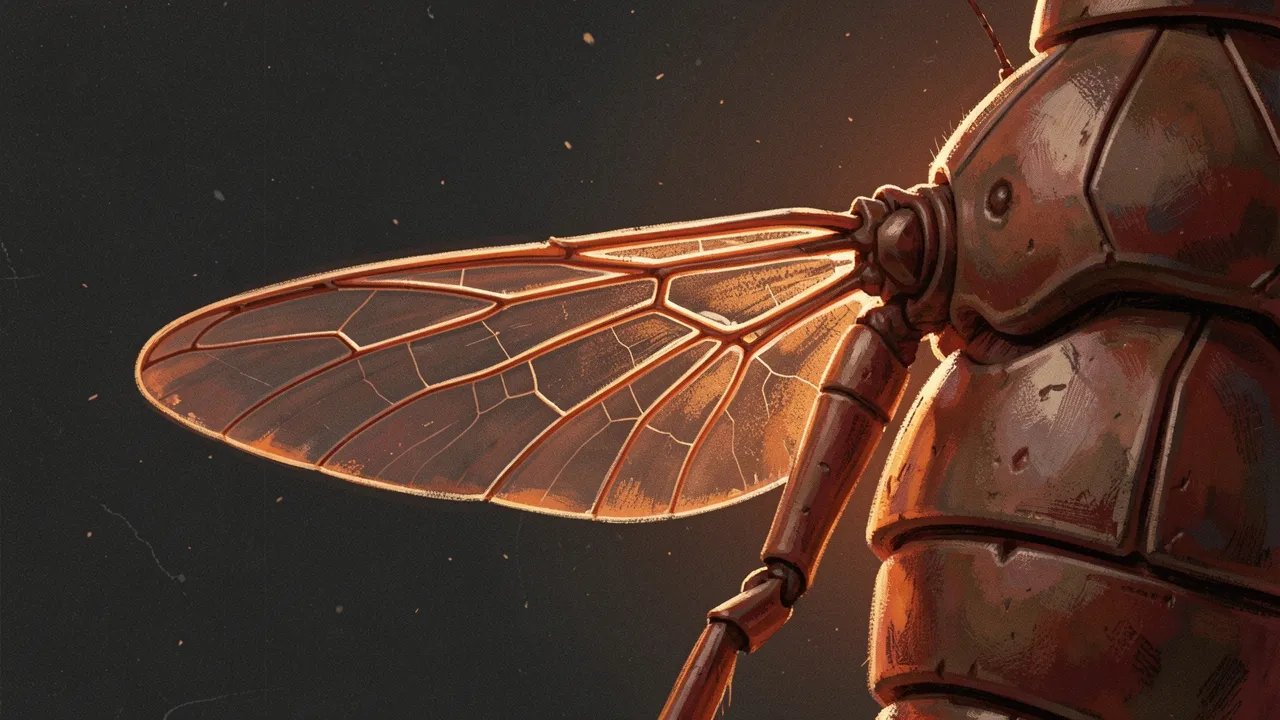
Cornell researchers have cracked something elegant: insects don't need complex control systems to fly. Their bodies are the control system.
A new computational model shows how three physical properties - wing mass ratio, hinge position, and flap frequency - create naturally stable flight configurations. No sensors. No feedback loops. Just physics doing the work. The findings could eliminate the need for the twitchy, expensive control systems that currently keep flying robots airborne.
The Stability Is in the Structure
Think about how much computing power goes into keeping a drone stable. Accelerometers, gyroscopes, constant micro-adjustments to keep it level. Now look at a dragonfly - it doesn't have any of that. It just flies.
The Cornell team's model reveals why. Wing mass distribution relative to body mass creates passive stability. Where the wing attaches to the body matters. How fast it flaps matters. Get those three parameters right and the insect's morphology itself resists perturbations. A gust of wind hits, the physics of the wing automatically compensates.
This isn't new information packaged differently. This is a computational framework that maps specific morphological configurations to stable flight regimes. You can now design a flapping-wing robot by choosing the right ratios, not by writing better control algorithms.
What This Means for Robotics
The practical implications are immediate. Every gram of sensors and processing hardware you remove from a flying robot is a gram you can add to battery life or payload. Current micro air vehicles spend half their energy budget fighting their own instability. If the airframe itself is stable, that energy goes into flying further or carrying more.
For search and rescue applications, simpler is better. Fewer failure points. Easier to manufacture. Cheaper to deploy in swarms. A flapping-wing robot that's inherently stable doesn't need constant communication with a ground station to stay airborne.
There's a deeper point here about how we approach robotics design. We've been trying to make robots smart enough to overcome physical limitations. Insects evolved the opposite approach - make the body smart so the brain can be simple. That's a design philosophy worth stealing.
The Path to Production
The gap between a computational model and a working robot is still significant. Manufacturing wings with precise mass distributions at insect scale is hard. Materials that are light enough, strong enough, and flexible enough in the right ways don't grow on trees.
But the framework is there now. Engineers know what parameters to target. The question shifts from "how do we control this?" to "how do we build this?" That's a manufacturing problem, not a fundamental physics problem. Manufacturing problems get solved.
What's particularly clever is that this approach scales down better than traditional drones. The smaller you go, the harder it is to pack in sensors and processors. But physical stability from morphology works at any scale. The same principles that keep a fruit fly stable will work in a robot the size of a bee.
This isn't about replacing quadcopters for package delivery. This is about unlocking a class of robots that can fly in tight spaces, survive impacts, and operate where GPS doesn't reach. Indoor inspection. Agricultural monitoring. Disaster response in collapsed structures.
The elegance of the solution is what makes it promising. Not more complexity, but less. Not smarter algorithms, but smarter structures. Sometimes the best control system is no control system at all - just good design.