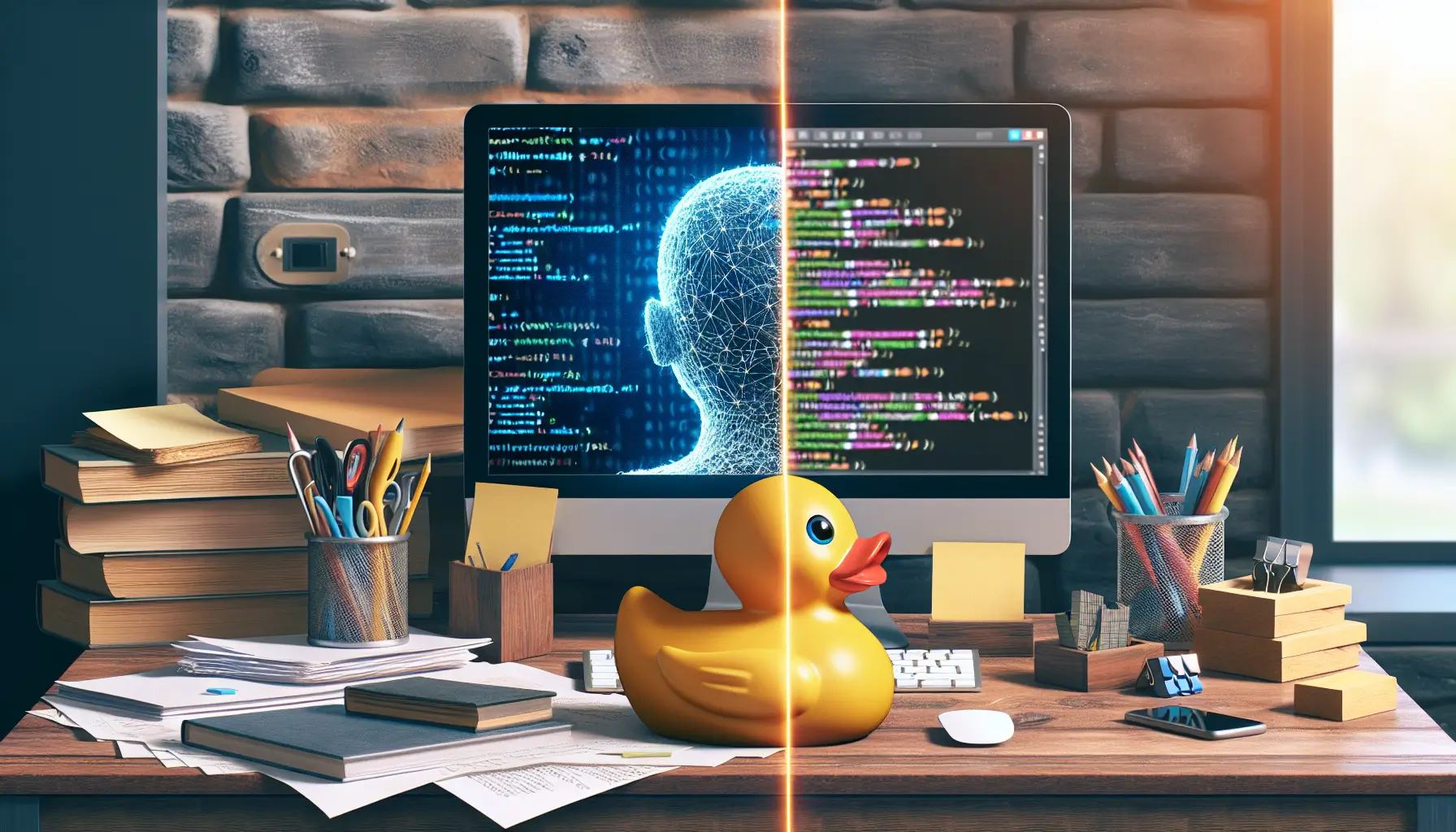
Every programmer knows about rubber duck debugging - explaining your code line by line to an inanimate object until the solution suddenly becomes obvious. But what happens when AI becomes your primary coding partner and you find yourself in the rubber duck's position?
The Reversal
Traditional programming education teaches you to think through problems systematically, build mental models of complex systems, and debug through methodical analysis. These skills remain essential, but AI-assisted coding introduces a fascinating reversal of roles.
Now, instead of explaining your logic to a rubber duck, you're often explaining context, requirements, and edge cases to an AI that can generate working code faster than you can type. The developer's role shifts from pure code production to becoming a sophisticated requirements translator and quality assessor.
This isn't about AI replacing programmers - it's about programmers evolving into something more strategic. You become the bridge between business needs and technical implementation, the quality gatekeeper who understands not just what code does, but whether it should exist at all.
The New Skill Set
Effective AI-assisted development requires different muscles than traditional coding. Prompt engineering becomes as important as algorithm design. The ability to quickly review and understand code written by others - even when that 'other' is an AI - becomes crucial.
Perhaps most importantly, developers need to maintain their problem-solving instincts even when AI can solve many problems automatically. The temptation to accept the first working solution without understanding its implications can be strong, but it leads to technical debt and systems that nobody fully comprehends.
Experienced developers report that AI coding assistance is most valuable when they maintain a clear vision of what they're building and why. The AI handles implementation details, but human judgement guides architectural decisions, performance considerations, and long-term maintainability.
The Mentorship Question
This shift raises important questions about how new developers learn. If AI can generate functional code from high-level descriptions, how do junior programmers develop the deep understanding that comes from wrestling with implementation details?
The answer seems to lie in treating AI as an advanced teaching assistant rather than a replacement for fundamental learning. New developers still need to understand data structures, algorithms, and system design. But they can focus on these concepts without getting bogged down in syntax or boilerplate code.
The rubber duck metaphor extends here too. Just as explaining your code to a duck helps clarify your thinking, explaining requirements to an AI forces clearer problem definition. The difference is that the AI can respond with working solutions, creating a more dynamic feedback loop.
For builders and developers, this represents both opportunity and responsibility. The opportunity to focus on higher-level problem solving and system design. The responsibility to maintain technical depth while embracing new tools. Sometimes the best way forward is to embrace being the rubber duck - the thoughtful questioner who ensures the right problems get solved, not just the ones that are easiest to code.