You've built a semantic search system. It works brilliantly on 10,000 documents. Then you scale to a million documents, and suddenly your search queries take six seconds to return results. Your users leave. Your product feels broken. What happened?
You hit the wall between exact search and scalable search. And this is where FAISS matters.
FAISS - Facebook AI Similarity Search - is a library for efficient similarity search in high-dimensional vector spaces. It's what powers semantic search at scale. But understanding how to move from simple exact search to production-grade approximate search requires seeing the tradeoffs in practice. This tutorial does exactly that.
The Three Index Types That Matter
The tutorial walks through three FAISS index types with code and benchmarks for each. Not in theory. In runnable Python with real performance numbers.
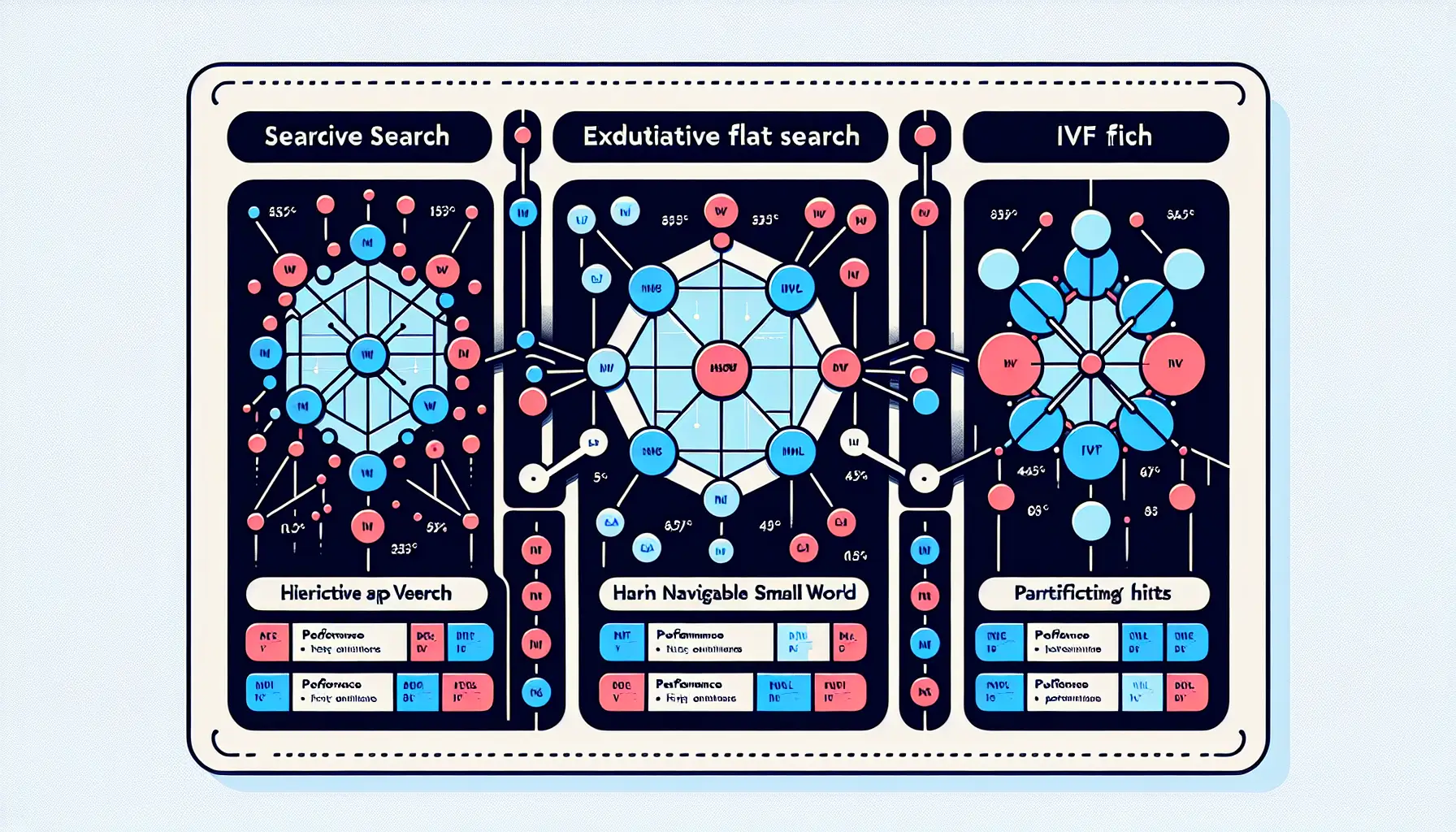
Flat Index is the baseline. It's exact search - every query compares against every vector in the database. Perfect accuracy. Perfect recall. Also perfectly impractical beyond about 100,000 vectors. The search time scales linearly with dataset size. At a million vectors, you're waiting.
The code shows this clearly. Building a Flat index is trivial - add your vectors, done. Searching is exhaustive. The benchmark reveals the problem: query time grows proportionally with dataset size. This is fine for prototypes. It's unusable in production.
HNSW - Hierarchical Navigable Small World graphs - is where things get interesting. This is an approximate nearest neighbour method that builds a graph structure over your vectors. Instead of checking every vector, the search navigates the graph, dramatically reducing the number of comparisons needed.
The tradeoff? You're no longer guaranteed to find the absolute nearest neighbours. But with proper tuning, you get 95%+ recall with 10-100x speed improvement. The tutorial includes code showing how to build an HNSW index, configure the graph parameters, and benchmark the recall vs speed tradeoff.
This is where most production systems land. HNSW is fast enough for real-time search and accurate enough that users don't notice the approximation. The graph structure also makes it memory-intensive - you're storing more than just the vectors - but modern hardware handles this.
IVF-Flat: When You Need Even More Speed
IVF-Flat - Inverted File with Flat quantization - takes a different approach. It clusters your vectors into partitions, then only searches the most relevant partitions for each query. Think of it as bucketing your data, then only looking in the likely buckets.
The tutorial shows the full implementation: how to train the index to learn the cluster structure, how to configure the number of partitions, and how to tune the search parameter that controls how many partitions to probe per query.
IVF-Flat is faster than HNSW but typically has slightly lower recall unless you probe more partitions, at which point the speed advantage diminishes. The real value is in understanding the recall vs latency curve for your specific use case.
Why the Benchmarks Matter
What makes this tutorial valuable is the benchmarking code. You can see exactly how each index performs on the same dataset with the same queries. Query latency. Memory usage. Recall percentage. Build time.
This is critical because there's no universal best answer. If you're building a search system with 50,000 documents and memory is cheap, Flat might be fine. If you're at 10 million documents and need sub-100ms query times, HNSW or IVF-Flat become necessary. The right choice depends on your constraints.
The code also shows how to measure recall - comparing approximate results against exact results to see what percentage of true nearest neighbours you're finding. In production, you need to know this number. If your approximate index only has 70% recall, your search quality suffers. If you're at 98% recall, users won't notice the difference from exact search.
Deployment Considerations
The tutorial touches on deployment patterns: how to save and load indexes, how to update indexes as new documents arrive, and how to handle the fact that some index types (like IVF) require training on a sample of your data before use.
This is where theory meets reality. You can't just drop FAISS into production without understanding these operational constraints. The training step for IVF means you need a representative sample of your data. The memory requirements of HNSW mean you need to plan your infrastructure accordingly. The query parameters affect both speed and accuracy, so you need monitoring and tuning.
For builders working on semantic search, RAG systems, or recommendation engines, this tutorial is a practical foundation. The code is clear, the benchmarks are reproducible, and the tradeoffs are explained without hype. Worth working through if you're scaling beyond toy datasets.