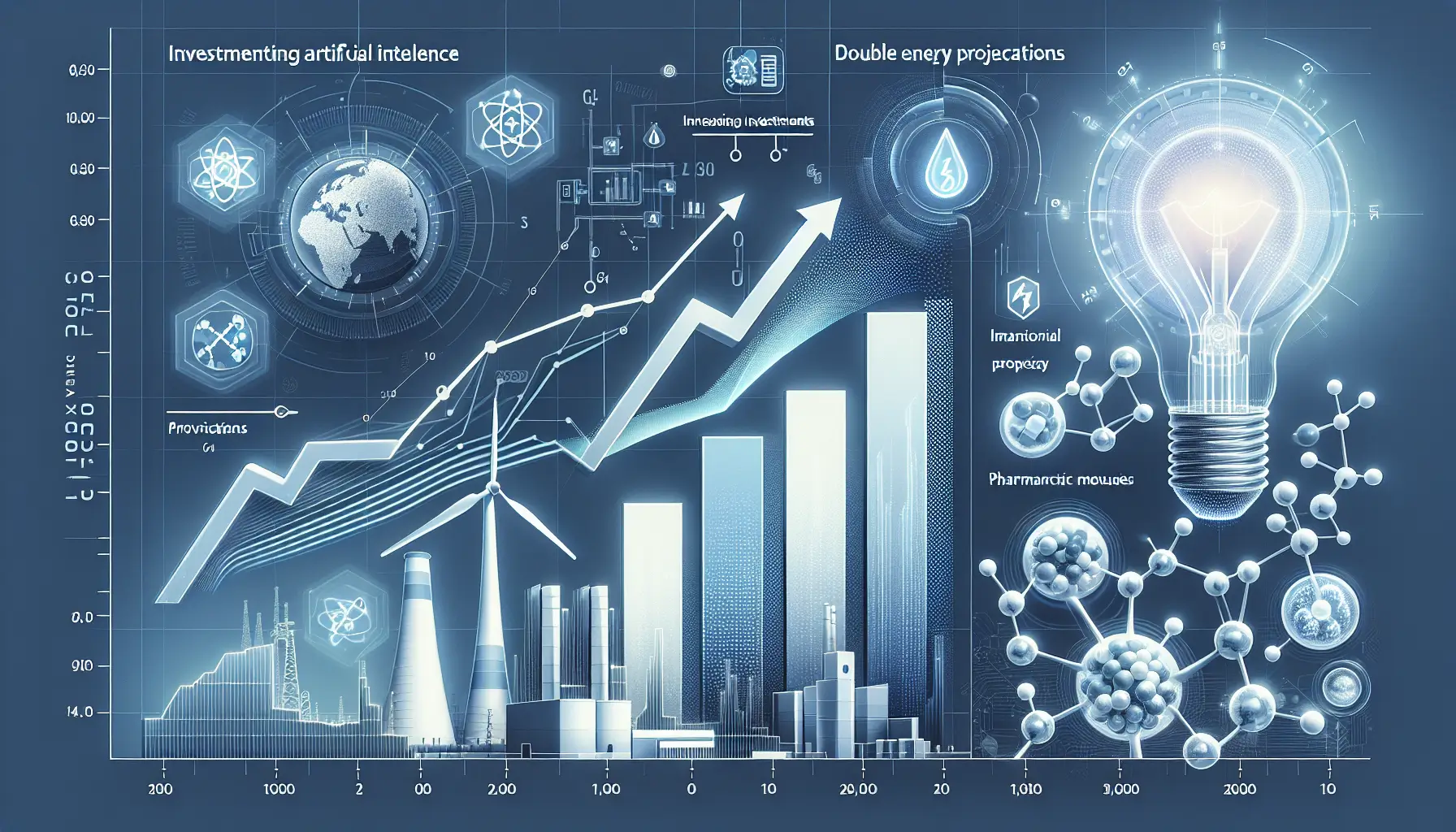
What if I told you the global energy demand projections for 2035 just doubled? Not a typo. Doubled. And it's not because of population growth or traditional industry expansion. It's because of AI data centres.
This is one of several data points in Azeem Azhar's weekly roundup that shifts how you might be thinking about the next decade. Not predictions. Not speculation. Just numbers, tracked and contextualised.
The $1 Trillion AI Boom
Let's start with investment. AI funding has hit $1 trillion in cumulative investment. That's venture capital, corporate R&D, infrastructure builds, the whole stack. For context, that's roughly equivalent to the entire GDP of the Netherlands.
This isn't just about large language models or consumer-facing chatbots. The bulk of this capital is flowing into compute infrastructure, chips, and the energy systems required to power them. Which brings us back to that energy forecast.
Energy providers are now projecting demand in 2035 to be twice what they forecast just two years ago. The driver? Data centres. AI training and inference workloads consume power at scales that traditional IT infrastructure never approached. A single large model training run can use as much electricity as a small town does in a month.
This has second-order effects. Grid operators are scrambling. Renewable energy projects that were considered ambitious are now baseline requirements. Nuclear power is back in the conversation - not as a fringe idea, but as a pragmatic necessity. The question isn't whether we'll need more energy. It's where it comes from and how fast we can build it.
GLP-1 Drugs and Market Realities
Switching sectors entirely, the GLP-1 drug market is growing faster than most healthcare analysts expected. These are the drugs originally developed for diabetes but now widely used for weight management - Ozempic, Wegovy, and similar medications.
The market is expanding not just because of consumer demand, but because the data on cardiovascular benefits keeps getting stronger. What started as a diabetes treatment has become a multi-billion-pound category with implications for insurance models, healthcare costs, and chronic disease management.
The interesting bit here is the collision with AI. Drug discovery and optimisation are increasingly AI-assisted. The speed at which new compounds can be tested, modelled, and refined has compressed timelines that used to take decades into years. It's not sci-fi. It's happening in labs right now.
Mistral's $400 Million Revenue Milestone
Meanwhile, in the world of foundation models, Mistral has crossed $400 million in annual recurring revenue. For a company that's less than two years old, that's striking. More striking is what it represents: the European AI ecosystem is no longer playing catch-up.
Mistral's approach has been different from the outset. Open weights. Smaller, efficient models. A focus on enterprise deployments rather than consumer hype. The revenue milestone suggests this strategy is working. Businesses want models they can run on their own infrastructure, with predictable costs and no dependency on external API providers.
This is also a data point about the AI market maturing. The early phase was about who could build the biggest model. The current phase is about who can build the most useful model. Efficiency, cost, and control are starting to matter more than raw parameter counts.
What This Tells Us
Taken together, these numbers sketch a picture of an industry under acceleration. Investment is flowing. Infrastructure is being built at speed. Markets are forming around both the technology itself and the second-order effects it creates.
But there's also tension. Energy demand is outpacing supply. Regulatory frameworks are still catching up. The gap between the pace of development and the pace of adaptation is widening.
None of this is inevitable. But it's happening. And the numbers are worth tracking, because they tell you where the pressure points are before they become crises.