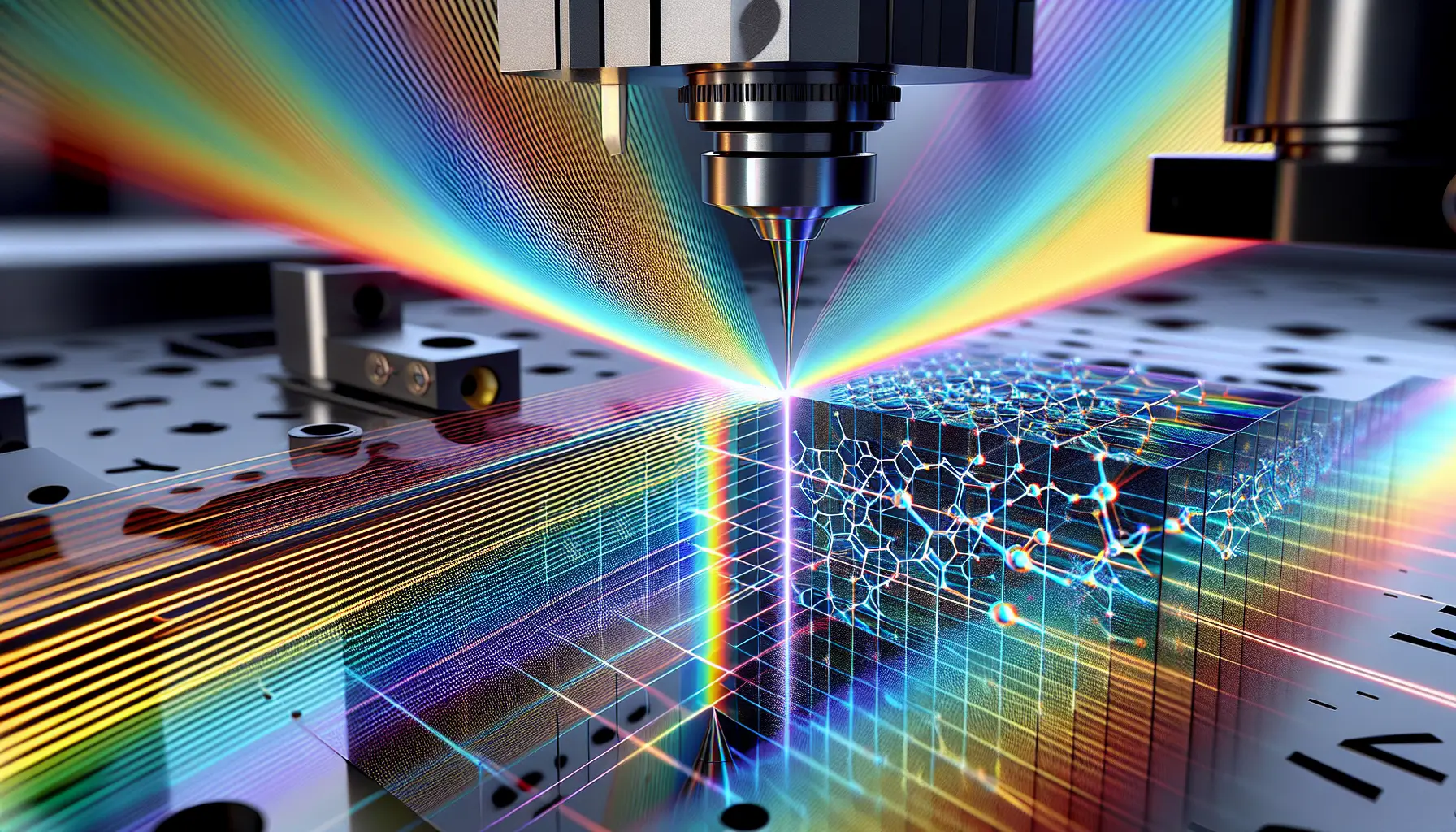
Identifying molecules used to require bulky, expensive equipment locked away in labs. Now researchers have developed cascade lasers capable of generating optical frequency combs - essentially precision rulers made of light - that could fit in a backpack.
The Breakthrough in Plain Terms
Think of an optical frequency comb like the markings on a ruler, but instead of centimetres, you're measuring light frequencies with extreme precision. Every molecule absorbs light at specific frequencies, creating a unique fingerprint. Match the frequencies, and you can identify what you're looking at - whether that's pollutants in air, gases in space, or compounds in a chemical sample.
Until now, generating these combs required complex setups involving multiple lasers, amplifiers, and careful alignment. The new cascade laser design from Quantum Zeitgeist does something remarkable: it creates the frequency comb itself, without external triggers or complicated auxiliary systems. The technical term is 'self-starting' - the laser just... works.
Why This Actually Matters
The practical implications span industries. Environmental monitoring becomes portable - you could have sensors detecting methane leaks or air quality in real time, powered by something the size of a smartphone. Medical diagnostics could identify disease markers from breath samples without sending anything to a lab. Free-space optical communications - think data transmission through open air rather than fibre optic cables - becomes more reliable and precise.
But perhaps most significantly, this makes molecular spectroscopy accessible. Right now, if you want to analyse the chemical composition of something, you need lab equipment that costs tens of thousands of pounds and requires trained specialists to operate. This technology points toward a future where that capability sits in a handheld device.
The Engineering Elegance
What's genuinely impressive here isn't just what the laser does, but how simple the design is compared to previous approaches. Cascade lasers work by electrons 'cascading' down through carefully engineered layers of semiconductor material, emitting photons at precise frequencies as they go. Getting them to produce a stable frequency comb without external help required solving some fiendish quantum mechanics problems, but the result is remarkably elegant.
The researchers managed to create a system where the laser's own internal structure generates the comb naturally. It's like designing a clock that keeps perfect time without needing to be wound or adjusted - the mechanism itself maintains the precision.
What Comes Next
This is still lab technology, not a product you can buy. But the path from here to commercial applications is clearer than usual. The underlying physics works. The manufacturing processes for cascade lasers already exist. What's needed now is engineering refinement and scaling.
For builders and developers working on sensing applications, keep watching this space. We're likely 2-3 years from seeing these frequency combs in commercial products, but when they arrive, they'll enable entirely new categories of portable analysis tools. The question isn't whether this happens, but which applications emerge first.
The deeper pattern here? Quantum technologies are moving from 'impressive lab demonstrations' to 'practical tools we can actually use'. Not overnight, and not without significant engineering work, but the trajectory is clear. Molecular sensing is just the beginning.