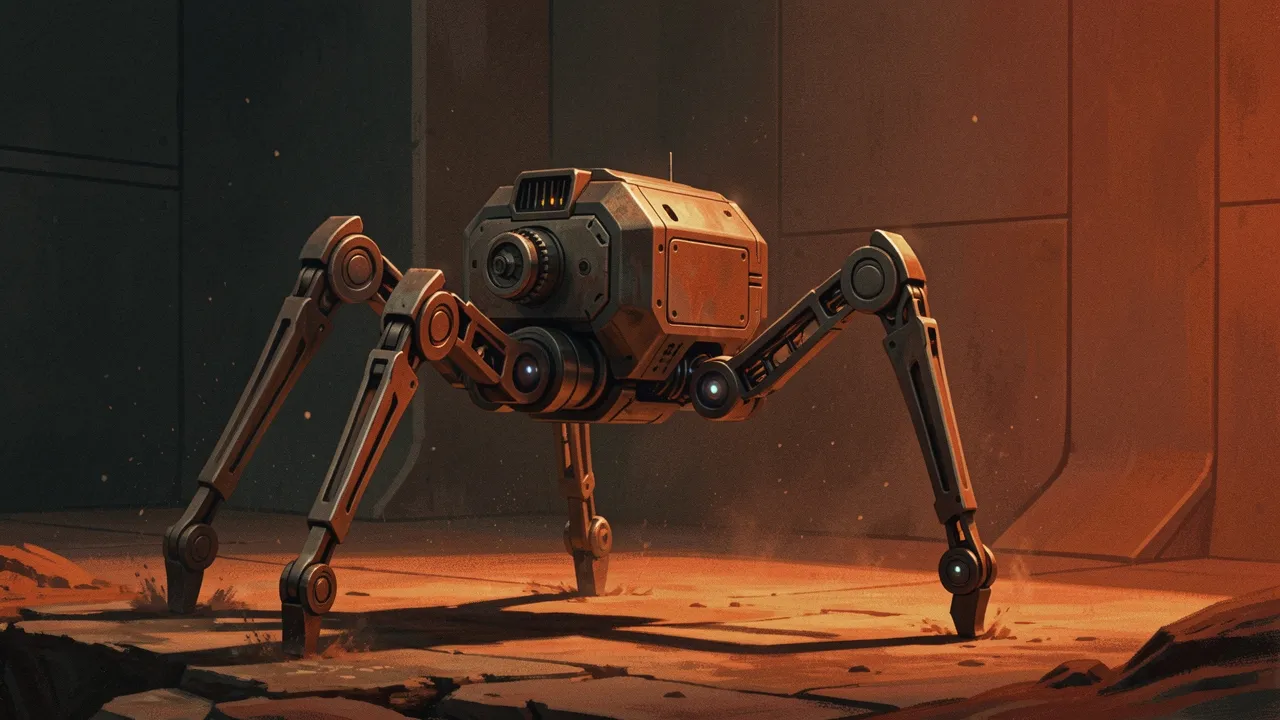
A robot vacuum is halfway across your kitchen when it stops. Not broken. Not out of battery. Just... frozen. The collision sensors say one thing, the path planner says another, and somewhere in the control system, the numbers stopped making sense.
This happens more than anyone wants to admit. Autonomous robots - warehouse bots, delivery rovers, surgical assistants - sometimes lock up in dynamic environments. Not because of hardware failure, but because their control systems hit a computational wall. The maths diverges. The robot stops trusting its own sensors. And everything grinds to a halt.
A researcher has proposed a solution that monitors two specific parameters simultaneously: external task pressure and internal control conflict. The idea is to catch the divergence before it happens - to see the freeze coming and adjust the system's behaviour in real time.
The Problem: When Numbers Stop Converging
Most autonomous robots use what's called a phase regulator - essentially a system that coordinates multiple control loops running at once. One loop handles navigation. Another handles obstacle avoidance. A third might manage power consumption or sensor fusion. These loops need to stay in sync, or the robot's behaviour becomes unpredictable.
The traditional approach monitors one thing: whether the control system is converging toward a stable solution. But that's reactive. By the time you notice the system isn't converging, the robot is already oscillating or frozen.
The new approach adds a second metric: external task pressure. How hard is the environment pushing back? How fast are obstacles moving? How much uncertainty is there in the sensor data? If you track both - internal conflict and external pressure - you can predict instability before it manifests.
In practice, this means the robot doesn't wait until it's stuck. It sees the conflict building and switches to a more conservative control strategy. Less aggressive pathfinding. More frequent sensor checks. Slower movement until the maths stabilises.
Why This Matters Beyond Robots
The interesting bit isn't just keeping robots from freezing. It's the broader principle: monitoring two dimensions of system health instead of one.
Most control systems - whether robotic, financial, or infrastructural - focus on internal metrics. Is the algorithm converging? Are the predictions accurate? Is the output stable? But they ignore the external pressure: How volatile is the input data? How fast is the environment changing? How much noise is in the system?
This dual-parameter approach could apply to AI inference systems running in production. A language model might generate coherent text (internal stability) while the input data drifts far outside its training distribution (external pressure). If you only monitor output quality, you miss the early warning signs that the model is about to produce something wildly off-base.
The same logic applies to supply chain systems, traffic management, or any real-time decision-making architecture that operates in changing conditions. One metric tells you where you are. Two metrics tell you where you're headed.
The Bigger Picture: Robots Need to Know When They're Confused
There's a tendency in robotics to optimise for performance - faster movement, more aggressive pathfinding, minimal safety margins. But the real challenge isn't speed. It's reliability in unpredictable environments. A robot that slows down when it's uncertain is more useful than a robot that freezes when it's confused.
This research suggests a shift in how we think about autonomous systems. Not just "does it work?" but "does it know when it's about to fail?" The ability to detect impending instability - to feel the system starting to wobble - is what separates a research demo from a deployable product.
For anyone building autonomous systems, the lesson is straightforward: track the conflict inside your control loops, but also track the pressure coming from outside. One number tells you if you're stable. Two numbers tell you if you're about to lose stability. And that distinction is the difference between a robot that works in a lab and one that works in a kitchen.
Read the full technical breakdown at The Robot Report.