Today's Overview
Three things converged this week that matter more together than separately. Robots are failing not because their motors are broken, but because their decision-making becomes overloaded. Engineers are spending less time coding and more time reviewing what AI wrote. And the hardest problems in physical AI aren't welding or assembly-they're handling materials that change shape.
When Robots Freeze: The Stability Problem Nobody Talks About
A five-stage AI pipeline where each model takes 200ms should complete in one second. In practice it takes 1.75 seconds. The missing 750ms isn't in the models-it's in the pipes between them. Every HTTP request over HTTPS costs 45ms just to negotiate: DNS lookup, TCP handshake, TLS setup. Multiply that across a pipeline and you're bleeding half a second to transport before a single token is processed.
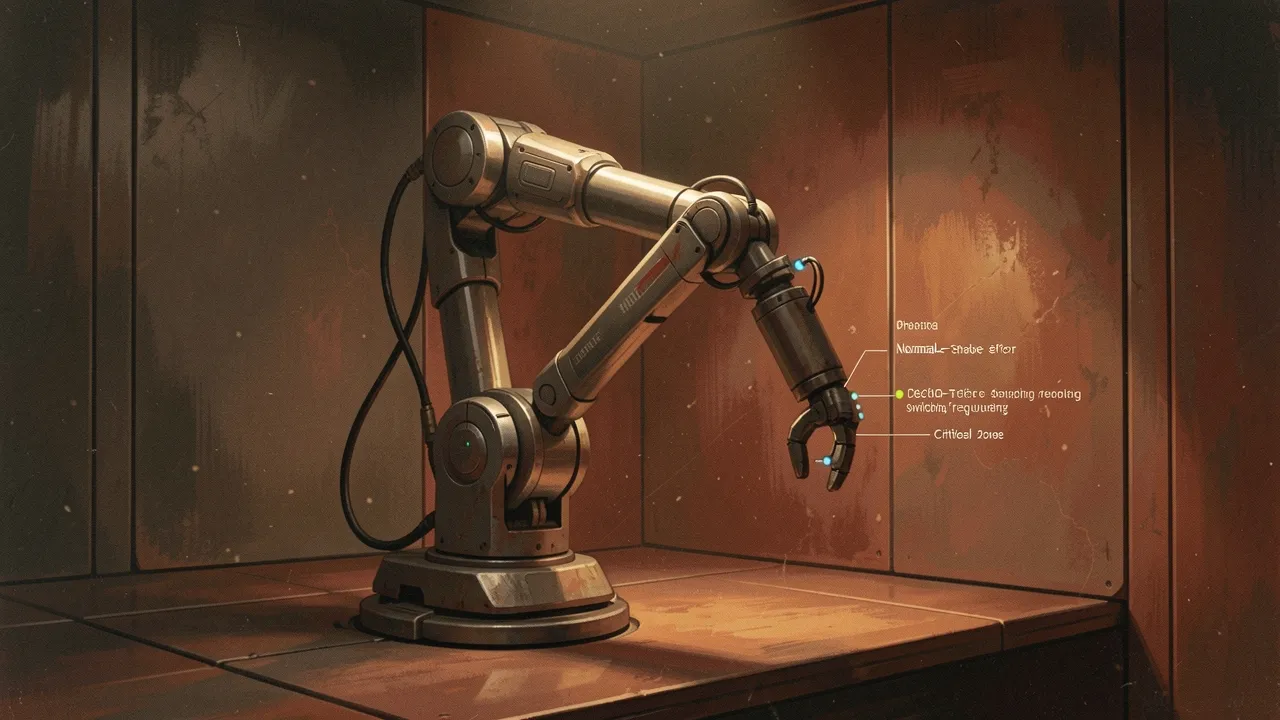
The deeper issue is computational divergence. When a robot's environment gets complex-more obstacles, noisier sensors, conflicting recovery pathways-its decision stack doesn't fail gracefully. The planner expands more nodes. The behaviour tree switches more frequently. The reactive controller becomes more aggressive. Individually stable, combined they amplify each other into oscillation. A researcher in Kazakhstan proposed a two-parameter phase regulator that monitors both external pressure (trajectory error, obstacle density) and internal conflict (behaviour tree switching frequency) simultaneously. When both spike together, the system deliberately reduces planning depth before it locks up. It doesn't replace the planner. It prevents the planner from drowning.
Fabric Is Where Physical AI Meets Reality
Most robot demos show rigid objects: boxes, components, welded joints. These are stable problems. Fabric isn't. It wrinkles, stretches, collapses. A robot can move with micron precision and still fail because it can't estimate what state the material is in. That's why apparel manufacturing-one of the hardest testbeds for physical AI-is exposing a fundamental gap between demonstration and production. The answer isn't more sophisticated control. It's redesigning the process around what robots can actually learn. Instead of automating the sewing machine (which was never designed for machines), systems are switching to adhesive bonding with three-dimensional molds and purpose-built grippers. The material becomes more stable. The learning becomes more reliable. Capability compounds through data rather than through retooling. That shift-from automating legacy processes to redesigning them for intelligence-is what separates demos from factories.
Software Engineering Is Becoming Plan and Review
When every junior can offload the routine coding to Claude or Gemini, what's left for humans? Planning the work. Reviewing what the AI produced. And teams are discovering this changes everything. One developer noted that with agents handling execution, the old bottleneck-actually writing code-disappeared. The new bottleneck is decision-making speed. How fast can a team plan work? How fast can they review it? Tools are shifting accordingly. One startup shut down their Kanban product because the real work now is parallel execution management, not sequential task tracking. When an AI agent can complete a feature in five minutes, your planning process can't take forty.
The pattern across robotics, manufacturing, and software is the same: systems fail not at the component level but at integration. Robots fail when decision-making overloads. Manufacturing fails when processes don't match what learning systems can handle. Engineering fails when planning can't keep pace with execution. The winners this cycle won't be those with better components. They'll be those who redesigned the whole system around the bottleneck.