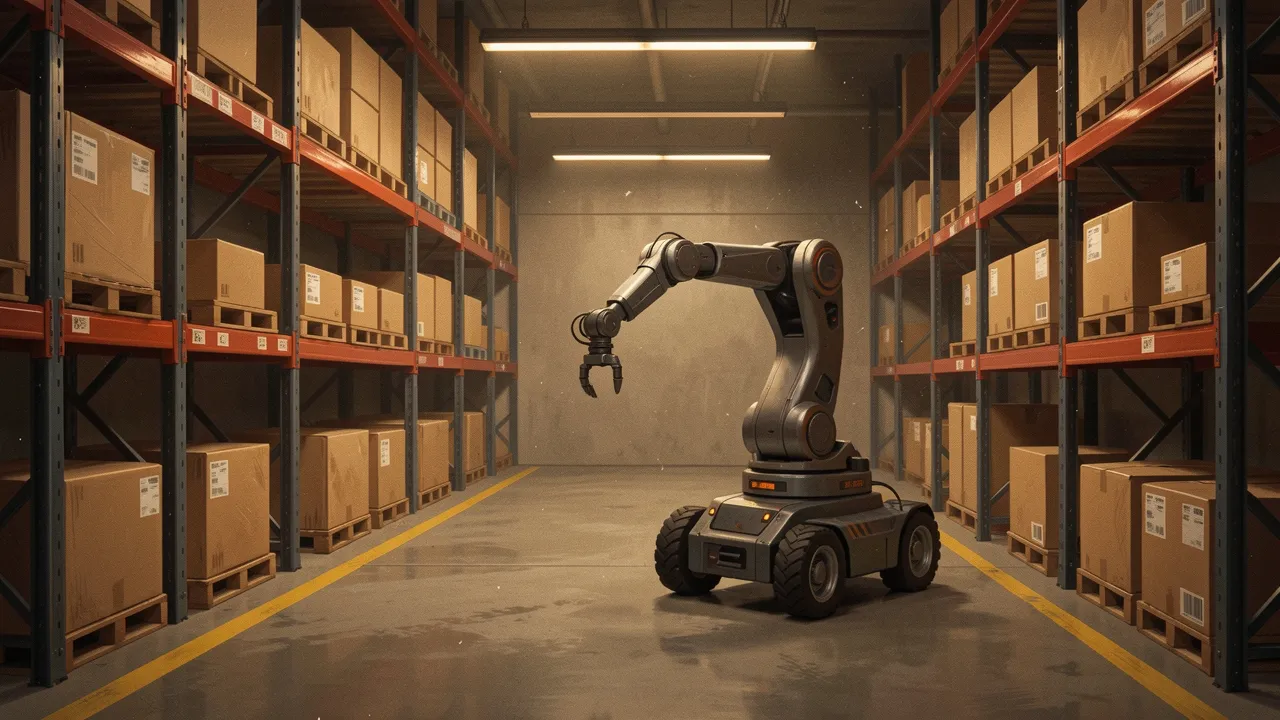
One hundred semi-humanoid robots are working a warehouse shift right now. When one of them encounters something it's never seen before - a crumpled box, an oddly-stacked pallet, a spill on the floor - a remote human tutor watches through its camera and guides it through the task. The robot learns. The next robot facing the same problem already knows what to do.
This is Tutor Intelligence's Data Factory, and it's solving the problem that's held robotics back for years: you can't train a robot for the real world in a lab.
The Edge Case Problem
Traditional robot training happens in controlled environments. You build scenarios, run simulations, test edge cases one by one. It's slow. It's expensive. And it misses the chaos that makes real warehouses, real kitchens, real factories different from your test environment.
Tutor Intelligence's approach flips this. Their Cassie mobile manipulators - robots with arms and wheels, designed for logistics and food handling - run in actual production environments from day one. When they hit something unexpected, remote tutors step in. The company claims this method detects edge cases 100 times faster than traditional training cycles.
The maths makes sense. A hundred robots, each working an eight-hour shift, encountering novel situations throughout the day, with human oversight ensuring correct responses. That's not simulation data. That's ground truth, at scale, in the environment where the robots will actually work.
Already in Production
What makes this more than a clever training method is that it's already deployed. Tutor Intelligence is running Cassie robots in live operations at logistics companies and food businesses. These aren't prototypes in a research lab. They're handling real orders, real products, real throughput targets.
The human tutors aren't on-site. They're remote, monitoring multiple robots, stepping in only when needed. As the robots learn, the frequency of interventions drops. Early tasks that required constant guidance become automated. The tutor's attention shifts to newer, harder problems.
This is the model that makes robot deployment economically viable. You don't need perfect robots on day one. You need robots that can learn fast enough to earn their keep, with human oversight that scales better than human labour.
What This Changes
The bottleneck in robotics has never been hardware. Boston Dynamics proved a decade ago that you can build machines with impressive physical capabilities. The bottleneck is intelligence - specifically, intelligence that works in messy, unstructured environments where the next edge case is always around the corner.
Tutor Intelligence's bet is that the fastest way to robust robot intelligence isn't better simulations or bigger models. It's real-world data, captured at scale, with humans in the loop to ensure quality. The Data Factory isn't just training robots. It's building a dataset of real-world manipulation tasks that grows every shift, every day.
For logistics and food companies watching labour costs climb and throughput demands increase, this matters. Robots that learn on the job, supervised remotely, with economics that improve as the fleet scales - that's a different proposition from buying a fixed-capability machine that can't adapt.
The question now is how fast the learning compounds. If edge case handling improves logarithmically - each new situation teaches the whole fleet, reducing future interventions - then the Data Factory model could make robot deployment viable in environments that were previously too variable to automate.
That's the shift. Not robots that replace humans. Robots that learn from humans, fast enough to become useful.