Today's Overview
The friction point in modern robotics isn't the machines themselves-it's the data. Train a robot on simulation and it fails in the real world. Train it in the lab and you're limited by what you can create in a controlled space. But what if you ran 100 robots in parallel, with humans teaching them in real time, and spotted edge cases in minutes instead of weeks?
Real-world robotics needs real-world data
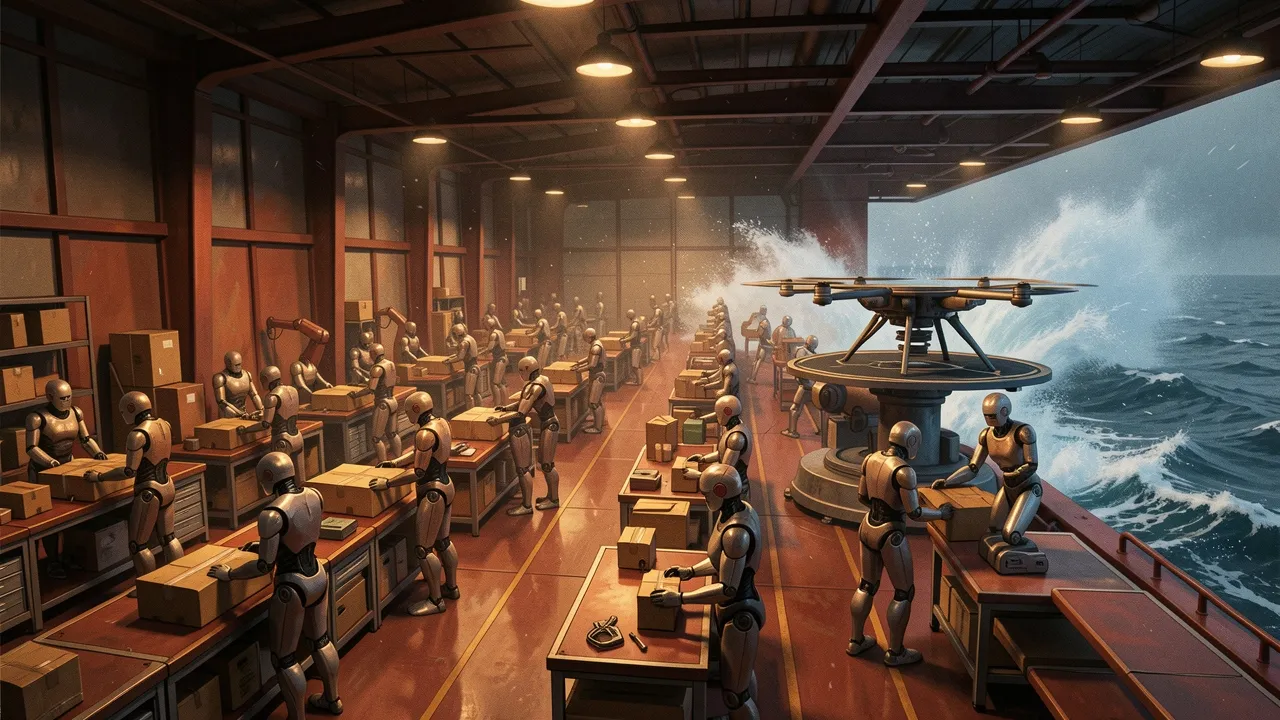
Tutor Intelligence just opened DF1, a 100-robot data factory in Massachusetts where semi-humanoid robots pick items under human supervision. The company deployed 45-50 remote tutors (in Mexico and the Philippines) using teleoperation to teach the robots, while a smaller team handles on-site work. The insight: running the same policy across 100 robots means you detect rare failure cases 100 times faster. An edge case that would take eight hours of single-robot operation to surface shows up in five minutes across the fleet. The robots already handle picking at a commercial pace, and Tutor has moved its mobile manipulator (Cassie) into production at food and logistics companies, deployed in two days at $14-18 per hour-competitive with increasingly scarce human labour.
WaiV Robotics tackled a different hard problem: landing drones on moving ships in the open sea. The company developed a gyro-stabilized landing pad with AI-driven predictive algorithms that can lock a drone to a vessel even while waves are rolling and the deck is in motion. No hardware or software changes needed to the drone-WaiV's system behaves like a pilot, intercepting the control signals and guiding the landing. With $7.5 million in seed funding, they're targeting offshore inspection, energy operations, and search-and-rescue where small vessels can't currently operate drones reliably.
The pattern: services and integration, not just models
Both companies point to the same structural shift: the bottleneck has moved. You don't win on model capability alone anymore. You win by solving the last-mile integration problem-the tutoring infrastructure, the ship motion prediction, the deployment playbook. Meanwhile, Anthropic and OpenAI are both launching services companies. Anthropic partnered with Blackstone, Hellman & Friedman, and Goldman Sachs ($1.5B total) to build Claude-powered systems for enterprise workflows. OpenAI's The Deployment Company raised ~$4B backed by TPG, Brookfield, and others. Both firms recognise what Tutor and WaiV have already learned: the AI model is the easy part. Getting it to work in a business process, at scale, with humans in the loop-that's where the real value sits.
For businesses watching these moves, the message is clear. Generalist AI models will become a commodity. The companies that win are the ones who integrate them into specific workflows, train the organization to use them, and iterate on real data. That requires patient capital, domain expertise, and the ability to operate in the messy space between research and production.