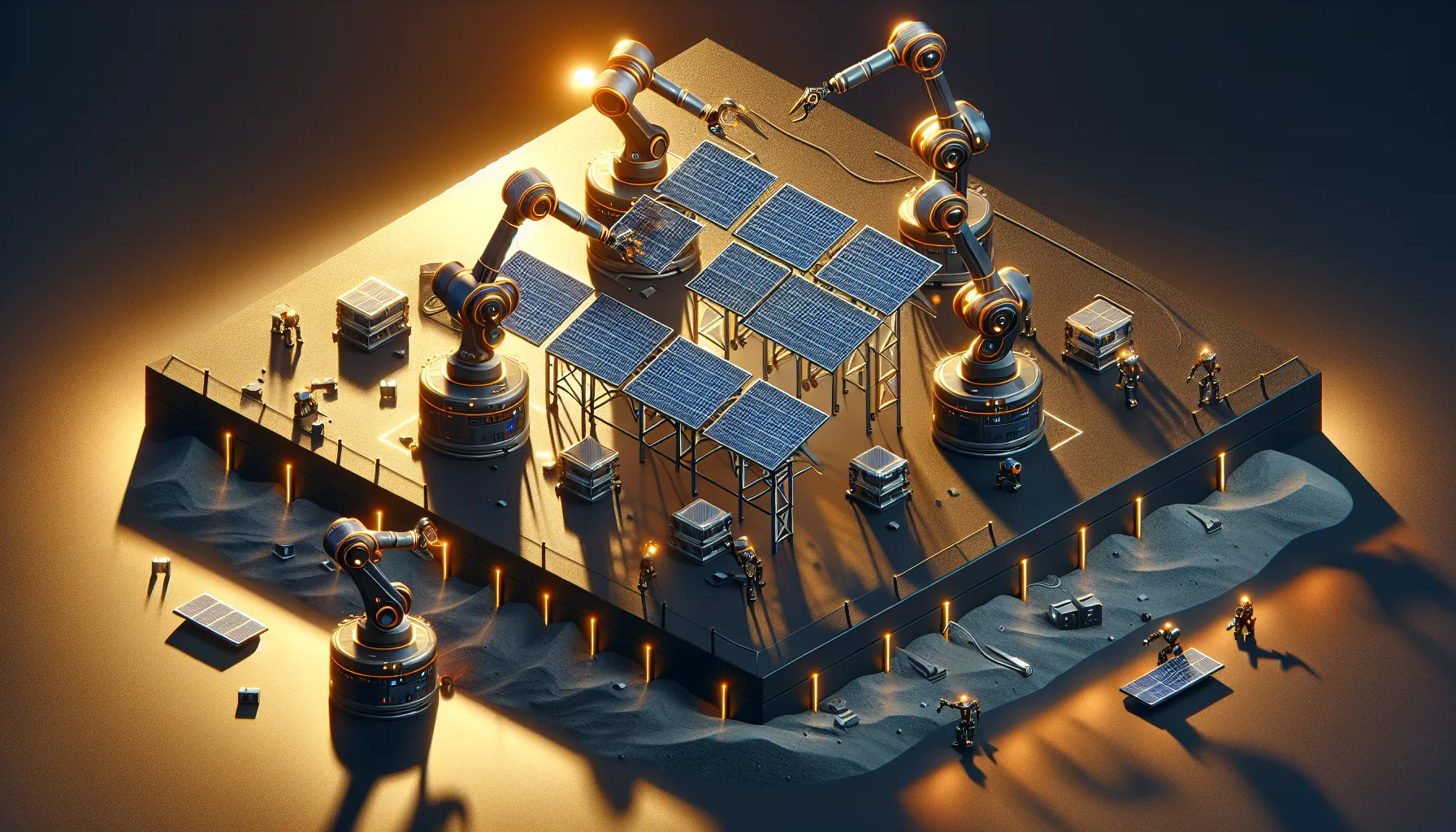
One hundred megawatts. That's enough solar capacity to power roughly 20,000 homes. And at AES's Bellefield complex in California, robots installed all of it.
Maximo's autonomous robots spent months placing solar modules across utility-scale arrays, working alongside human crews at what turned out to be double the standard installation rate. The machines achieved 24 modules per hour per person - a figure that suggests something fundamental has shifted in how renewable energy infrastructure gets built.
Submillimeter Accuracy at Industrial Scale
The technical achievement here isn't just speed. It's precision at scale. Maximo's robots use AI vision systems to place each solar module with submillimeter accuracy. That level of placement precision matters because misaligned modules create efficiency losses across the entire array. A tenth of a degree off here, a millimeter gap there - it compounds.
Solar installation has always been a volume game. Utility-scale projects measure success in megawatts deployed per quarter. The faster you install, the faster the project generates revenue. But speed without accuracy creates maintenance nightmares. Panels that don't sit flush degrade faster. Connections that aren't perfectly aligned fail sooner.
What Maximo appears to have solved is the tension between those two requirements. The robots maintain precision while moving faster than human crews. Not marginally faster - twice as fast.
What This Means for the Build-Out
The International Energy Agency projects the world needs to install 630 gigawatts of solar capacity annually by 2030 to hit climate targets. We're currently installing about 250 gigawatts per year. That gap isn't a technology problem - we know how to make solar panels. It's an installation problem. There aren't enough skilled workers to place all those modules fast enough.
Doubling installation rates changes the maths. If Maximo's approach scales beyond Bellefield, the constraint shifts from labour availability to manufacturing capacity. That's a different bottleneck - and potentially a more solvable one.
For project developers, the economic case becomes clearer. Faster installation means shorter project timelines, which means faster returns. Lower labour costs per megawatt mean better margins. If the robots can maintain that 24-module-per-hour rate across different sites and conditions, the payback period for automation investment drops significantly.
The Autonomy Question
The interesting detail in Maximo's deployment is what 'autonomous' actually means here. These aren't robots wandering around making independent decisions. They're operating within tightly defined parameters, with human oversight, in controlled environments.
That's probably the right approach. Utility-scale solar sites are dangerous places - heavy equipment, electrical systems, uneven terrain. Full autonomy would require solving problems that have nothing to do with solar installation. Maximo appears to have focused on automating the repetitive, precision-dependent parts of the job while keeping humans in the loop for everything else.
The result is a hybrid system that plays to each side's strengths. Robots handle placement accuracy and consistent pacing. Humans handle site management, quality control, and anything unexpected. It's not sexy, but it works.
Beyond Solar
The broader pattern here matters. Solar installation is highly repetitive, well-defined, and happens in relatively controlled environments. Those characteristics make it ideal for robotic automation. But those same characteristics apply to plenty of other construction tasks.
Wind turbine assembly. Battery storage installation. Data centre builds. Anywhere you have repetitive placement of standardised components at scale, this same approach could apply. The technology isn't solar-specific - it's about vision systems, precision placement, and reliability in field conditions.
For the renewable energy sector specifically, automation at this level could accelerate deployment timelines significantly. Every project that comes online faster starts generating revenue sooner and starts displacing fossil fuel generation sooner. The climate maths improves.
Maximo's robots aren't going to solve the energy transition alone. But doubling installation rates at utility scale? That's not nothing. That's 100 megawatts that wouldn't have existed yet, generating clean power right now. And if the approach scales, it's the first 100 megawatts of many more to come.