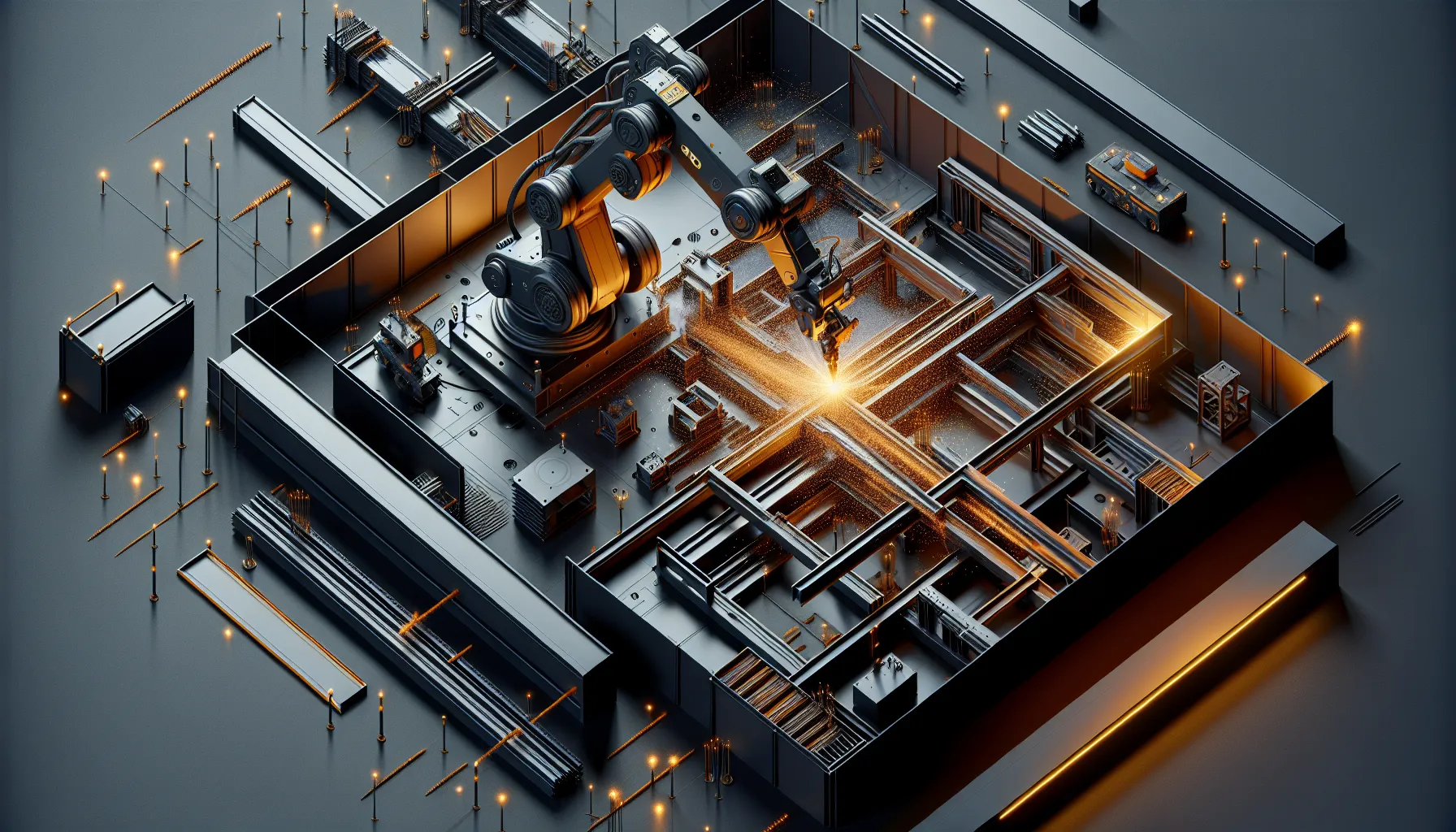
Dextall just tripled production of high-rise facade components. Not by buying faster robots. Not by adding shifts. By making their product more boring.
Before any welding robot touched their production line, the founder made a counterintuitive decision: standardise five distinct hook configurations down to one. The automation came second. The boring bit came first.
This is the pattern nobody talks about when they talk about robotics. The shiny bit - the robot arm, the vision system, the welding precision - that's the easy sell. The hard bit is admitting your product needs to change before the robot can help you.
Stability Before Speed
Automation rewards predictability. A robot that welds the same joint 500 times will outperform a human doing it manually. But a robot that has to handle five different configurations, each with its own quirks and tolerances, loses that advantage fast.
Dextall builds facade components for high-rise construction. These aren't mass-market widgets - each building has different architectural requirements, different load specifications, different finishing details. Custom work is the business model. But custom doesn't mean every single component needs to be unique.
The founder spotted the pattern: five hook types were doing the same job with minor variations. Consolidating them didn't reduce capability. It reduced chaos. And chaos is what kills automation projects.
The result: production tripled. Not because the robots work three times faster - they don't. Because the system runs without stopping to reconfigure, recalibrate, or troubleshoot edge cases that shouldn't exist.
What This Means for Builders
If you're looking at automation - whether that's robotic welding or an AI workflow - the first question isn't "what tool do I buy?" It's "what am I asking the tool to do?"
Most automation projects fail because they try to automate complexity. The tool gets blamed. The real problem is upstream. You handed a robot a mess and expected it to sort itself out.
Standardisation feels like compromise. It feels like you're giving up flexibility, reducing your offering, making the product less interesting. In practice, it's the opposite. You're making the product reliable. And reliability is what customers actually pay for.
This applies beyond welding. If you're building AI workflows, the pattern holds: clean your data before you train the model. Standardise your inputs before you automate the process. The boring work pays off.
The Real Cost of Variety
Five hook types means five sets of tooling. Five calibration routines. Five sources of failure. Five things that can go wrong in ways you didn't anticipate. The variety tax compounds fast.
Dextall didn't eliminate customisation. They eliminated pointless customisation. The hooks still do what they need to do. The buildings still get built to spec. But the production line doesn't stop every time a new order comes in.
This is the bit that frustrates engineers who love solving hard problems. Standardisation feels like admitting defeat. Like you couldn't figure out how to make the robot handle the complexity, so you dumbed down the product instead.
That's backwards. Making the robot handle unnecessary complexity is the compromise. Simplifying the product so the robot can do its job properly - that's the engineering win.
Automation Rewards Stability, Not Innovation
The founder's line is worth sitting with: automation rewards stability, not innovation. That's not an argument against innovation. It's an argument for knowing where innovation belongs.
Innovate on the product. Innovate on the materials. Innovate on the design. But when it comes to production, stability is the feature. The manufacturing process should be as boring as possible.
This applies to software automation too. Your AI agent doesn't need to handle every edge case creatively. It needs to handle the common case reliably. The creative problem-solving happens when you're designing the system, not when it's running.
Dextall's story isn't flashy. There's no breakthrough algorithm here, no novel robotics technique. Just the discipline to simplify before automating. That discipline is what separates projects that scale from projects that stall.
Read the full breakdown at The Robot Report.