Superconductivity comes in different flavours. Most of them we understand. One - chiral superconductivity - has been predicted for decades but never definitively observed.
Physicists at the University of Tennessee found its signature this week. They used tin atoms arranged in a specific pattern and measured a flower-like interference effect that only appears in chiral superconductors. It's the fingerprint that confirms the theory.
What Makes It Chiral
Chiral superconductivity is named after handedness - the property that makes your left hand different from your right even though they're mirror images. In a chiral superconductor, the electron pairs that carry current have angular momentum. They spiral as they move, either clockwise or anticlockwise, but never both at once.
This isn't just a curiosity. Chiral superconductors behave differently at edges and interfaces. They can host states that are protected from interference - useful for quantum computing. They also break time-reversal symmetry, which opens up new physics that conventional superconductors can't access.
The problem has always been proof. Chiral superconductivity produces subtle effects that are hard to distinguish from other exotic behaviours. You need a very clean system, precise measurements, and a way to rule out alternative explanations.
How They Found It
The Tennessee team used scanning tunnelling microscopy to arrange tin atoms on a niobium diselenide substrate. The substrate provides superconductivity. The tin atoms act as impurities that scatter the superconducting electrons. When you scan across the tin atoms, you see an interference pattern - the scattered electron waves overlapping with the original current.
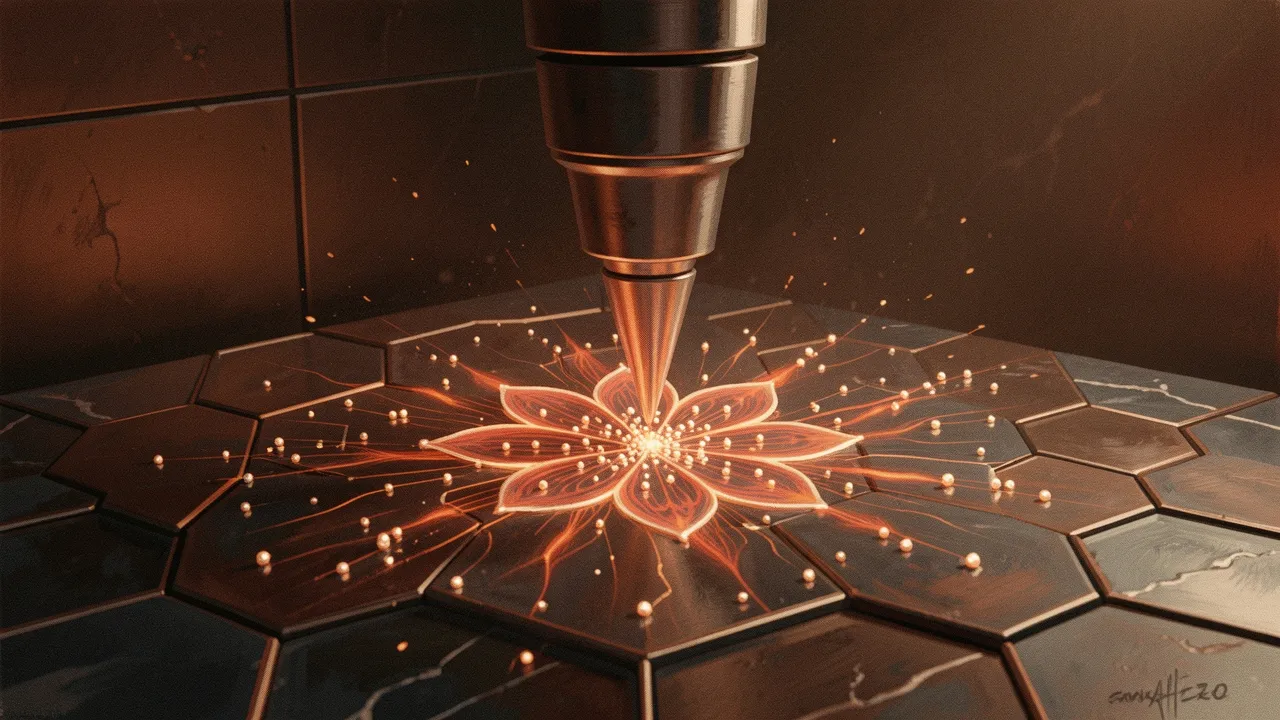
In a conventional superconductor, the pattern is symmetric. In a chiral superconductor, it's not. The angular momentum of the electron pairs creates a flower-like pattern with petals that have a specific asymmetry. The researchers measured that pattern, compared it to theoretical predictions, and confirmed the match.
The key was control. They didn't just observe chiral superconductivity in a random material. They engineered the conditions to make it appear, measured the signature, and verified the theory. That's the difference between seeing something strange and proving what you're seeing.
What It Enables
Chiral superconductors are candidates for topological quantum computing. The edge states they host can encode information in a way that's resistant to local disturbances. If you can engineer a chiral superconductor reliably, you have a building block for more robust qubits.
But the immediate impact is about materials science. This experiment proves you can design a system to exhibit chiral superconductivity. You're not hunting for naturally occurring materials that might have the right properties. You're building them from components you understand. That's a different game entirely.
The team's method - using a substrate to provide superconductivity and impurities to shape the electron behaviour - is a template. You can apply it to other materials, other geometries, other combinations. The tin-niobium system is one example. It won't be the last.
For researchers working on quantum materials, this closes a long-standing question and opens a new direction. Chiral superconductivity is real, it's measurable, and it's engineerable. The next question is what you build with it.