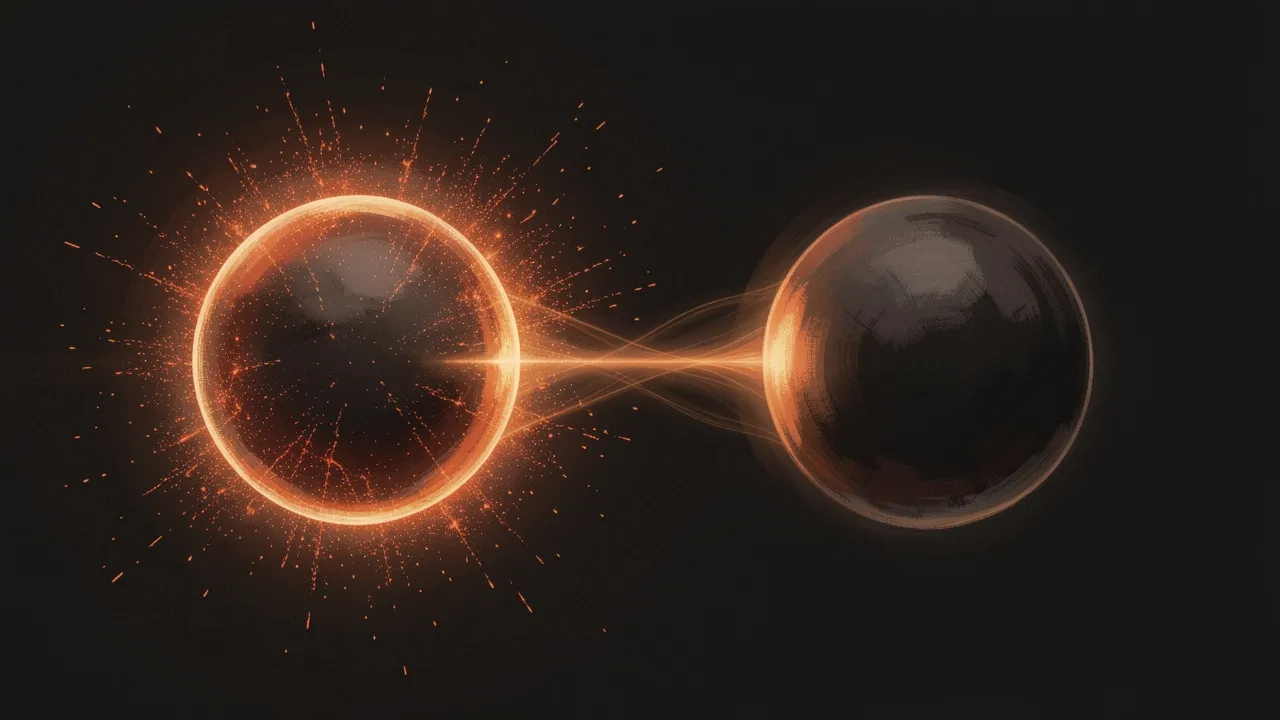
Entanglement doesn't just happen. New research from arXiv proves there's a threshold: if thermal noise dominates the interaction between two quantum systems, entanglement can't form. Gravity, electromagnetic forces, or any coupling mechanism must overpower the noise floor or you get nothing.
This matters because entanglement is the foundation of quantum computing, quantum communication, and every proposed quantum technology. If you can't create entanglement reliably, you can't build the thing. The new result defines exactly when that creation is physically possible.
What the Research Shows
The paper derives a separability-preserving condition for bilinear interactions under white thermal noise. In plain terms: when two quantum systems interact, thermal noise is always present - random energy fluctuations from the environment. If that noise is strong enough relative to the interaction coupling them together, the systems stay separable. They don't entangle.
The threshold is precise. Below a certain signal-to-noise ratio, entanglement cannot arise no matter how long the interaction runs or how carefully you tune the system. Above that threshold, entanglement becomes possible. This isn't an engineering problem you can optimise around. It's a fundamental limit set by the physics.
Previous work established that noise destroys entanglement. This result goes further: it proves noise can prevent entanglement from forming in the first place. That distinction matters. Protecting existing entanglement requires error correction. Preventing entanglement from forming in noisy conditions requires stronger coupling or lower noise - and there are hard limits to both.
Why It Matters for Quantum Computing
Quantum computers rely on entangled qubits. You need many of them, entangled in precise patterns, maintained long enough to run a computation. Every qubit in a quantum computer is coupled to its neighbours through interactions designed to create and control entanglement.
Thermal noise is the enemy. Qubits are kept at near-absolute-zero temperatures to suppress it, but you can't eliminate it entirely. The new result tells you exactly how much noise you can tolerate before entanglement becomes impossible. If your coupling strength can't exceed the noise floor, your qubit architecture doesn't work. Not "doesn't work yet" - doesn't work, full stop.
This changes the design constraints. Instead of assuming entanglement can always be created if you tune the system carefully enough, engineers now have a hard boundary. If thermal noise in your system sits above the threshold, you need either stronger coupling mechanisms or better noise suppression. Both options are expensive and difficult.
Implications for Quantum Communication
Quantum communication depends on distributing entangled photon pairs across distances. Photons travel through fibre-optic cables or free space, interacting with the environment along the way. Every interaction introduces noise.
The new separability condition applies here too. If environmental noise exceeds the coupling strength between photon pairs, entanglement degrades or fails to distribute properly. Current quantum networks already fight this problem - they use repeaters, purification protocols, and error correction to maintain entanglement over distance.
But the research suggests there are scenarios where no amount of error correction helps. If the noise is too high at the point of generation, entanglement never forms robustly enough to survive distribution. You're trying to protect something that was never solid to begin with.
The Gravitational Angle
The paper's framing includes gravitational interactions, which is where things get speculative but interesting. If gravity couples quantum systems weakly - and it does, compared to electromagnetic forces - then creating entanglement through gravitational interaction requires extraordinarily low thermal noise.
This matters for experiments trying to detect quantum signatures of gravity. If you're trying to entangle two masses through gravitational coupling alone, the threshold condition tells you how cold and isolated those masses need to be. The numbers are brutal. Thermal noise at room temperature obliterates any gravitational entanglement signal. Even at millikelvin temperatures, it's marginal.
That doesn't mean the experiments are impossible, but it narrows the parameter space significantly. You need better isolation, colder systems, or stronger coupling than researchers initially hoped.
What This Means for Builders
If you're building quantum systems, this result gives you a design rule: measure your thermal noise, measure your coupling strength, and check the ratio. If noise wins, entanglement won't form no matter what you do downstream. Fix the noise or boost the coupling before you move forward.
For researchers, the separability condition provides a new tool for analysing whether a proposed quantum architecture is viable. Instead of building the system and testing empirically, you can calculate the threshold and know in advance whether the physics allows what you're trying to do.
The broader implication is philosophical. Quantum mechanics is often framed as a world of infinite possibility constrained only by decoherence. This research says no - there are creation thresholds too. Some states are unreachable not because they decay too fast, but because the conditions required to form them don't exist. That's a harder limit than decoherence, and it forces a different kind of honesty about what quantum technology can achieve in real-world conditions.