Researchers at the University of Pennsylvania created particles that are neither light nor matter, but both at once. These hybrid particles interact strongly enough to perform computation - and they sidestep the heat problem that's been limiting chip design for a decade.
The work, published in Nature, combines photons with excitons - electron-hole pairs bound together in semiconductors. The resulting particles, called polaritons, behave like matter when they need to interact and like light when they need to move. That dual nature is what makes them useful for computing.
Why Electrons Are Hitting a Wall
Modern chips run on electrons. Electrons are good at computation because they interact with each other - flip one bit, and it affects the next. But that interaction comes with a cost: resistance. Every time electrons bump into atoms or each other, they generate heat. At the densities we're building chips now, heat dissipation is the bottleneck. You can't pack transistors closer without melting the silicon.
Photons don't have that problem. Light doesn't generate heat when it moves. But photons don't interact with each other easily. You can't build logic gates if your bits pass through each other without noticing. That's why optical computing has been "five years away" for three decades.
Polaritons split the difference. They're photons coupled to excitons, locked together in a quantum superposition. When they need to interact - for computation - the matter component takes over. When they need to move - for signal transmission - the light component dominates. The Penn team figured out how to engineer materials where this coupling is strong enough to matter.
What Strong Coupling Actually Means
The breakthrough is in the strength of interaction. Previous polariton systems were too weak. The particles would decouple before they could do useful work. The Penn researchers used layered semiconductors - specifically, tungsten diselenide and hexagonal boron nitride - to create an environment where polaritons stay coupled long enough to perform logic operations.
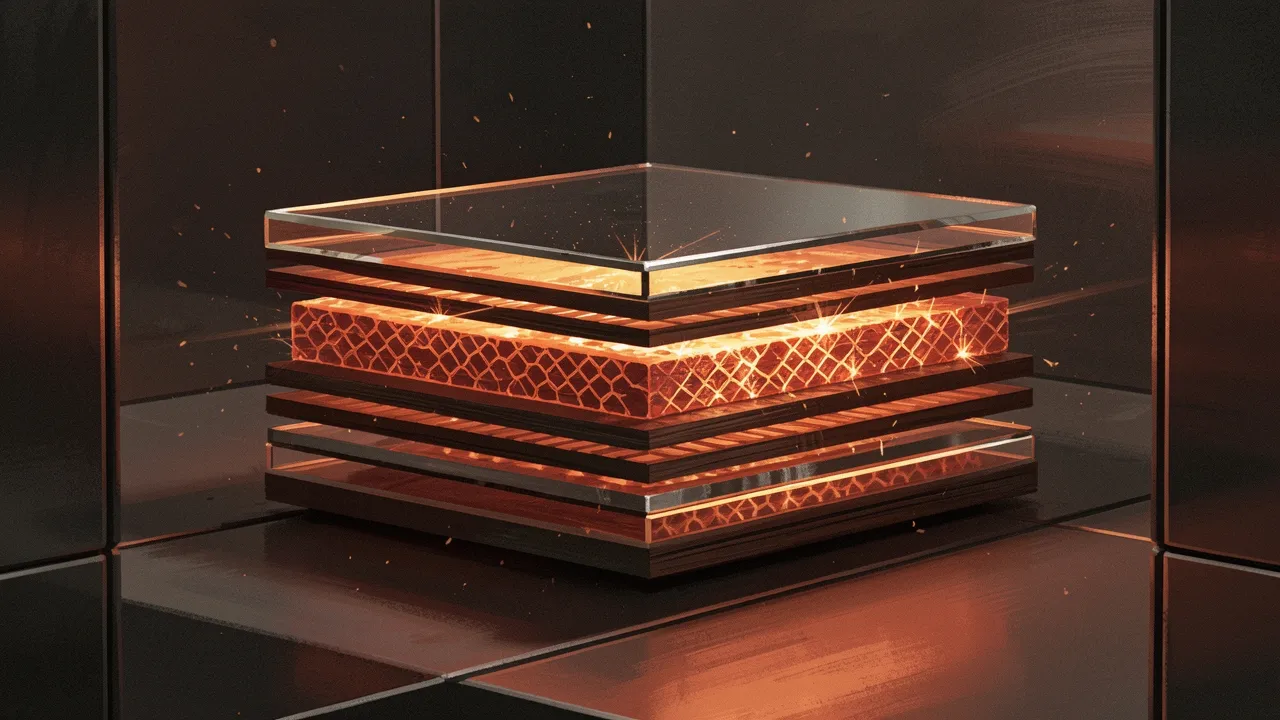
The setup involves trapping light between two mirrors, spaced nanometres apart. The light bounces back and forth thousands of times, interacting with the semiconductor layer each pass. That repeated interaction is what creates the strong coupling. The polaritons that emerge are stable enough to be manipulated, but still fast enough to compete with electronic switching speeds.
The team demonstrated polariton-based switches operating at room temperature. That's critical. Most quantum or optical computing approaches only work at cryogenic temperatures. This operates in the same thermal range as current chips. It doesn't need exotic cooling. It could, theoretically, slot into existing manufacturing pipelines with modifications rather than complete redesigns.
What This Means for Chip Design
If polariton-based computing scales, it changes the maths on power density. Current data centres spend as much on cooling as they do on electricity. AI training runs are limited by thermal constraints as much as by compute. A chip architecture that generates less heat per operation doesn't just save power - it enables designs that are physically impossible today.
The Penn team is careful not to claim this replaces electronics. What they're suggesting is a hybrid approach: use electrons for low-speed control logic, use polaritons for high-speed parallel operations. Think of it like a CPU with a polariton-based accelerator for specific workloads - matrix multiplication, signal processing, anything that's currently thermal-limited.
The Gaps Nobody's Solved Yet
The research is early. The team demonstrated switches and basic logic gates. They haven't built a general-purpose processor. They haven't shown how to integrate this with CMOS manufacturing. They haven't proven it scales to the billions of operations per second that modern chips require.
There's also a materials problem. Tungsten diselenide and hexagonal boron nitride aren't standard semiconductor materials. They're harder to manufacture at scale, harder to pattern with precision, harder to integrate with existing chip architectures. The physics works in the lab. Making it work in a fab is a different challenge.
But the heat problem is real, and it's getting worse. Every chip generation is more thermally constrained than the last. If we want to keep scaling compute density - and AI workloads suggest we do - we need something that doesn't turn more transistors into more heat. Polaritons might not be the answer, but they're the first credible alternative to electrons that works at room temperature.
The full paper is available at Nature. The team is now working on scaling the system to more complex logic circuits. The next milestone: a polariton-based multiplier. If that works, the rest is engineering.