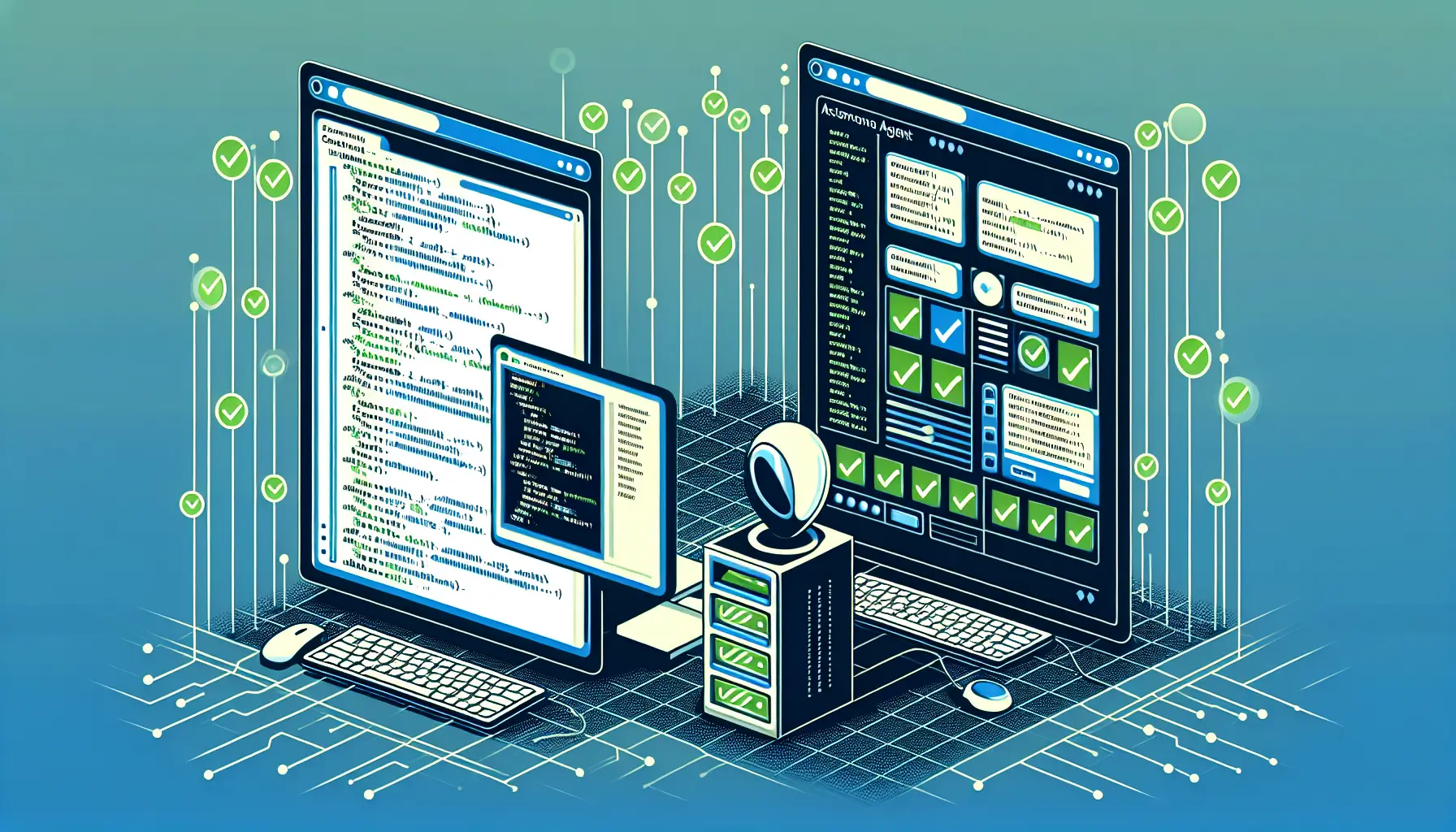
Something's shifting in how developers work with AI coding tools. Not just better autocomplete or smarter suggestions - a fundamental change in where the AI sits in the development process.
Latent Space tracked the pattern: developers are moving from "inner-loop" tools (AI inside your IDE, suggesting code) to "outer-loop" tools (AI that builds, verifies, and demos results without asking permission at each step). The difference matters more than it sounds.
Inner loop vs outer loop
The inner loop is where most AI coding tools have lived until now. You're writing code in your editor. The AI suggests the next line, or completes a function, or refactors something you've selected. You're still in control of every decision. The AI is a very smart autocomplete.
The outer loop is different. That's building, testing, deploying, monitoring - the stuff that happens outside your editor. Setting up environments. Running test suites. Checking if the change actually works in production-like conditions. Creating demo environments. Writing documentation. The scaffolding around the code itself.
Outer-loop work is tedious, necessary, and - here's the thing - mostly deterministic. There's a right answer. Either the tests pass or they don't. Either the build succeeds or it fails. Either the demo environment spins up correctly or it errors out.
Which makes it perfect for agents.
The pattern Latent Space spotted
Cursor shipped a feature that lets their AI build entire projects, run them, and show you the result in a browser preview - without stopping to ask permission at each step. Claude launched something similar with Artifacts - environments where the AI can write code, execute it, and demonstrate the output in one flow. OpenAI's recent updates to their API lean heavily on agents that can verify their own work.
The common thread: closing the loop. Instead of "generate code, wait for human approval, try again", it's "generate code, test it, fix what breaks, show the working result".
This sounds like a small iteration. It's not. It's the difference between a tool that makes you faster and a tool that handles entire categories of work autonomously.
Why this changes the economics
For professional developers, outer-loop work is where time disappears. You write a feature in 20 minutes. Then you spend two hours setting up the CI pipeline, configuring the staging environment, debugging why the tests fail in Docker but pass locally, writing the deployment documentation, and creating a demo for the product team.
If an agent can handle that two-hour block reliably - not perfectly, but reliably enough that you trust it to try first and only call you when genuinely stuck - that's a massive shift in how development work gets distributed.
It also changes what kinds of projects become viable. Solo developers can ship things that previously needed a team. Small teams can move at the pace of much larger organisations. The bottleneck stops being "how much code can we write?" and becomes "how clearly can we specify what we want?"
The trust problem
There's a reason inner-loop tools arrived first. They're lower risk. If GitHub Copilot suggests bad code, you see it immediately and don't accept the suggestion. The blast radius of a mistake is tiny.
Outer-loop automation has a bigger blast radius. An agent that deploys broken code to staging, or misconfigures a test environment, or writes incorrect documentation can create problems that take hours to untangle. So the trust threshold is higher.
What's changed is that the models are now good enough - and importantly, reliable enough - that developers are willing to let them operate in the outer loop with supervision rather than permission. You set them running, check back periodically, and intervene when they get stuck. Like delegating to a junior developer you trust, rather than pair programming with them on every line.
Where this goes next
The Latent Space analysis suggests we're watching a category of work move from "human-driven with AI assistance" to "AI-driven with human supervision". That shift is happening fastest in outer-loop tasks because they're more mechanical, more verifiable, and less creatively ambiguous than inner-loop work.
Which raises an obvious question: how much of professional software development is actually outer-loop work in disguise? How much of what we think of as "engineering" is really systems administration, environment wrangling, and process management?
The answer is probably "more than we'd like to admit". And if agents can handle that category reliably, the remaining work - the genuinely creative, architecturally significant, requires-real-judgement work - becomes more valuable, not less.
Cursor, Claude, and OpenAI shipping loop-closure features in the same window isn't coincidence. It's a pattern. And patterns like this tend to move faster than anyone expects.