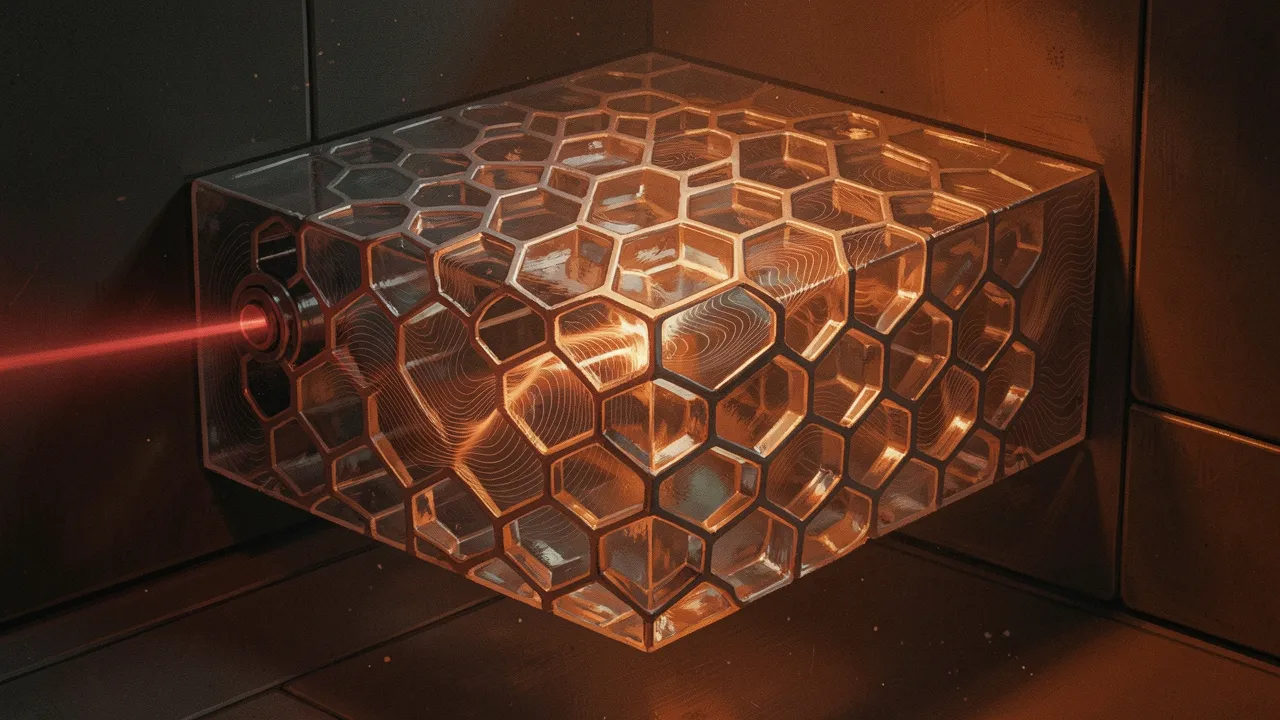
A Columbia University team just observed something that shouldn't exist according to classical physics: coherent ferrons, polarization waves that maintain their structure over measurable distances and times. Published in Nature Materials, the discovery opens applications in quantum computing and telecommunications that weren't on the roadmap six months ago.
Ferrons are collective excitations in ferroelectric materials - think of them as ripples in a material's electric polarization, similar to how phonons are ripples in atomic positions. Scientists predicted their existence decades ago, but observing them in a coherent state proved elusive. Coherent means the wave maintains phase relationships over time, which is exactly what you need if you want to encode and transmit information reliably.
Why Coherence Matters
Most waves in solid materials decohere quickly. They scatter off defects, lose energy to heat, and turn into noise within picoseconds. Coherent waves are different. They hold together long enough to carry information from one place to another without degrading. That's the difference between a signal and static.
In quantum systems, coherence is everything. Qubits need to maintain superposition states for computation to work. Decoherence is the enemy - it's why quantum computers require extreme cooling and isolation. Finding a material phenomenon that naturally maintains coherence at higher temperatures changes the design constraints for quantum devices.
Ferroelectric materials are already used in memory storage and sensors. They switch polarization states in response to electric fields, which makes them useful for non-volatile memory. But nobody had successfully demonstrated that polarization could propagate as a coherent wave. The Columbia team managed it by using ultrafast laser spectroscopy to both excite and measure the ferron waves in a lead titanate crystal.
The Telecommunications Angle
The quantum applications get most of the attention, but the telecommunications implications might arrive sooner. Coherent ferrons could enable new types of electro-optic modulators - devices that convert electrical signals into optical ones for fiber networks.
Current modulators rely on the electro-optic effect, where an electric field changes a material's refractive index. That works, but it's limited by how fast you can apply the field and how much voltage you need. Ferrons offer a different mechanism: you're modulating light by coupling it to a collective polarization wave that's already propagating through the material.
In simpler terms: instead of pushing individual atoms around with an electric field, you're riding a wave that's already moving. That could mean faster modulation speeds with lower power consumption. Both matter for data centers trying to move information between chips and across networks without melting the hardware.
What Makes This Different from Other Quantum Materials Research
Most quantum materials research focuses on electronic states - superconductivity, topological insulators, exotic magnetism. Ferrons are different because they're rooted in the lattice structure of the material, not just the electron behaviour. That makes them potentially more robust. Electrons scatter easily. Lattice vibrations are harder to disrupt.
The Columbia team used lead titanate, which is a well-understood ferroelectric. That's important. They didn't need to synthesize a new exotic compound or work at millikelvin temperatures. The phenomenon exists in a material that's been studied for decades. We just hadn't looked at it the right way.
The measurement technique was key. Ultrafast spectroscopy lets you probe events on femtosecond timescales - that's a millionth of a billionth of a second. At that speed, you can watch the ferron wave form and propagate before it decoheres. The team essentially built a high-speed camera for polarization dynamics.
The Path to Applications
Discovery and application are different timelines. Coherent ferrons are real, but turning them into working devices requires engineering. You need to control how the waves are generated, how they propagate, and how they couple to other systems.
For quantum computing, the question is whether you can use ferrons to store or transmit quantum information between qubits. That requires maintaining coherence long enough to perform operations and read out results. The Columbia results suggest it's possible, but the details matter. What's the decoherence time at different temperatures? How do defects affect propagation? Can you entangle ferron states?
For telecommunications, the bar is different. You don't need quantum coherence - you just need a clean signal. The challenge is integration. Can you fabricate ferron-based modulators that work with existing silicon photonics? What's the bandwidth? How much does it cost to manufacture?
Both paths are open. The Nature Materials paper provides the foundation. What happens next depends on how quickly other groups can reproduce the results and start building on them.
Why This Landed Now
The timing isn't random. Ultrafast spectroscopy tools have improved dramatically in the past five years. What used to require a national lab setup now fits in a university lab. That's what enabled the Columbia team to measure ferron dynamics with enough precision to confirm coherence.
There's also a broader shift happening in quantum materials research. For years, the focus was on finding materials with exotic ground states. Now the emphasis is on dynamics - what happens when you excite a material and watch how it responds. Ferrons are a dynamical phenomenon. You create them by perturbing the system and watching the polarization oscillate.
This is the kind of result that opens doors. It doesn't solve a product problem directly, but it gives engineers a new degree of freedom to work with. Sometimes that's enough.