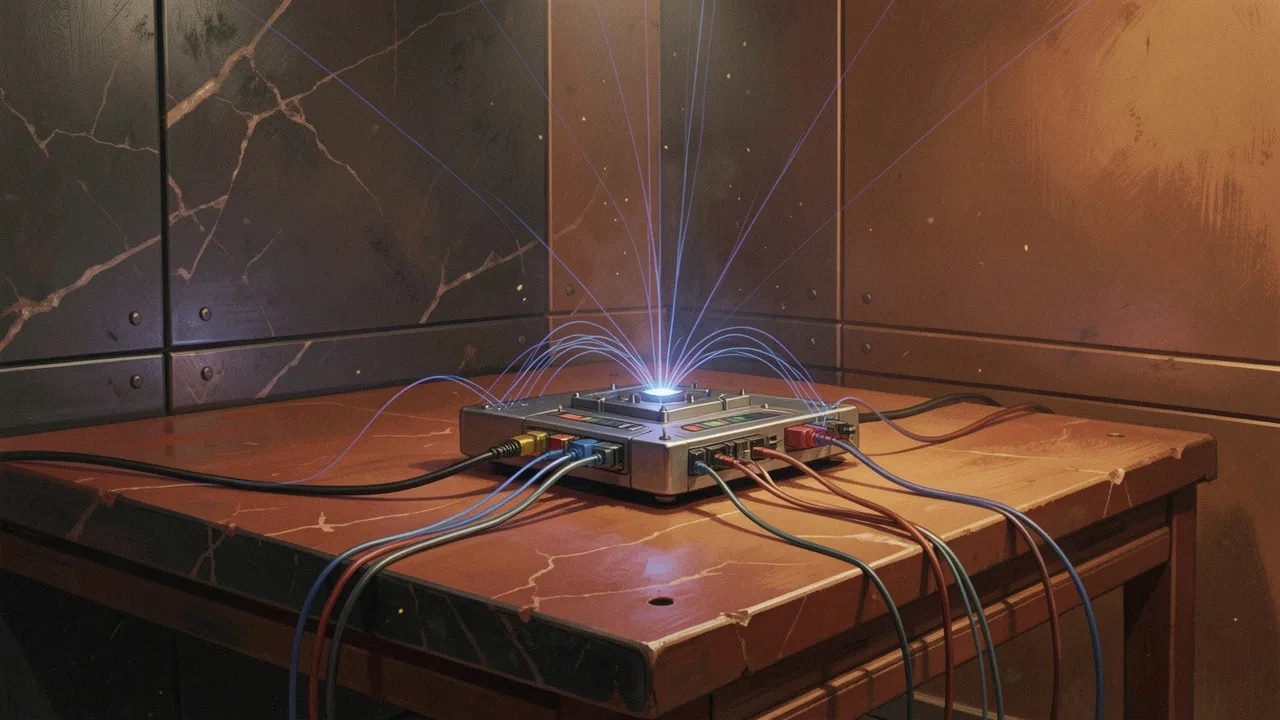
Quantum computers have a temperature problem. Most quantum systems operate at near absolute zero, requiring cryogenic cooling that makes them expensive, fragile, and impractical for anything beyond lab environments. Cisco's new Universal Quantum Switch routes entangled photons without any of that cooling infrastructure. That changes the economics of quantum networking.
The Routing Problem
Connecting quantum computers isn't like connecting servers. You can't just run an ethernet cable. Quantum information is carried by entangled photons - particles of light that remain linked even when separated. Break that entanglement and you lose the quantum state. Measure it incorrectly and the information collapses.
Existing quantum networks route entangled photons through specialised switches that require cryogenic temperatures to maintain coherence. That works in research labs. It doesn't scale to the kind of infrastructure needed for practical quantum computing networks.
Cisco's prototype solves this by using optical switching at room temperature. The photons remain entangled as they're routed between quantum processors and sensors. No cryogenics. No complex cooling systems. Just a switch that works like existing optical networking hardware, but preserves quantum states.
Why This Matters for Deployment
The cooling requirement has been one of the biggest barriers to deploying quantum systems outside research facilities. Cryogenic systems are expensive to install, expensive to maintain, and fragile. A cooling failure can destroy quantum states and corrupt experiments that took hours to set up.
Room-temperature switching means quantum networks can be deployed in standard data centres. You don't need specialised facilities. You don't need dedicated cooling infrastructure. The operational complexity drops significantly.
That's the difference between quantum computing remaining a research curiosity and becoming a practical tool. Not because the computers themselves are suddenly easier to build - they're not - but because the networking layer stops being a deployment blocker.
What It Connects
The switch is designed to route quantum information between three types of devices: quantum computers, quantum sensors, and classical computing infrastructure. That hybrid architecture is where near-term quantum utility lives.
Quantum computers handle specific calculations - optimisation problems, molecular simulations, cryptographic tasks - that classical computers struggle with. Quantum sensors measure physical phenomena with precision that classical sensors can't match. The switch routes quantum data between them while maintaining entanglement.
The classical computing layer handles everything else: orchestration, data preprocessing, results interpretation, user interfaces. The switch bridges the quantum and classical domains, letting each system do what it does best.
The Infrastructure Angle
Cisco isn't building quantum computers. They're building the infrastructure layer that connects them. That's a smart play. Quantum computing hardware is still evolving rapidly - different qubit technologies, different error correction approaches, different thermal requirements. Betting on one architecture is risky.
But every quantum system needs networking. Whether you're connecting superconducting qubits, trapped ions, or photonic processors, you need a way to route quantum information between nodes. Cisco is positioning this switch as the universal layer that works across different quantum technologies.
The prototype demonstrates feasibility. The next question is performance. How much signal loss occurs during routing? How many nodes can you connect before entanglement degrades? How does it handle different photon wavelengths and polarisation states?
Those engineering details will determine whether this becomes infrastructure or just an interesting experiment. But the core problem - routing quantum information without cryogenics - has been solved. That's the breakthrough.
What Happens Next
If room-temperature quantum switches prove reliable, the deployment map for quantum computing changes. Instead of isolated quantum processors in specialised labs, you get distributed quantum resources connected through optical networks. Universities, research institutions, and eventually companies could access quantum computing capacity without building their own quantum labs.
The cloud providers will notice. AWS, Azure, and Google Cloud already offer quantum computing as a service, but the backends are single quantum processors accessed remotely. A practical quantum network means distributed quantum resources that can be orchestrated like classical compute clusters.
That's still years away. Cisco's prototype is exactly that - a prototype. But it removes one of the key barriers to scaling quantum infrastructure beyond research environments. The quantum computers themselves remain complex and expensive. The network connecting them just got simpler.