The terminology collision was inevitable. "Agentic AI" and "workflow automation" both describe systems that do things without constant human input. But conflating them misses something fundamental. This breakdown from DEV explains why the difference is architectural, not just semantic - and why choosing the wrong approach for your use case costs time and money.
How Workflow Automation Actually Works
Workflow automation is deterministic. You define a sequence of actions - if this happens, do that, then do this other thing, with these specific parameters. The system executes exactly what you programmed, in the order you specified, with no deviation. Think Zapier, Make, n8n. Connect APIs, transform data, trigger actions based on clear conditions.
That determinism is a feature. When you need predictable, repeatable processes, workflow automation is reliable. It does the same thing every time. A form submission triggers an email, creates a database entry, updates a spreadsheet. No surprises. No interpretation. Just execution.
The limitation surfaces when conditions change in ways you didn't anticipate. Workflow automation can't adapt. If the API response structure changes, the workflow breaks. If a step fails unexpectedly, the entire sequence halts. You get exactly what you programmed, which means you also get only what you programmed.
What Makes AI Agentic
Agentic AI platforms work differently. Instead of programming a sequence of steps, you define a goal. The system figures out how to achieve it, adapting its approach based on context. An agentic system might try multiple paths, backtrack when something doesn't work, or discover approaches you never explicitly programmed.
That flexibility comes from reasoning capability. The agent doesn't just execute predefined actions. It evaluates situations, makes decisions, adjusts strategy. If an API call fails, it might try an alternative approach. If data is missing, it might know where to find it. The intelligence is in the adaptation, not just the execution.
Here's a concrete example. A workflow automation system might be programmed to extract invoice data from PDFs and create accounting entries. It works perfectly until someone sends a slightly different PDF format. The workflow breaks. An agentic system facing the same challenge might recognise the format variation, adjust its extraction approach, or flag uncertainty and ask for clarification. Same goal, adaptive execution.
The Architecture Underneath
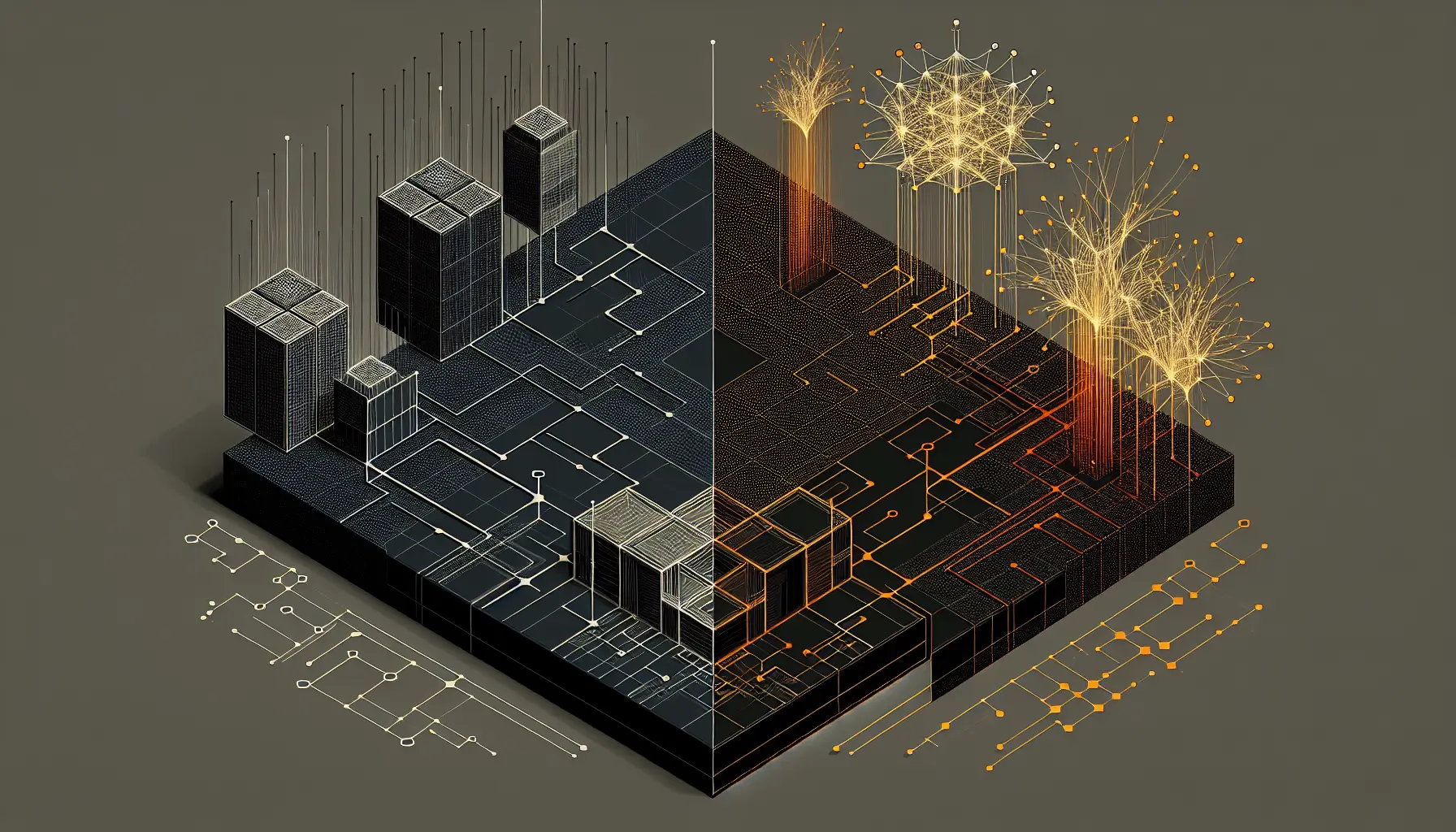
This isn't just different behaviour. It's different architecture. Workflow automation is state machines - explicit transitions between defined states. Agentic AI is reasoning loops - evaluate, plan, act, observe, repeat. Workflow systems optimise for reliability and predictability. Agentic systems optimise for flexibility and problem-solving.
That architectural difference shows up in how these systems handle complexity. Workflow automation struggles with branching logic and edge cases. You end up building increasingly complicated if-then structures trying to account for every scenario. Agentic systems handle complexity by reasoning about it rather than hardcoding every possibility.
When To Use What
The practical question is knowing which approach fits your use case. If the process is well-defined, steps are predictable, and you want consistent execution every time - workflow automation wins. It's faster, cheaper, more reliable, and easier to debug when something goes wrong.
Choose agentic AI when the task requires adaptation. When inputs vary significantly. When context matters. When you need the system to handle unexpected situations intelligently rather than breaking. Customer support triage, research tasks, complex data analysis - scenarios where rigid workflows would require constant maintenance.
There's a hybrid approach emerging too. Use workflow automation for the structure and agentic AI for the flexible pieces. The workflow handles routing and coordination. The agent handles the parts that need intelligence. That architecture gets you reliability where you need it and adaptability where it matters.
The Cost Equation
Agentic AI costs more to run. Every reasoning loop uses compute. Every decision requires model inference. Workflow automation, by contrast, is computationally cheap - just API calls and data transformation. Factor that into your architecture decisions. Sometimes the deterministic approach is better not because it's more capable, but because it's more economical.
There's also a development cost difference. Building robust workflow automation requires mapping every edge case and handling every possible failure mode. Building agentic systems requires different skills - prompt engineering, reasoning loop design, output validation. Neither is trivial. They're just different kinds of complexity.
Where This Is Heading
The terminology will keep evolving, but the architectural distinction matters. As AI capabilities improve, agentic systems will handle increasingly complex tasks. But workflow automation isn't going away. Deterministic execution has enduring value when predictability matters more than flexibility.
The real shift is understanding these aren't competing approaches. They're complementary tools for different problems. Build workflows when you know exactly what needs to happen. Build agents when you know what outcome you want but the path to get there varies. And increasingly, build hybrid systems that use both where they make sense.
Read the full technical breakdown for code examples, architecture patterns, and deeper exploration of when each approach fits production systems.