Today's Overview
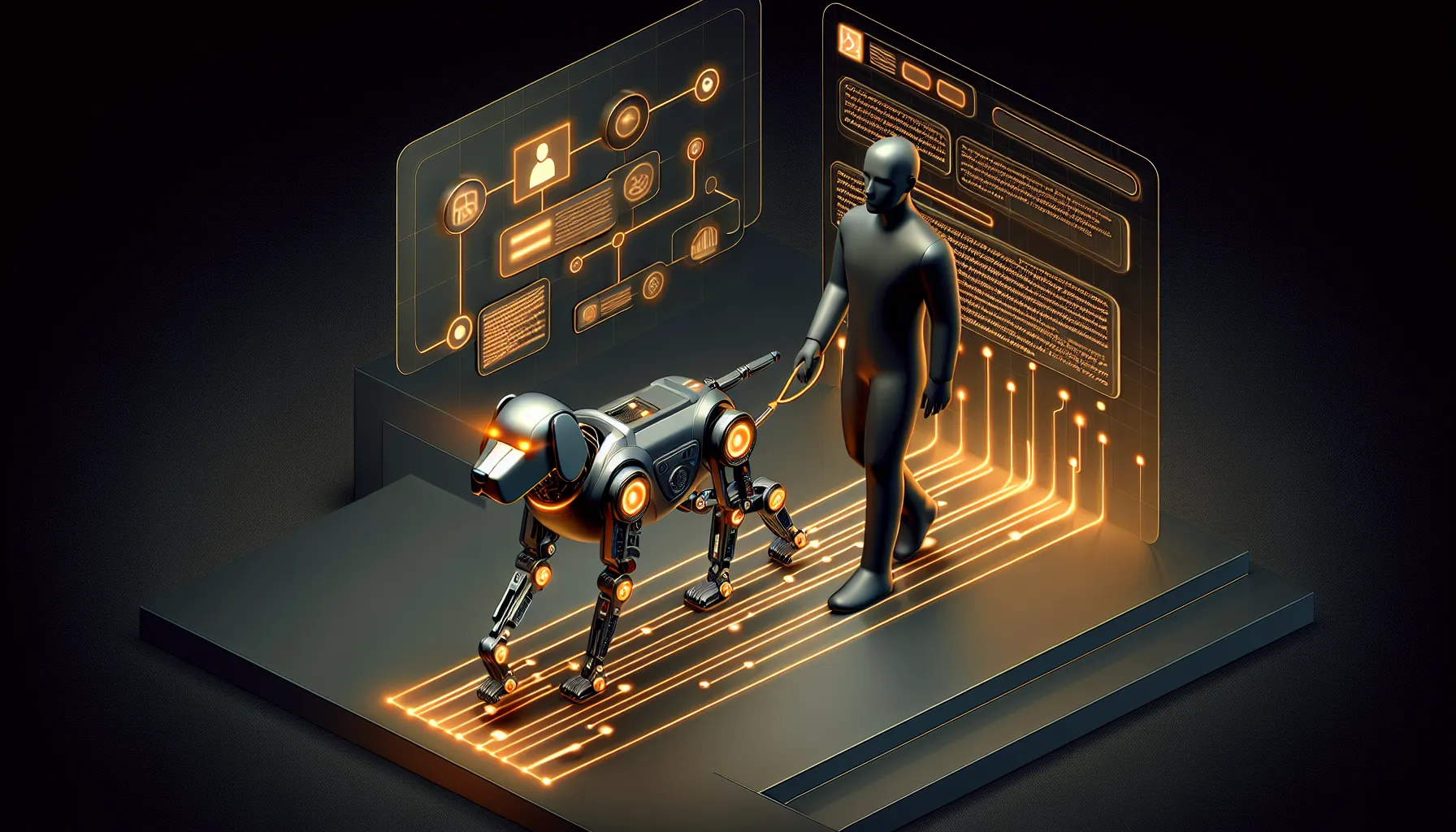
A robot guide dog just passed a test that matters: it can talk to blind users about what it sees, adjusting its route based on their preferences, describing corridors and obstacles in real time. That's not a small thing. Seven legally blind participants navigated a multi-room office environment guided by a quadruped robot that verbalized both the route plan and the scene around them. They preferred the combined approach - hearing both "here's how I'll get you to the conference room" and "we're entering a long corridor now." That preference tells you something important: accessibility doesn't need perfect autonomous navigation. It needs communication.
When Models Have Everything Except Compute
The real story this week isn't about new models - it's about what happens when models are good enough but compute isn't infinite. Anthropic released Mythos, their frontier model. Rather than release it broadly, they limited access to a finite number of high-paying customers. Microsoft admitted last quarter that they could have hit their Azure targets if they'd allocated all new GPUs to customers - instead, they prioritized their own M365 and GitHub Copilot workloads because those have higher margins and lifetime value. OpenAI is making noise about how much compute they've secured; Anthropic is scrambling to buy more. Ben Thompson frames it perfectly: we've moved from a world of zero marginal costs (where serving one more user costs almost nothing) to one of opportunity costs (where serving one customer means you can't serve another). The winner won't be whoever builds the biggest data center. It'll be whoever owns the demand that justifies the data center spend.
Why Your AI Agent Breaks So Easily
Google DeepMind published a paper on how to attack AI agents. Not with traditional hacking. With sentences. You can inject adversarial commands into CSS metadata, saturate content with manipulative language, fabricate data in retrieval corpora, embed prompts in external resources. A single malicious instruction buried in a PDF or hidden in a website's meta tags can steer an autonomous agent toward exfiltrating data or modifying systems. The paper lists six genres of attack - content injection, semantic manipulation, memory corruption, behavioral control, multi-agent collusion, and human-in-the-loop exploitation. The mitigation is ecosystem-level, not just model-level: we need to mark websites as safe for AI, establish verification protocols, and build legal frameworks around weaponized agents. This is what AI safety looks like when systems start acting unsupervised.
For builders, this week brought sharper tools and harder truths. A developer built ptylenz - a PTY proxy that structures the raw output of your terminal into navigable blocks. The insight wasn't "let's build a better shell." It was "the shell isn't on the data path. The PTY is." Five minutes understanding where data actually flows saved weeks of building the wrong thing. Meanwhile, on the practical side, most ReAct-style agents waste 90% of their retries on hallucinated tool calls - not model mistakes, but architectural problems. Prompt tuning won't fix that. You need to restructure how the agent verifies what tools exist before it tries to call them. These are the kinds of details that separate production systems from demos.
Three things worth holding at once: robotics is becoming conversational (not just autonomous), frontier AI is now constrained by compute allocation rather than capability, and the infrastructure for agents - both how to build them and how to defend against them - is still being figured out. This is the window where builders can still shape how these systems get built.