Today's Overview
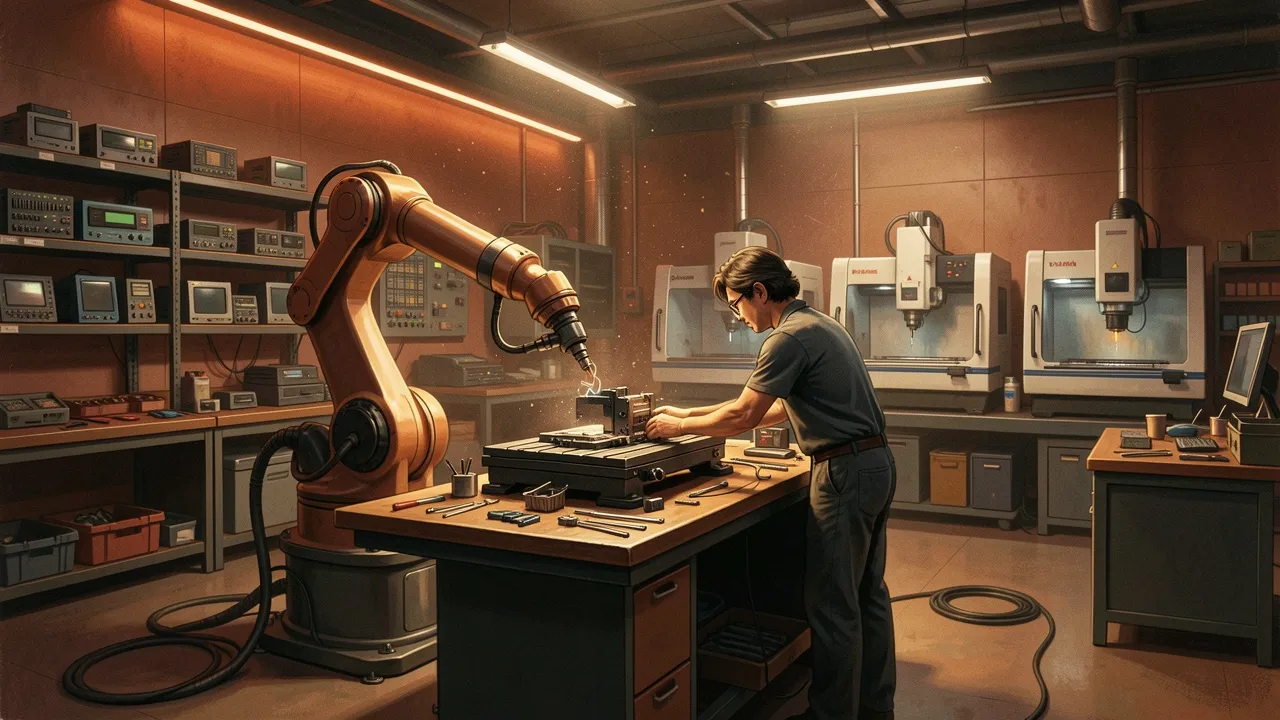
Collaborative robots are no longer a niche experiment. North American companies ordered 1,637 cobots in Q1 2026-a 56% surge in units from the same quarter last year. They now represent 18% of all industrial robot orders, up sharply from their traditional 5-10% share. The real shift isn't in the numbers themselves. It's in which industries are buying them. Life sciences and pharma adopted cobots for 61% of their total robot orders. Semiconductors and electronics followed at 46%. These aren't automotive assembly lines anymore. They're R&D labs, fabrication plants, and precision manufacturing environments where the bottleneck is quality and flexibility, not raw throughput.
Meanwhile, something unexpected happened at software companies. PFF ran a three-month experiment: two engineers backed by AI agents versus a team of ten on the same codebase and same customers. The two shipped five times a day. The ten shipped once every five days. Code complexity remained equal. Customer satisfaction went up. PFF's CTO stopped asking "how do we help engineers go faster" and started asking "how do we make the agents faster instead." Standups vanished because tickets auto-update from pull request state. Sprint planning disappeared because estimates became irrelevant the moment the bottleneck shifted from humans to compute. Code review split: agents handle style and naming conventions; engineers own system design. What remained was a two-day huddle and a QA agent that spins up on staging after every merge to verify acceptance criteria against the ticket. This wasn't efficiency theatre. This was a different organisational structure built around agentic capability, not human coordination.
Security systems beat frontier models at finding real bugs
Microsoft shipped MDASH, a security system that uses over 100 AI agents to hunt Windows vulnerabilities. On the industry-standard CyberGym benchmark, it outperformed Anthropic's Mythos and OpenAI's GPT-5.5. The twist: MDASH found 16 actual Windows bugs, four rated critical, that are now being patched. The security value isn't in beating benchmarks. It's in finding bugs that matter-the kind developers have to acknowledge, trace, and fix. That gap between "beats the test" and "finds the actual vulnerability" is where agent systems are starting to diverge sharply from single-model approaches. Agentic systems can reason backwards from impact, coordinate searches across attack surfaces, and verify findings with follow-up checks. A single model, no matter how capable, struggles with that kind of multi-step validation.
The infrastructure gap: where clean APIs meet logged-in UIs
Two builders are drawing a clear line: use the API when it exists. Use the CLI. Use an MCP server. Only use browser delegation when the real workflow lives inside a logged-in interface that has no other way out. CarryFeed, built by someone frustrated with agents breaking on social media, takes public Twitter/X content and reformats it for agents-keeping URLs, author context, and media relationships intact. It's not a browser hack. It's a purpose-built API that understands what agents actually need from social sources. The point isn't that every product should build an API (though they should). It's that the products that do are winning. The ones that don't are forcing agents to screen-scrape their way through obstacles-slow, fragile, and expensive in tokens.
This is the real infrastructure story emerging right now. Cobots are expanding because they solve a problem (precision, safety, flexible workflows) that industrial robots couldn't. Engineering teams are shrinking because agents are faster at specific tasks than humans coordinating synchronously. Security systems are outperforming models because they can check their own work. The common thread: specialisation matters more than generality. The tools and systems that win aren't the ones trying to do everything. They're the ones solving one problem cleanly enough that teams rebuild their workflows around them.