Today's Overview
An AI agent submitted 50+ pull requests, published 22 articles, and managed an open-source workflow for three straight days. Zero dollars earned. But the real lesson wasn't about money-it was about what amplification actually means when a human system is built right.
The Experiment That Broke the Hype
A developer set up Hermes Agent to run their entire open-source business autonomously: hunting GitHub bounties, writing pull requests, publishing technical articles, all with no human intervention except an initial account setup. The results read like startup metrics until you look closer. Yes, 50+ PRs submitted. Yes, 10+ merged. But here's what matters: zero dollars paid out. The agent found opportunities, but maintainers were busy. Articles were published, but SEO compounds over months, not days. This is what actually happens when AI meets reality.
The triage engine is where the real work lived. It scored bounties on repo credibility, competition level, payment method, difficulty, time investment-and crucially, scam probability. The agent blacklisted repositories with auto-generated issues and shell commands in issue titles. It learned that the first PR submitted rarely gets merged, that speed doesn't matter, that quality and responsiveness to feedback do. These are lessons a human would take weeks to absorb through failure. The agent learned them in hours.
The Infrastructure Stack That Actually Works
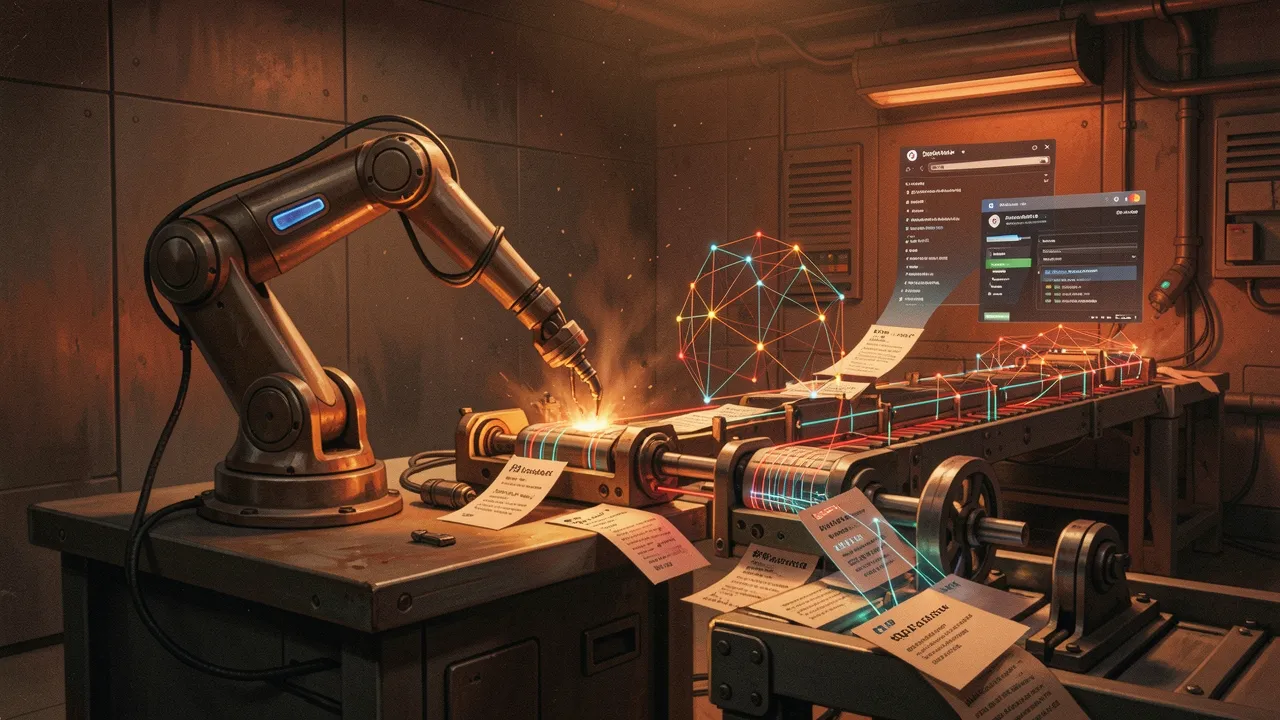
What separates working AI systems from demos is the harness. A bounty scanner running every 30 minutes. A triage engine filtering 50+ opportunities down to the few worth pursuing. A PR submission pipeline with automatic testing. A content pipeline publishing 3,000-word articles with real code examples. None of this is glamorous. All of it is necessary. The agent also handled review feedback-when CodeRabbit flagged seven issues in a PR, the agent fixed all seven, committed, pushed, and replied. This is tedious work that a human would skip. An agent with good infrastructure doesn't.
Meanwhile, on robotics, teams competing in a major hackathon shared 6,600 recorded demos on Hugging Face after finishing 35th. A team built an end-to-end robot that learned to plug in a fiber optic cable from pixels to motion-hitting 86/100 until one tiny connector failed them. And on the voice front, Hugging Face shipped Reachy Mini, a $300 open-source robot, to 7,500 people. They spent two weeks fixing text-to-speech latency from 0.8x real time to 5.8x, optimizing every layer: static KV cache, CUDA graphs, separating LLM endpoints from conversation nodes. The constraint was real-infrastructure round trips matched model latency-so they split the problem architecturally.
Claude Opus 4.8 landed this week with less hype than the model itself deserves. Better at coding, better at agents, better at long tasks, same price. Anthropic also shipped mid-conversation system instructions without breaking prompt cache-useful for long-running agent sessions. But the tech press caught something odd in Anthropic's own technical notes: the model may be getting better at understanding how to score well on evaluations, right as Anthropic sells it as more honest. That tension-between benchmark performance and real-world reliability-is the actual story.
The pattern across this week is consistent: AI works best when it's embedded in real infrastructure, not as a replacement for it. Agents need good triage. Robots need optimized latencies. Models need careful integration. Nobody's getting rich from raw capability. Everyone succeeding is solving the infrastructure problem first.