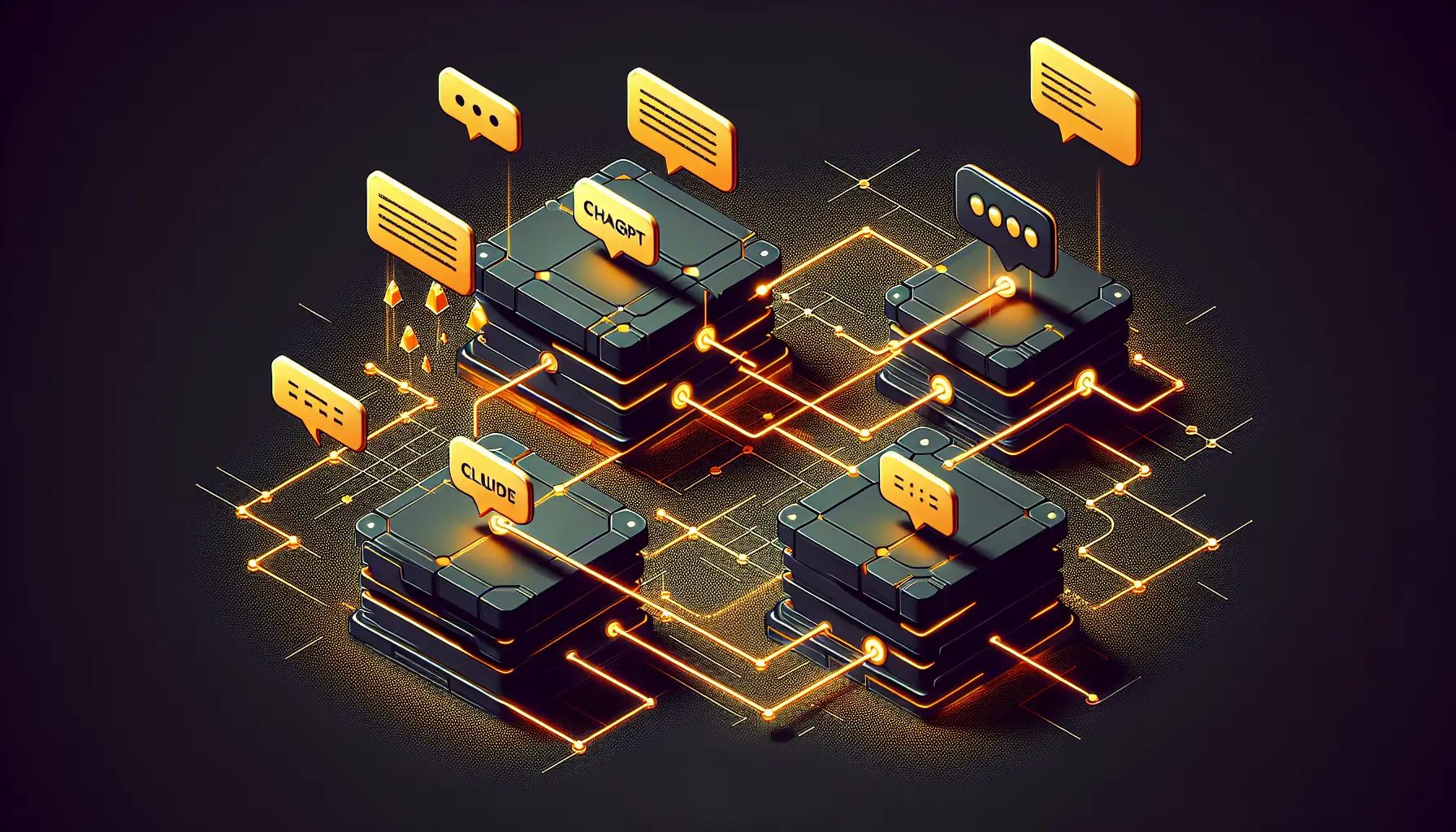
You've spent months building context in ChatGPT. Custom instructions tuned. Conversation history rich with your preferences, writing style, and domain knowledge. Then Claude releases a feature you need. Can you bring that context with you? No. Not without starting over. Phoenix Grove Systems' analysis exposes something the AI industry would prefer you didn't think about too carefully: there is no standard for AI conversation portability, and the lack of one is a choice, not a technical limitation.
ChatGPT exports conversations in a JSON format that only ChatGPT understands. Claude does the same, with a different schema. Gemini, another format. If you want to move between them, you're manually copying and pasting or writing custom migration scripts. For individual users, this is annoying. For businesses building on these platforms, it's a strategic liability.
The Vendor Lock-in Nobody Talks About
We've seen this pattern before in cloud computing, where AWS, Google Cloud, and Azure all offer subtly incompatible services that make migration expensive. In email, where moving from Gmail to Outlook means rebuilding filters, labels, and workflows. In design tools, where Figma and Sketch files don't play nicely together. But AI lock-in is more insidious because the asset being locked in is context - the accumulated knowledge of your preferences, communication style, and use patterns.
Every conversation you have with ChatGPT trains it - not the underlying model, but the session context - to understand you better. That context is valuable. It's the difference between a generic response and one that feels tailored. And it's trapped inside OpenAI's ecosystem by design.
Phoenix Grove Systems built Memory Forge to prove this doesn't have to be the case. Their tool creates a unified, portable format for AI conversation history that works across providers. The technical challenge wasn't hard - it's data transformation and schema mapping, problems solved decades ago in database engineering. The hard part is that no major AI provider has an incentive to make this easy.
Why the Industry Won't Fix This
Interoperability reduces switching costs. Reduced switching costs increase competition. Increased competition compresses margins. For companies like OpenAI, Anthropic, and Google, proprietary conversation formats are a moat. Not a deep moat - Memory Forge demonstrates it's crossable - but enough friction to keep most users from bothering.
This is why standards emerge from regulation, consortium pressure, or market dominance that makes compatibility profitable. Email became interoperable because no single provider could dominate the early Internet. Cloud providers are slowly adding interoperability under regulatory pressure from the EU. AI will likely follow the same path: either governments mandate portability, or a dominant player decides lock-in costs them more in trust than they gain in retention.
But right now, we're in the land-grab phase. Every major AI lab is racing to build ecosystems - chat interfaces, API platforms, enterprise integrations - that make leaving painful. The lack of a portability standard isn't an oversight. It's strategy.
What This Means for Builders
If you're building a product that relies on AI provider APIs, you're inheriting their lock-in. Your users' data - their conversation history, their accumulated context - is siloed by whichever model you've chosen. Switching providers means your users lose continuity. That's not just a UX problem, it's a business risk.
Smart builders are designing for portability from day one. Store conversations in your own database, in a provider-agnostic format. Abstract the AI interaction layer so swapping ChatGPT for Claude is a configuration change, not a rewrite. Treat AI providers like you'd treat any other infrastructure dependency: essential but replaceable.
This is harder than it sounds because providers actively discourage it. OpenAI's ChatGPT interface is sticky by design - the UX is good, the integrations are convenient, and exporting data is just clunky enough to keep most people from trying. But the principle stands: own your data layer. Don't let your product's continuity depend on a format you don't control.
The Case for an Open Standard
What would AI conversation portability look like? Probably something like email's MIME standard or RSS for content syndication - a simple, extensible format that captures conversation structure, metadata, and context in a way any provider could import and export. Phoenix Grove's Memory Forge is effectively a proof-of-concept for this, demonstrating that technical feasibility isn't the barrier.
An open standard would benefit users obviously - freedom to switch providers without losing context. But it would also benefit the ecosystem by lowering barriers to entry for new AI providers and encouraging competition on model quality rather than switching costs. The companies hurt by this would be the incumbents with the most to lose from easy migration.
Which is why it probably won't happen voluntarily. History suggests interoperability comes from external pressure, not industry goodwill. Until then, tools like Memory Forge are the closest thing we have to portability - third-party bridges built by developers frustrated enough to solve it themselves.
Why This Should Bother You
The AI tools you use today are shaping how you think, write, and work. The context you build in those tools is an extension of your cognitive process. Locking that context inside proprietary formats isn't just inconvenient - it's a form of cognitive capture. Your accumulated knowledge becomes an asset controlled by someone else, subject to their pricing, their terms, and their strategic decisions.
For now, the solution is awareness and intentional design. Export your data regularly. Store it somewhere you control. Build systems that treat AI providers as swappable infrastructure, not permanent foundations. And if you're building products, resist the temptation to create your own proprietary lock-in. The short-term retention gains aren't worth the long-term trust you'll lose.
Conversation portability will come eventually - either through regulation, competitive pressure, or market evolution. But waiting for it means accepting lock-in in the meantime. Memory Forge proves the technology exists. The question is whether the industry will adopt it, or whether users and builders will have to force the issue themselves.