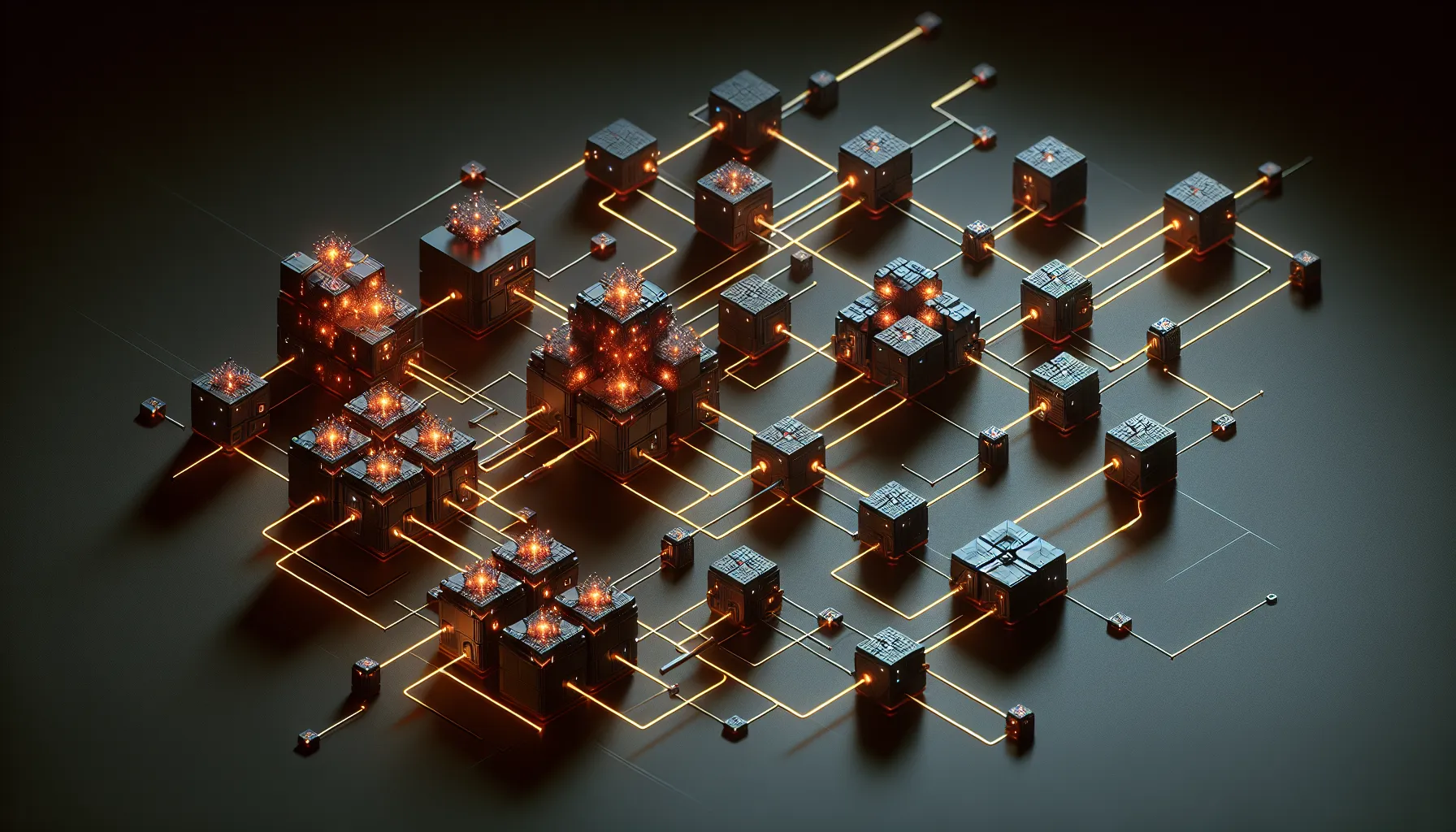
A robot lost its central processing module - the equivalent of its brain shutting down completely - and kept moving. Not limping forward on backup systems. Not degrading gracefully. Just... kept working.
This isn't science fiction. Researchers at EPFL built a modular robot called Mori3 where every module shares power, communication, and sensing with its neighbours. When one module dies, the others compensate. The robot navigated rough terrain with a dead module onboard, something traditional robots simply cannot do.
Why traditional robots fail hard
Most robots are built like organisms - centralised control, hierarchical systems, single points of failure. If the main processor fails, the machine stops. If a battery dies, everything downstream goes dark. If a sensor breaks, blind spots appear and stay blind.
The engineering logic makes sense. Centralisation is efficient. One brain coordinating many limbs is simpler than many brains negotiating movement. But efficiency has a cost: fragility. One critical component fails and the entire system collapses.
For robots in disaster zones, deep-sea exploration, or space missions, this is unacceptable. You cannot send a repair team when things go wrong. The machine either adapts or it dies.
The resource-sharing architecture
Mori3 inverts the traditional model. Instead of centralising resources, it distributes them. Every module has its own processor, battery, and sensors. But crucially, every module can share what it has with its neighbours.
If one module's battery drains, it draws power from adjacent modules. If a sensor fails, nearby sensors fill the gap. If a processor overloads, computation shifts elsewhere. The system treats resources as collective, not individual.
The result is a robot that degrades gracefully. Performance drops as modules fail, but the robot continues operating far longer than traditional designs. In EPFL's tests, Mori3 reduced failure rates significantly compared to non-sharing modular robots.
More striking: the robot successfully navigated terrain with its central module completely dead. The brain was offline. The body carried on.
What this means for real-world robotics
The obvious applications are extreme environments - search and rescue, planetary exploration, underwater missions. Places where failure is expected and repair is impossible.
But the architecture has broader implications. Industrial robots could self-repair during production runs. Agricultural robots could continue harvesting if a module breaks mid-field. Warehouse automation could tolerate component failures without halting operations.
The trade-off is complexity. Resource-sharing requires coordination protocols, real-time negotiation between modules, and smarter power management. It is computationally heavier than centralised control. But as processors get cheaper and more efficient, this trade-off becomes easier to justify.
The bigger pattern
This research fits into a larger shift in robotics: moving away from perfect, rigid systems towards resilient, adaptive ones. Nature solved this problem millions of years ago. Biological systems distribute function, compensate for damage, and continue operating with degraded components.
Swarm robotics already embraces this principle - many simple robots coordinating to achieve complex tasks. But Mori3 applies the same logic at the component level. The robot itself is the swarm.
The question is whether this approach scales. Can a hundred-module robot coordinate as effectively as a ten-module one? Can resource-sharing work when modules are not physically adjacent? Can the system handle cascading failures where multiple modules die simultaneously?
EPFL's work suggests the answer is yes. But the real test will come when these robots leave the lab and face uncontrolled environments. When they do, we will find out if resilience matters more than efficiency. My guess: in most places that matter, it does.