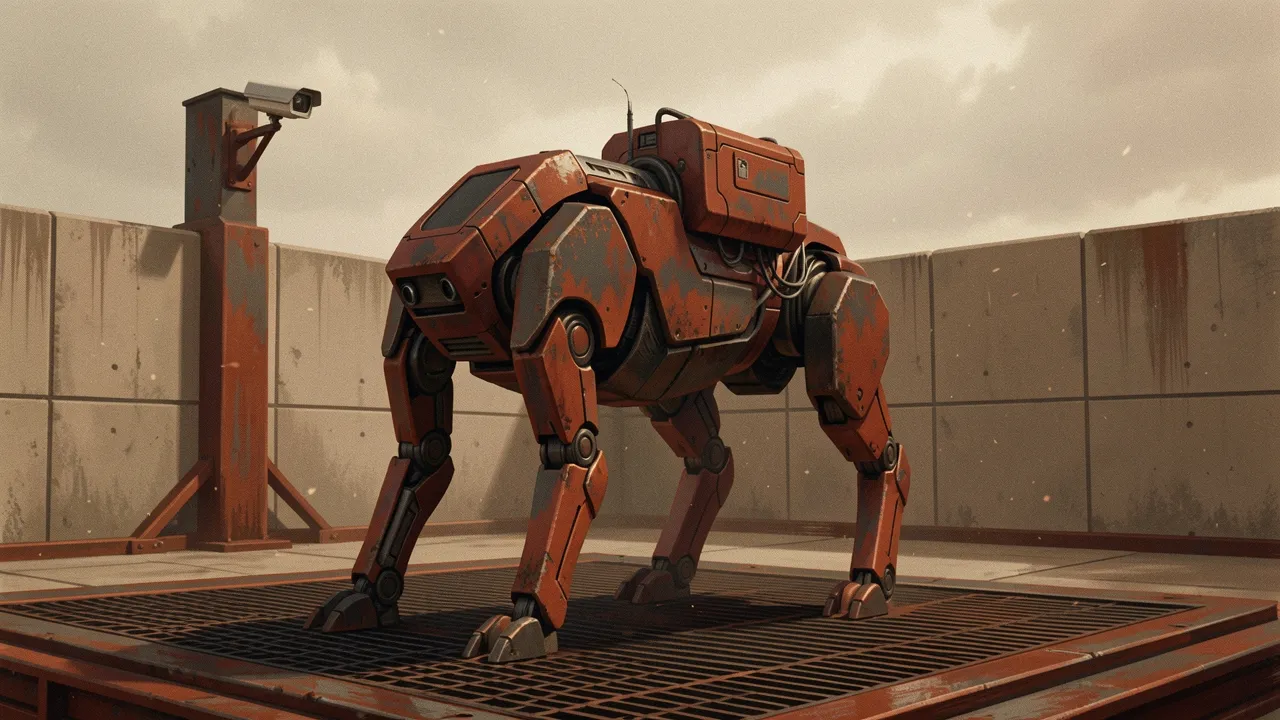
Most robotics companies talk about deployment in the future tense. Ghost Robotics has already put over 1,000 quadrupeds into the field.
Their CEO will speak at the May 2026 Robotics Summit, and the focus isn't on what's possible - it's on what already happened. Defence installations. Security perimeters. Industrial sites. A decade of learning what breaks, what works, and what nobody anticipated.
The Reality Gap Closes
The robotics industry has spent years talking about the reality gap - the difference between simulation and the real world. Ghost Robotics closed it by not caring about perfect performance in controlled environments. Their robots operate in dust, rain, snow, and mud. On stairs, gravel, and uneven terrain. In environments where a single failure means a security breach or a lost inspection window.
The case studies from their deployments reveal something the lab can't teach: reliability matters more than capability. A robot that works 98% of the time in perfect conditions is less useful than one that works 95% of the time in any conditions. That 3% difference disappears when the alternative is sending a human into a hazardous area.
Defence applications drove much of this learning. When a quadruped patrols a perimeter, it can't stop working because the weather changed. When it inspects a site for explosives, uncertainty isn't acceptable. The machines had to become predictable, maintainable, and boring. Boring is what you want in a tool that keeps people safe.
Software Outpaced Hardware
The surprising bit isn't the physical capability - it's how much of the progress came from software. Ghost Robotics' early models were impressive for their mechanical design, but the real leap happened when the software stack matured enough to handle edge cases autonomously.
Navigation in GPS-denied environments. Obstacle avoidance when the map is wrong. Recovery from falls without human intervention. These aren't hardware problems. They're software problems that only surface after hundreds of deployments.
The industrial use cases tell the same story. A quadruped inspecting an oil rig doesn't just need to walk - it needs to know where to walk, what to look at, and when something it sees matters. That's sensor fusion, path planning, and anomaly detection running in real time on hardware that gets knocked around daily.
What's Next Isn't More Legs
The next five years, according to Ghost Robotics' roadmap, focus on integration, not innovation. The hardware works. The challenge now is making these robots fit into existing workflows without requiring a robotics expert on staff.
That means better APIs for third-party sensors. Simpler mission planning tools. Integration with security management systems and industrial SCADA networks. The goal is to make deploying a quadruped feel like deploying a camera - useful infrastructure, not a research project.
It also means smarter autonomy. Current systems handle structured tasks well: patrol this route, inspect these points, return to base. The next generation needs to handle semi-structured tasks: investigate that noise, assess this spill, decide if that's a threat. That requires better perception models and more sophisticated decision-making, all running on hardware that can't afford to fail.
The Unsexy Truth About Robotics
The broader lesson from Ghost Robotics' decade is this: commercial robotics succeeds by solving boring problems reliably, not by building impressive demos.
Humanoid robots get the headlines. Quadrupeds doing perimeter security for a decade don't. But the latter is what actually changes industries. Defence contractors don't buy robots because they're cool. They buy them because they work, and they keep working, and they cost less than the alternative.
The Robotics Summit talk will likely focus on case studies - specific deployments, specific failures, specific solutions. That's what builders need. Not another vision of the future, but data from the present. How long do these things actually run between maintenance? What breaks first? What did you wish you'd known five years ago?
For anyone building commercial robotics - or deploying it - that's the conversation worth having. The future is already here in a thousand installations. It's just not evenly distributed yet.