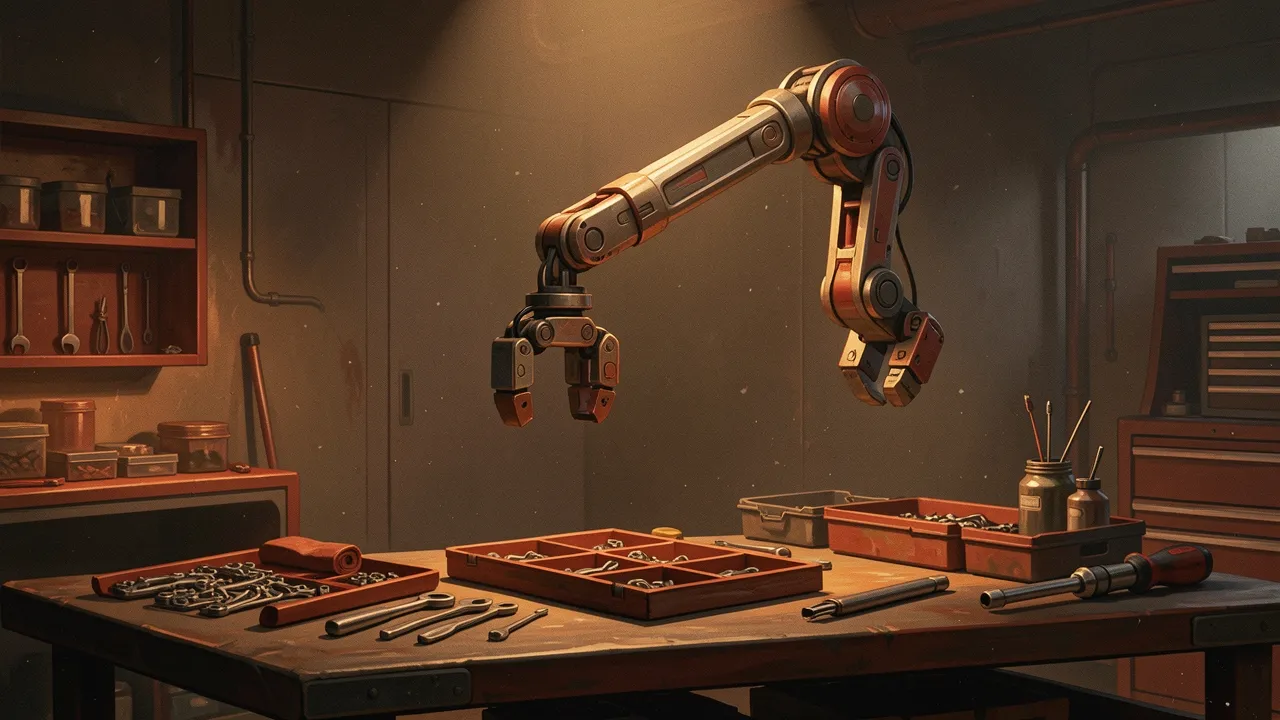
Hailo's VP of physical AI, Orr Danon, has a thesis that cuts against the grain of current robotics hype: the future isn't humanoid robots doing everything. It's millions of task-specific machines, each brilliant at one thing, running intelligence locally on cheap edge processors.
The argument is simple. A humanoid robot designed to do everything is expensive, complex, and years away from reliable deployment. A robot designed to do one thing - pick strawberries, inspect pipelines, fold laundry - can be optimised ruthlessly for cost, speed, and durability. And critically, it can run its AI models on-device, no cloud required.
Why Edge Intelligence Changes the Economics
Running AI on edge processors - chips built into the robot itself - solves three problems at once. First, latency. A robot arm sorting components on a factory line can't wait 200 milliseconds for a cloud response. It needs to decide in 10 milliseconds or the line stops. Second, cost. Sending video feeds to the cloud and paying per API call adds up fast. A million robots sending constant data to the cloud is not a sustainable cost model. Third, privacy. Nobody wants their warehouse operations, medical imaging, or agricultural data leaving the building.
Danon's point is that edge inference chips are now powerful enough to run vision models, decision-making algorithms, and real-time control loops without breaking the bank. Hailo's processors are designed specifically for this: small, efficient, capable of running neural networks locally. The result is robots that are cheaper to deploy, faster to respond, and easier to scale.
Generality Is Expensive. Specificity Scales.
The humanoid robot dream is seductive. One machine that can cook, clean, fetch, carry, and respond to natural language commands. But the engineering challenge is enormous. Every joint, sensor, and actuator adds cost and failure points. Training a general-purpose robot to handle the full range of human tasks requires massive datasets and years of iteration. And even then, it will be outperformed by a task-specific machine in every individual use case.
A strawberry-picking robot doesn't need legs, doesn't need to understand speech, doesn't need hands that can hold a wrench. It needs a vision system that can identify ripe fruit, an arm that can reach without damaging plants, and a gripper that can pluck without bruising. That's it. And because the task is constrained, the robot can be optimised ruthlessly for cost and reliability. Deploy 10,000 of them across farms and the economics work.
The same logic applies to inspection drones, warehouse sortation robots, medical imaging assistants, and autonomous delivery vehicles. Each one does one thing, and does it better and cheaper than a general-purpose machine ever could.
What This Means for the Next Decade
If Danon is right - and the economics suggest he is - the next wave of robotics won't look like sci-fi. It will look like infrastructure. Millions of specialised machines, each embedded with just enough intelligence to do its job, running locally, deployed at scale. The humanoid will remain a research curiosity or a luxury product. The real transformation will happen in fields, factories, warehouses, and hospitals, where task-specific robots quietly do the work that humans don't want to do or can't do safely.
This isn't a slower future. It's a more practical one. And for anyone building in robotics, it's a reminder: generality is a luxury. Deployability is what scales.