Quantum computers fail in expensive ways. A single qubit drifts out of calibration, and suddenly your million-dollar system is producing garbage. Right now, fixing that requires a human expert to manually tune hundreds of parameters, one at a time, hoping they catch the problem before it cascades.
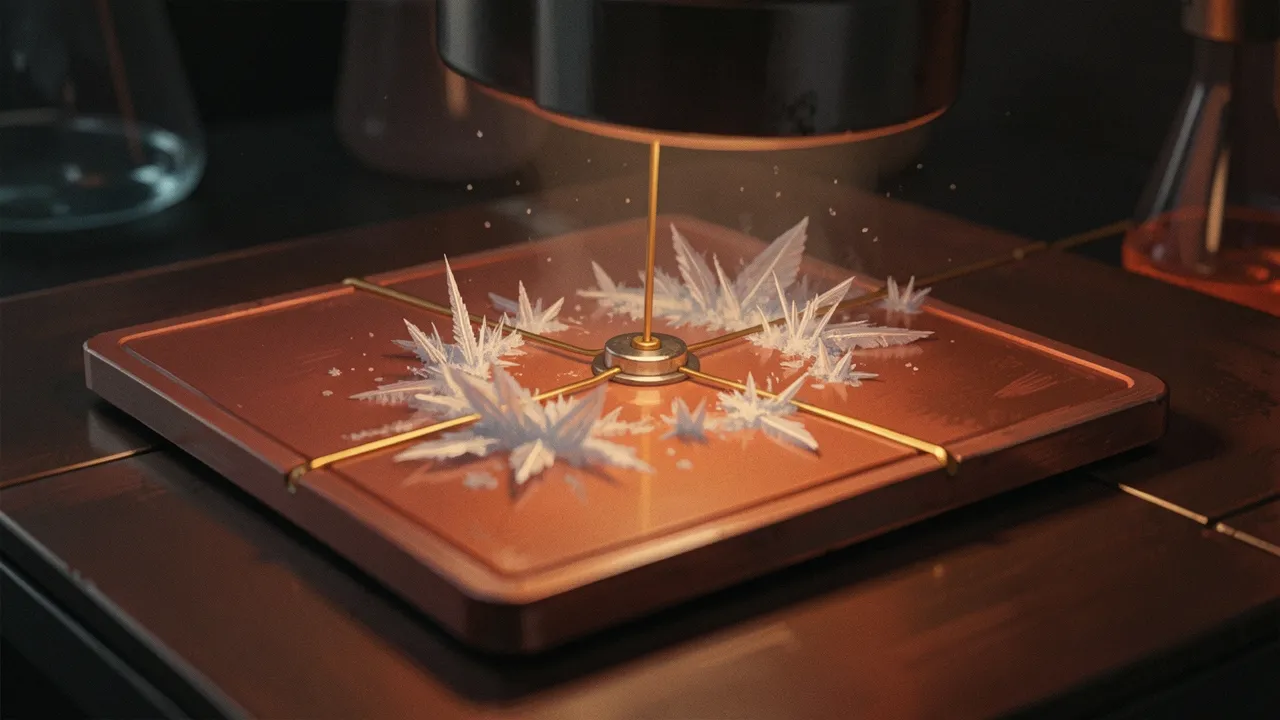
Researchers at Aalto University just built a sensor that might make that process obsolete. It's called a bolometer, and it can measure energy changes smaller than a zeptojoule - that's 10 to the power of minus 21 joules. To put that in perspective: if a joule is a litre of water, a zeptojoule is a single molecule.
The breakthrough isn't just about measurement precision. It's about what becomes possible when you can sense quantum noise at that resolution. Specifically: you can automate calibration. And that changes the economics of quantum computing entirely.
Why Quantum Systems Drift
Quantum computers are fragile. They operate at temperatures colder than deep space, and even at those temperatures, qubits interact with their environment in ways that throw off their behaviour. A stray photon, a magnetic field fluctuation, thermal noise from the wiring - all of it adds up.
The current fix is manual. An engineer runs test sequences, measures the output, tweaks parameters, runs another test. It's slow, it requires expertise, and it has to be done regularly because qubits don't stay calibrated. As quantum systems scale up - more qubits, more complexity - this becomes the bottleneck. You can't manually tune a 1,000-qubit system. There aren't enough hours in the day.
The Aalto bolometer changes that equation because it can see the noise that causes drift. Not infer it from outputs. Not estimate it from models. Actually measure the energy fluctuations in real time, at the quantum level.
How a Josephson Junction Becomes a Sensor
The device uses superconducting Josephson junctions - the same components that make up qubits - configured as an energy detector. When a photon or thermal fluctuation hits the junction, it changes the current flow in a measurable way. The resolution comes from operating at 25 millikelvin and using clever readout electronics that amplify the signal without adding noise.
What makes this useful for quantum computers is the size of what it can detect. Quantum noise operates at energy scales that were previously invisible. You knew something was wrong because your qubit wasn't behaving correctly, but you couldn't see what was wrong. This sensor makes the invisible visible.
That means you can build feedback loops. The sensor detects drift. The control system adjusts parameters. The sensor confirms the fix. No human in the loop. It's the difference between flying a plane manually and having autopilot - you still need a pilot, but they're not adjusting the trim every 30 seconds.
The Cost Problem in Quantum
Here's why this matters beyond the technical elegance: quantum computing is currently too expensive to scale, and a significant chunk of that cost is human expertise. You need PhDs babysitting the system, and even then, utilisation is low because the system spends so much time being tuned.
If you can automate calibration, you reduce staffing costs and increase uptime. The system stays online longer. More compute gets done per dollar. That's the economic shift that makes quantum practical for more than just research labs with government funding.
The Aalto team estimates this could cut operational costs significantly by reducing the need for constant manual intervention. More importantly, it makes scaling feasible. A 10-qubit system you can tune by hand. A 1,000-qubit system you cannot. Automated calibration using real-time noise sensing is the only path forward.
What Else Can You Measure?
The other interesting bit is what this sensor enables beyond calibration. If you can measure energy at sub-zeptojoule resolution, you can study quantum noise itself. Where does it come from? How does it propagate? What materials or configurations reduce it?
Right now, quantum researchers are designing systems based on theory and educated guesses about noise sources. This gives them a direct measurement tool. That's valuable for improving qubit design, shielding, and error correction strategies. It's the difference between knowing your house is cold and being able to see exactly where the heat is escaping.
The device is still experimental. It's not shipping in commercial quantum computers yet. But the fact that it works - that sub-zeptojoule measurement is possible with existing superconducting technology - means the path to integration is clear. No new physics required. Just engineering.
The Automation Layer for Quantum
If quantum computing is going to move from research curiosity to practical infrastructure, it needs an automation layer. Systems that can self-diagnose, self-tune, and self-correct without human experts in the loop for every decision.
This bolometer is one piece of that layer. Not the whole solution, but a critical enabling component. It's the sensor that makes automated calibration possible. And automated calibration is what makes scaling possible. And scaling is what makes quantum useful for more than just very specific, very expensive problems.
The timeline matters. The companies building quantum computers now - IBM, Google, IonQ, Rigetti - are all wrestling with this calibration problem. The ones who solve it first get a significant advantage in system reliability and cost. Aalto just open-sourced a path to solving it.
Whether they take it is the next question.