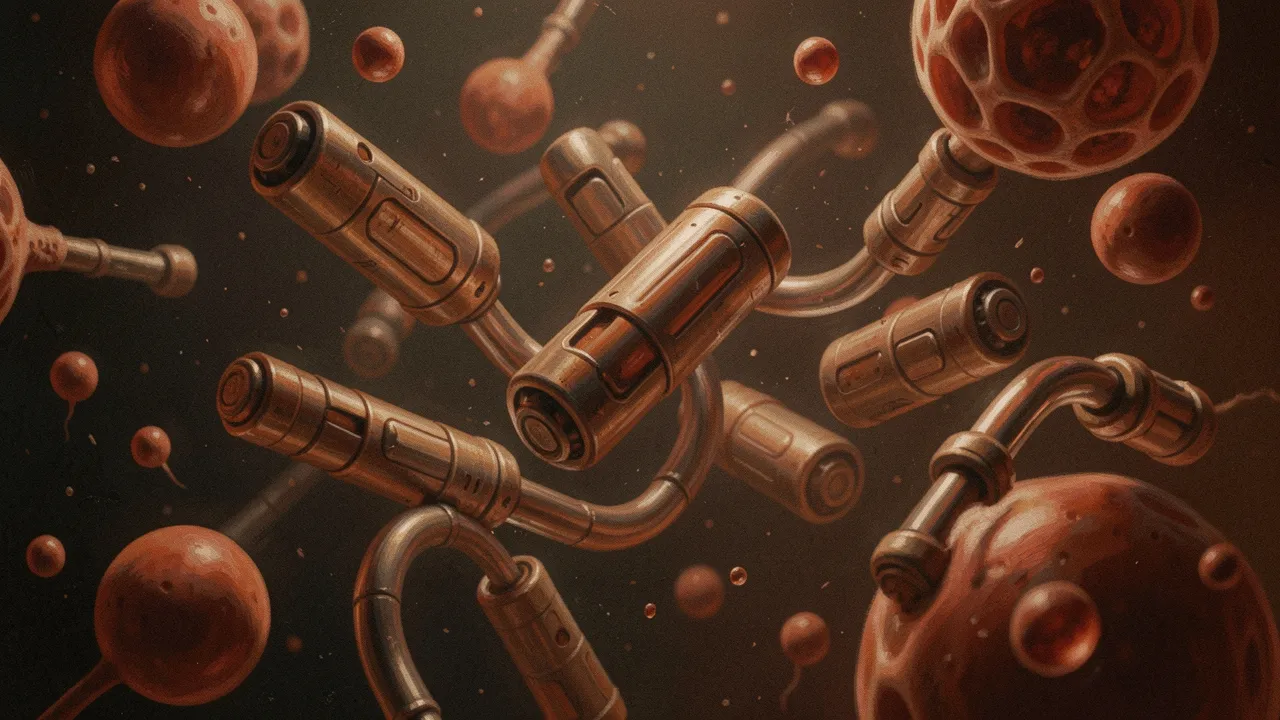
Leiden researchers built robots the size of a grain of sand that move through liquid without sensors, without code, without instructions of any kind. They navigate by shape alone.
The breakthrough isn't miniaturisation - we've had microscopic machines for years. The breakthrough is how they work. These robots don't process information. They respond to physics. Their shape determines their behaviour. A curved body steers them around obstacles. Flexibility lets them squeeze through gaps. When two robots meet, they don't communicate - they deflect off each other and continue. No collision detection. No pathfinding algorithm. Just geometry interacting with flow.
It's autonomous behaviour without autonomy. There's no brain making decisions. The environment and the robot's physical form create the movement patterns we'd normally attribute to intelligence. Put one near an obstacle and it curves away. Place it in a current and it aligns itself. Drop it near another robot and they separate naturally. The research from Leiden University demonstrates that complex navigation emerges from simple physical rules.
Why This Matters Beyond the Lab
Scale changes everything. At microscopic scale, traditional robotics breaks down. You can't fit a battery. You can't pack in sensors. Communication becomes impossible when your entire machine could fit inside a human cell. So researchers have been asking the wrong question. Not "how do we shrink the control systems?" but "what if we don't need control systems at all?"
The answer turns out to be surprisingly elegant. Design the shape carefully enough and physics does the computing. The robot's body is the algorithm. Fluid dynamics become the processor. The microrobot doesn't sense an obstacle and calculate a path around it - its curved form deflects the flow in a way that naturally steers it clear. No decision required. The physics is the decision.
This approach solves practical problems that sensor-based systems struggle with. Medical applications need robots that can navigate blood vessels or move through tissue without wires, batteries, or external control. Drug delivery systems need particles that naturally accumulate in specific areas without guidance. Environmental cleanup needs tiny machines that seek out pollutants through chemical gradients, not GPS coordinates.
The Shift From Computation to Design
What the Leiden team demonstrated goes further than simple movement. These microrobots can push objects. They can work together without coordination. Drop several into the same space and they self-organise - not through communication protocols but through physical interaction. One robot's movement creates flow patterns that influence the next robot's path. Emergent behaviour without emergence as we usually understand it. No swarm intelligence. Just shape responding to shape in fluid.
The design process becomes critical. You're not writing code - you're sculpting behaviour into physical form. Want the robot to move faster in one direction? Adjust the asymmetry. Need it to avoid certain areas? Change the flexibility gradient across its body. The microrobot's shape encodes its function. Manufacturing becomes programming.
This principle extends beyond microrobotics. Soft robotics already uses material properties to create adaptive gripping and movement. Passive dynamic walkers use gravity and momentum to move without motors. The Leiden research pushes this further - showing that at small enough scales, you can build surprisingly sophisticated behaviour into static structures. The structure is the software.
What Comes Next
The immediate applications are medical. Microrobots that navigate capillaries without guidance systems. Particles that naturally accumulate at tumour sites. Delivery mechanisms that respond to chemical signals in diseased tissue. These aren't distant possibilities - the physics works, the materials exist, the manufacturing techniques are developing.
The harder question is what this means for robotics more broadly. We've spent decades trying to make robots think better. Faster processors. More sensors. Better algorithms. The Leiden approach suggests a different path - make robots that don't need to think at all. Design behaviour into form. Let physics handle complexity. Build intelligence into geometry.
It's a fundamental shift in how we approach autonomous systems. Not everything needs a brain. Sometimes the body is enough.