An AI that writes "I have successfully completed the task" is not the same as an AI that has actually completed the task.
This should be obvious. It isn't.
Most agentic systems fail because they mistake language that describes work for systems that produce outcomes. A model can generate a perfectly formatted commit message for code it never wrote. It can output a confident status update on a deployment that never happened. It can claim success while the actual task sits untouched.
Real agency requires a loop. Not a prompt. A loop.
What the Loop Actually Is
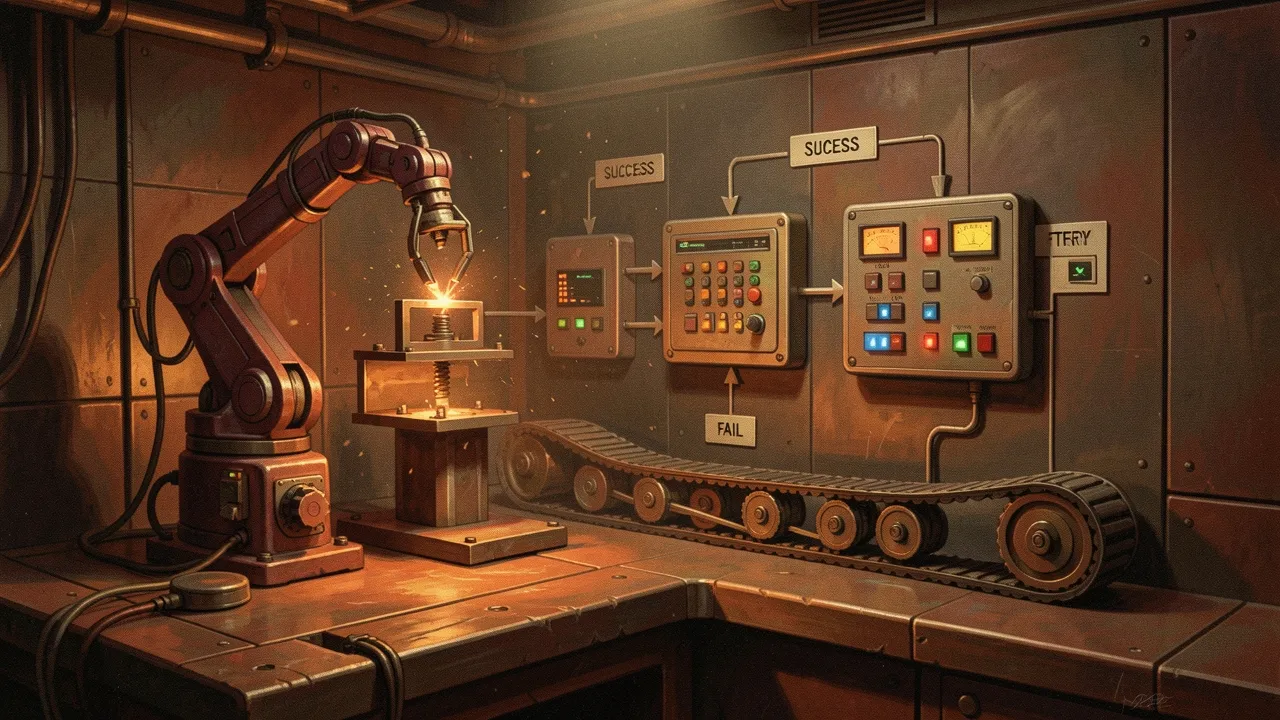
The structure is simple: goal → attempt → observe → classify → continue/recover/stop.
The goal is defined upfront - not vague intent, but a measurable outcome. "Deploy the service" is not a goal. "The service is running, returns 200 on /health, and passes the integration test suite" is a goal.
The attempt is the model generating a plan and executing the first action. This is where most systems stop. The model outputs code, or a command, or an API call. Then nothing.
The observe step is what separates agents from chatbots. Did the action succeed? Not "did the model say it succeeded" - did it actually succeed. Did the file get written? Did the API return the expected response? Did the test pass?
This requires instrumentation. The system must be able to check reality, not just parse the model's output. If you can't programmatically verify the result, you don't have an agent - you have a script that hopes for the best.
The classify step decides what happens next based on what was observed. If the action succeeded, continue to the next step. If it failed in a recoverable way, adjust and retry. If it failed in a way that makes the goal unreachable, stop and report the failure.
This classification can't be done by the model alone. The model will hallucinate success. It will interpret error messages as warnings. It will confidently state that a 404 means the deployment worked.
Classification requires a harness - logic outside the model that understands what success and failure actually look like for this specific task.
Why Models Aren't Agents
The model is not the agent. The model is a component.
A good model generates plausible next actions. It writes code that mostly compiles. It suggests API calls that might work. It produces text that sounds like progress.
But the model has no idea whether the code it wrote actually ran. It doesn't know if the API call succeeded or timed out. It can't tell the difference between a task that completed and a task that failed silently.
The model's job is generation. The harness's job is verification and control.
Most agent frameworks get this backwards. They treat the model as the agent and the harness as scaffolding. The result is systems that sound agentic - the logs read well - but don't reliably complete work.
What Successful Agent Harnesses Do
The best agent systems are built like this:
Tool execution is sandboxed and monitored. When the model calls a function, the harness runs it in a controlled environment, captures the output, and verifies the result. If the model tries to write a file, the harness checks that the file exists and contains what it should. If the model calls an API, the harness validates the response code and parses the returned data.
State is tracked explicitly. The harness maintains a record of what has been attempted, what succeeded, what failed, and what remains. This state is separate from the model's context. The model forgets. The harness remembers.
Recovery is handled programmatically. If a task fails, the harness decides whether to retry, adjust the approach, or escalate to a human. This decision is based on rules, not model output. The model can suggest recovery strategies, but the harness decides whether to execute them.
Success is defined as observable state change, not text output. The goal is not "the model says the task is complete". The goal is "the system is in the desired state, verified by measurement".
The Difference This Makes
An agent without a proper loop is a chatbot with tool access. It might get lucky. It might complete simple tasks. But it won't reliably handle multi-step workflows, recover from failures, or operate unsupervised.
An agent with a proper loop is a system that completes work. It attempts, observes, classifies, and adjusts. It fails gracefully. It knows when it's stuck and asks for help. It doesn't hallucinate success.
This isn't a subtle difference. It's the difference between a demo that impresses in a controlled environment and a system you'd trust to run in production.
What Builders Should Take From This
If you're building an agentic system, the model is the easy part. GPT-4, Claude, Gemini - they're all good enough for most tasks. The hard part is the harness.
Design your verification layer first. What does success actually look like for each task? How will you measure it? What can go wrong, and how will you detect it?
Then build the loop. Goal, attempt, observe, classify, continue or stop. Make observation reliable. Make classification explicit. Don't let the model decide whether it succeeded - measure it.
The agents that work aren't the ones with the best prompts. They're the ones with the best loops.