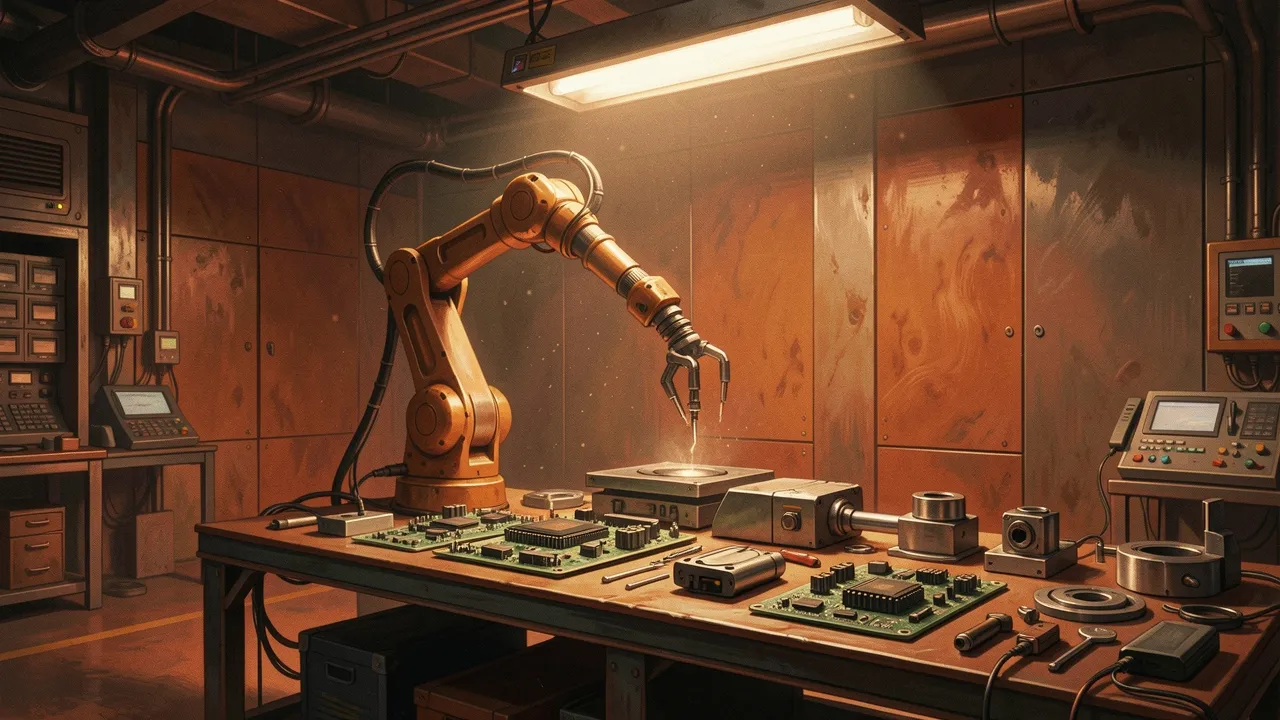
Flex - the contract manufacturer behind everything from Fitbits to automotive electronics - just turned itself into a living laboratory for physical AI. The company expanded its partnership with Teradyne Robotics this week, deploying cobots and autonomous mobile robots across its global manufacturing network. But here's the twist: Flex isn't just buying robots. It's building core components for them AND running them in production at scale.
This matters because most robotics deployments are science experiments. A warehouse trial here, a pilot programme there. Flex operates 100+ facilities across 30 countries. When they scale automation, they're stress-testing it against the messiness of real manufacturing - SKU changes, supply chain chaos, line reconfigurations, the stuff that breaks elegant demos.
The Feedback Loop Nobody Else Has
What stood out to me isn't the deployment itself. It's the closed loop. Flex manufactures components for Teradyne's robots, then deploys those same robots on its own production lines, then feeds operational data back to Teradyne for the next design iteration. That's not a partnership - it's a development cycle with a built-in reality check.
Most robotics companies design in isolation, ship to customers, then wait months for feedback through support tickets and sales calls. Flex gets daily signals from their own operations. A cobot that struggles with a specific pick-and-place motion? They see it immediately. An AMR navigation issue in high-traffic zones? It's their problem to solve, which means it becomes Teradyne's problem to fix.
Physical AI Meets Production Physics
The phrase "physical AI" is doing a lot of work in the announcement. What it means in practice: robots that adapt to changing conditions without reprogramming. A cobot that learns the optimal grip pressure for different materials. An AMR that reroutes itself when a forklift blocks its usual path. Machine learning models running locally on the robot, making decisions in milliseconds.
The challenge with physical AI isn't the algorithms - it's the environments. A lab robot trained on perfect lighting and consistent object placement falls apart when you drop it into a factory with flickering fluorescents, oil-stained floors, and workers moving unpredictably. Flex's facilities are the anti-lab. If a robot works there, it works.
What This Means for Everyone Else
The implications ripple outward. Flex isn't keeping these deployments internal - they're learning what works at scale, then offering that knowledge as a service to other manufacturers. Companies that can't afford to stumble through robotics pilots themselves can lean on patterns Flex has already validated across dozens of facilities.
For Teradyne, this is product development with training wheels off. Every robot they ship to Flex gets battle-tested in production before the design locks. That compresses iteration cycles from quarters to weeks. The cobots and AMRs coming out of this partnership won't just be better in theory - they'll be proven in conditions most robotics companies never see until after the sale.
The broader pattern: robotics is moving from isolated deployments to networked systems where operational data flows back to design teams in near real-time. Flex and Teradyne aren't the only ones building this loop, but they're doing it at a scale that matters. When you're running robots across 100 facilities, edge cases become common cases. The problems you solve aren't hypothetical - they're the ones blocking production right now.
Physical AI stops being a research curiosity when it has to keep a production line moving. That's the filter Flex just applied to Teradyne's entire product roadmap. The robots that survive it will be the ones that work everywhere else.