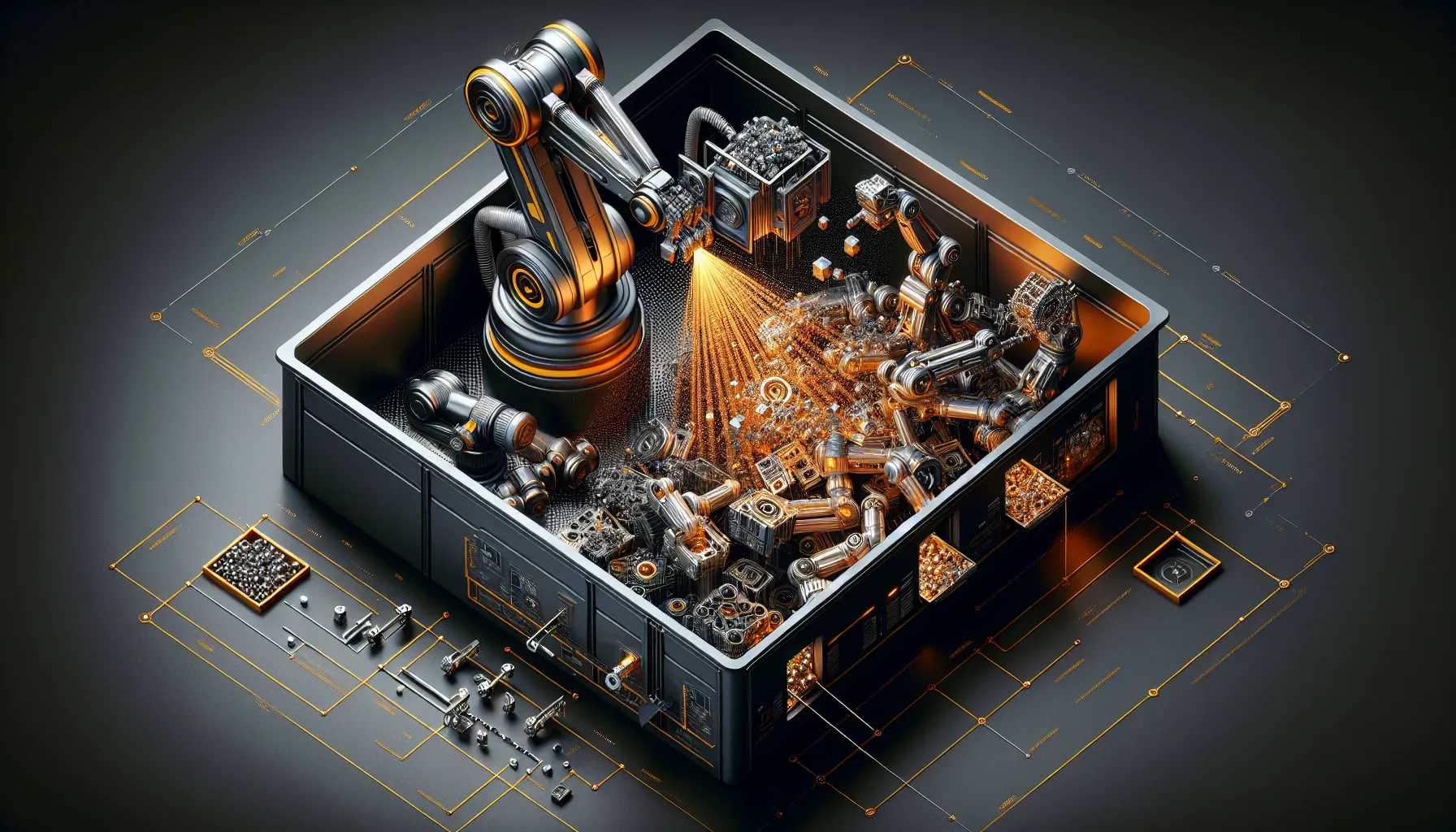
Vention just solved one of manufacturing's oldest frustrations. At GTC 2026, they released Rapid Operator AI - a system that can reach into a deep bin of randomly scattered parts and pick them out, one by one, without error. This sounds simple. It isn't.
Traditional vision systems fail at this task repeatedly. The problem isn't seeing the parts - it's understanding their position in three-dimensional space when they're piled on top of each other, some upright, some sideways, some obscured. Add transparent or translucent materials, variable lighting, and container depth, and the task becomes genuinely hard.
Why This Matters Now
Manufacturing floors are full of bins. Parts arrive in bulk containers, get stored in totes, move between stations in crates. Human workers reach in, identify what they need, grasp it, and move on. Robots have struggled with this for decades.
Previous attempts relied on structured lighting, calibrated cameras, or pre-sorted containers. They worked in lab conditions. On factory floors, with real mess and real variation, they failed. Workers went back to doing it manually.
Vention's approach combines AI perception with motion planning. The system doesn't just see the parts - it understands how to reach them. It plans the grasp, accounts for obstacles, adjusts in real time. It works across opaque, translucent, and transparent materials. It handles any lighting condition. That versatility is what makes it production-ready.
The Economics of Automation
Vention is targeting a two-year payback period. For manufacturers, that number matters more than technical specifications. A system that costs £100,000 but saves £50,000 annually in labour gets approved. One that costs the same but takes five years to break even sits in a proposal document forever.
The interesting question isn't whether this works - Vention has demonstrated that. It's how fast adoption happens once the economics make sense. Manufacturers move cautiously. They pilot, they test, they wait for others to go first. But once ROI is proven, deployment accelerates.
This is also a case study in AI solving problems that pure vision systems couldn't. The leap wasn't better cameras or faster processors. It was perception plus planning - understanding the scene AND knowing how to act within it. That combination is what makes difficult manipulation tasks suddenly tractable.
What Happens Next
If Rapid Operator AI works as described, it removes a bottleneck. Parts that previously required manual handling can now flow through automated lines. That changes throughput calculations. It changes hiring decisions. It changes which products are economically viable to manufacture domestically versus offshore.
The broader pattern here is specificity. This isn't a general-purpose robot trying to do everything. It's a focused solution to one hard problem. That focus is what makes it shippable. General-purpose manipulation is still years away. Narrow solutions to specific high-value tasks are happening now.
For manufacturers running dual shifts with workers standing at bins all day, this is the kind of automation that actually pencils out. Not replacing people for the sake of it - replacing a repetitive task that nobody enjoys, freeing capacity for more complex work.
Source: The Robot Report