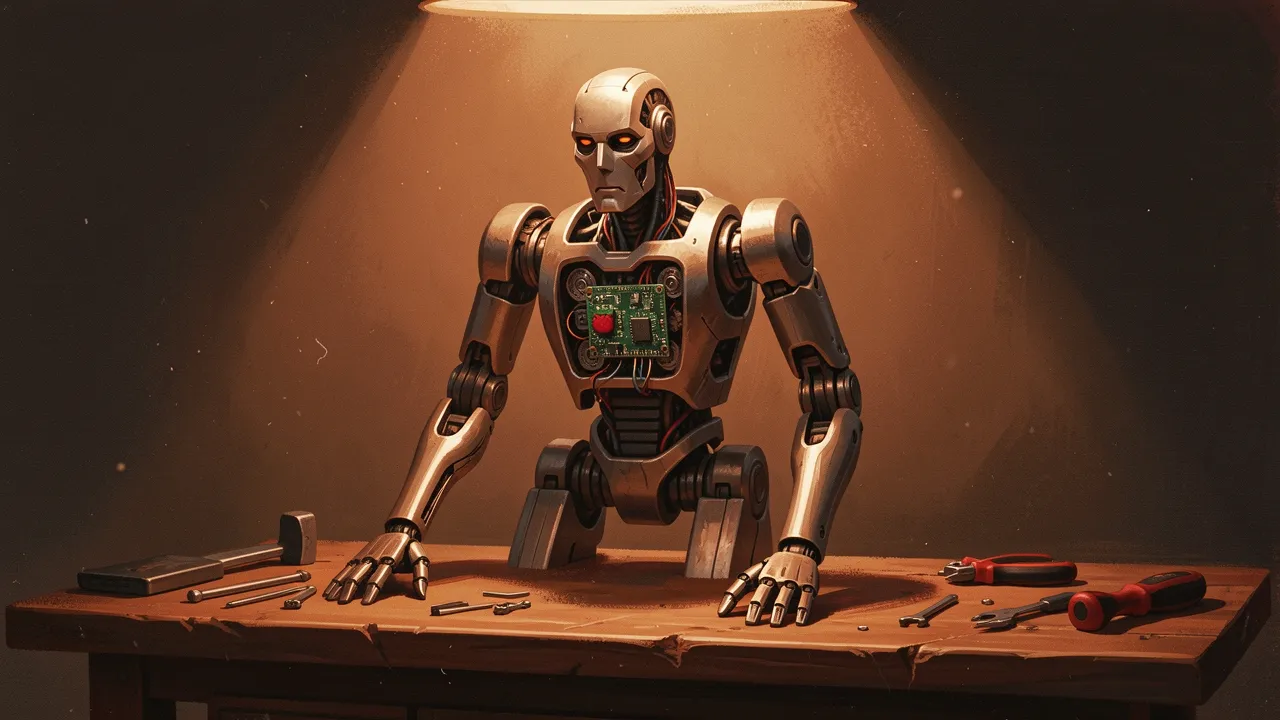
A humanoid robot showed up on GitHub last week with a complete Bill of Materials, assembly instructions, and $15,000 price tag. No venture capital. No press release promising to revolutionise manufacturing. Just an open-source build called Asimov that anyone with a workshop and patience can actually make.
This matters because robotics has lived in two worlds for too long. Corporate labs build million-dollar machines that demo beautifully but never ship. Hobbyists build clever rigs that work once. The middle ground - practical, affordable, reproducible - barely existed. Asimov sits in that gap.
What Makes This Different
Twenty-five degrees of freedom. Compute running on a Raspberry Pi. Every component listed on GitHub with part numbers and supplier links. The designer didn't hide the hard bits or gloss over what doesn't work yet. The repository includes failure logs. That's rare enough to be worth noting.
For context, Boston Dynamics robots cost more than a house and require support contracts. Research-grade humanoids run six figures minimum. Asimov costs what a decent used car costs. The difference isn't just price - it's who gets to learn by building.
The Raspberry Pi detail is quietly significant. High-end robotics runs on custom compute or industrial controllers that cost thousands. Using off-the-shelf consumer hardware means the software stack is accessible too. Python libraries, standard Linux tools, nothing proprietary. If you've built a home automation project, you've used this hardware. The gap between hobby electronics and humanoid robotics just got smaller.
Open Source Changes the Incentive Structure
When a company builds a robot, they protect the architecture. Trade secrets, patents, competitive advantage. When someone open-sources a build, they're inviting improvement. Asimov's GitHub already has contributors proposing actuator swaps and sensor upgrades. That feedback loop - build, share, iterate - is how homebrew computers became an industry in the 1970s. It's how 3D printing went from $50,000 machines to $200 printers in a decade.
Robotics hasn't had that moment yet. Corporate secrecy and high capital requirements kept the field narrow. A $15,000 open-source humanoid with full documentation changes the maths. University labs can afford it. Makerspaces can build one. Developers who've never touched hardware can learn from the repository and start modifying.
The Bill of Materials lists motors, sensors, structural components, electronics - everything down to screws. That transparency matters because it means someone in Malaysia or Peru or Scotland can source locally and adapt. They're not locked into a single supplier or waiting for a company to maybe ship to their region eventually. The design is theirs to own.
What It Means for Builders
For developers who've been watching AI capabilities grow but felt locked out of robotics, this is the entry point. You don't need a PhD in mechanical engineering or a venture-backed lab. You need the BOM, some fabrication access, and time to assemble and debug. The learning curve is real, but the path is documented.
The practical applications aren't obvious yet and that's fine. Early computers didn't have killer apps either. What matters is that hundreds or thousands of people can now build, experiment, and share improvements. Some will teach in universities. Some will mod for art projects. Some will solve specific industrial tasks. The velocity of learning just increased.
Asimov won't replace Boston Dynamics or Figure AI. It's not competing with corporate robotics - it's building the grassroots layer those companies never bothered with. The hobbyist scene, the maker community, the self-taught builders who turn side projects into real tools. That's where accessibility compounds into innovation.
The Bigger Pattern
This isn't the first open-source robot, but it might be the first practical one at this capability level and price point. Earlier projects were either too simple to be useful or too complex to reproduce. Asimov balances capability with buildability. That's design work, not just engineering.
If this gains traction - if a community forms around it, if universities adopt it as a teaching platform, if builders start shipping modifications back upstream - then robotics just got a proper open-source movement. And that changes the field faster than any single company can.
The GitHub repository is live. The BOM is public. Someone's going to improve it this month. That's how you know something real is starting.