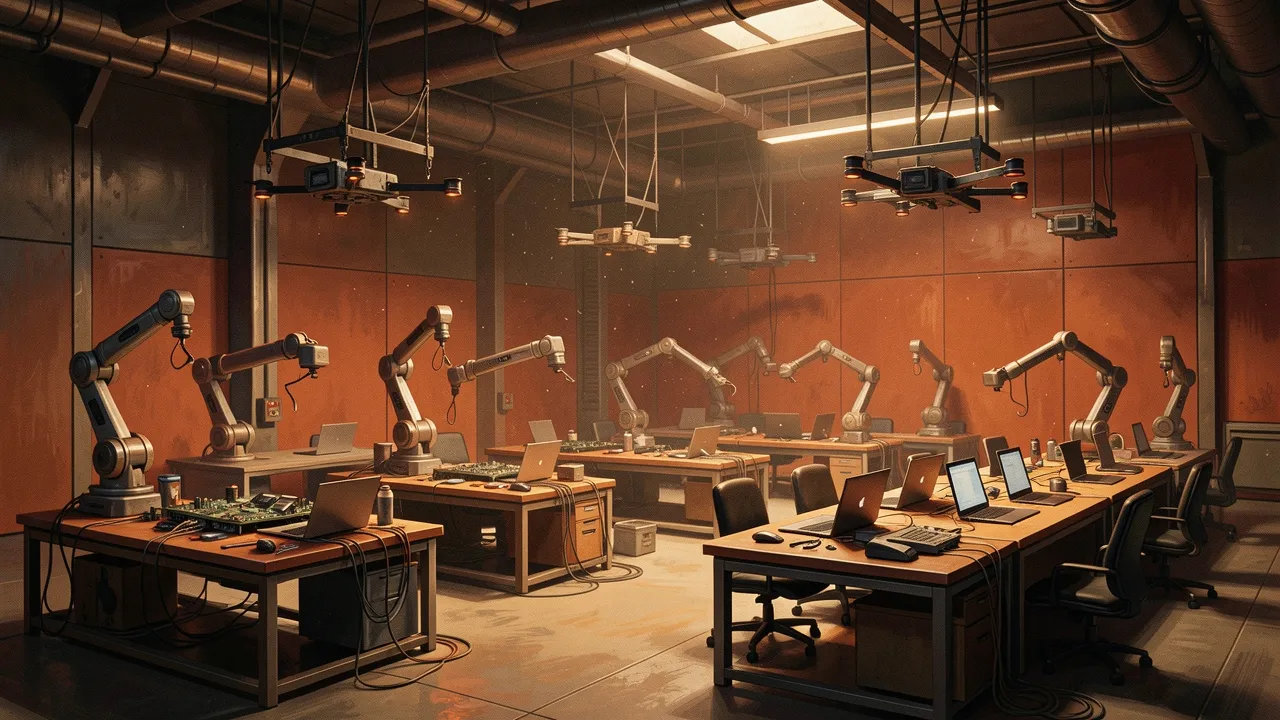
Registration opened this week for ROSCon Global 2026 in Toronto. Early bird pricing runs until July 12th. The conference has expanded to three days with ten hands-on workshops covering simulation pipelines, manipulation skills, aerial robotics, navigation, and ROS 2 middleware optimisation.
For anyone building with ROS - the Robot Operating System that powers everything from warehouse robots to research drones - this is the annual gathering. It's where the core maintainers, industrial users, and academic researchers converge to share what's working and what isn't.
What's New This Year
The expansion to three days is the headline change. Previous years ran two days with workshops tacked on before or after. This year integrates them properly - ten workshop tracks running parallel to the main conference sessions.
The workshop lineup tells you where the focus has shifted. Simulation pipelines get a dedicated track - because testing robot behaviour in the real world is slow and expensive. Digital twins and physics engines have become critical infrastructure for anyone deploying robots at scale.
Manipulation skills - teaching robots to pick, place, grasp, and handle objects - gets its own workshop. This is harder than it sounds. A human toddler learns object permanence and hand-eye coordination through thousands of hours of play. Robots need explicit training for every object category, every grip angle, every surface type. The workshop will likely cover learning-based approaches, where robots improve through repetition rather than hand-coded rules.
Aerial robotics has a track, which reflects the growing maturity of drone platforms. These aren't hobbyist quadcopters - they're industrial inspection systems, agricultural survey platforms, and autonomous delivery vehicles. ROS 2 has become the de facto standard for commercial drone development, largely because it handles communication between distributed systems reliably.
Navigation gets attention too. For mobile robots - whether ground-based warehouse bots or delivery rovers - getting from A to B without hitting things is the foundational problem. The workshop will cover SLAM (Simultaneous Localisation and Mapping), path planning, and obstacle avoidance. These are solved problems in controlled environments. They're still actively researched problems in dynamic, unpredictable spaces.
ROS 2 middleware optimisation rounds out the workshops. This is the plumbing - how messages move between nodes, how data serialises, how latency is minimised. Not glamorous, but critical. A poorly tuned middleware layer can bottleneck an entire robot system.
Why Toronto, Why Now
Toronto is a strong robotics hub - academic centres like the University of Toronto and Vector Institute, plus industrial players in autonomous vehicles and logistics automation. Hosting ROSCon there puts the conference in proximity to real deployment environments.
The timing matters too. We're at an inflection point where robots are moving from research labs into production environments. Warehouses, factories, hospitals, and farms are deploying robot systems at scale. That shift changes what people need from ROS. It's no longer just a research tool - it's production infrastructure. The reliability, security, and performance requirements have jumped several levels.
The Robotics Reality Check
Conferences like this surface the gap between robotics hype and robotics reality. The public-facing narrative is always about humanoid robots and general-purpose AI. The actual work is about making a robotic arm pick up a specific part 10,000 times without dropping it. It's about keeping a fleet of delivery bots running in rain, snow, and urban traffic. It's about reducing the time it takes to retrain a system when you change warehouse layouts.
That's not less interesting - it's more honest. The problems being solved at ROSCon are the problems that actually ship. They're the constraints that determine whether a robot business succeeds or fails.
For developers, this is where you learn what works. Not from vendor demos or research papers, but from people who've deployed systems in the real world and hit every edge case. The hallway conversations at these events are worth more than the talks - you find out which sensors are reliable, which middleware configs cause problems, which simulation tools produce results that transfer to hardware.
Who This Matters For
If you're building anything with ROS - whether that's a research prototype or a commercial product - this conference is the forcing function. It's where you find out if your approach is standard practice or if you've reinvented something that already exists. It's where you discover the tools and libraries that save months of work.
For businesses evaluating robotics, ROSCon is a reality check. The workshops and technical sessions show you what's actually possible versus what's marketing. If someone's pitching you a robotics solution, send an engineer to ROSCon first. They'll come back knowing which questions to ask.
Early bird registration closes July 12th. If you're working in robotics and you're not going, you're learning everything three months late. That might not matter in research. It matters a great deal in production.
Full details and registration at ROS Discourse.