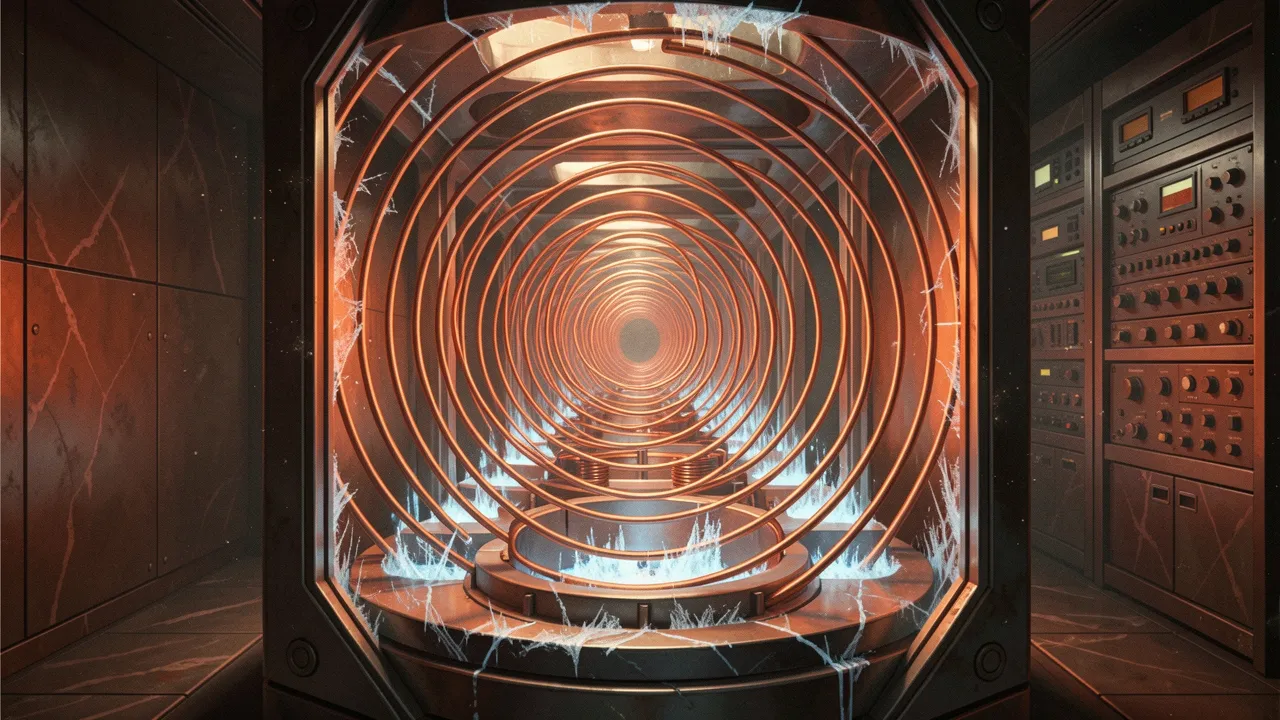
Researchers have discovered quantum states that don't exist under normal conditions. They only appear when you drive the magnetic field through time-varying patterns. And they might be more stable than the states we've been trying to use for quantum computing.
The study published this week shows that certain exotic phases of matter emerge only when magnetic fields change over time in specific ways. Under static fields - the kind we normally use - these states simply aren't accessible. The system needs the field to be in motion to stabilise them.
Why This Matters for Quantum Computing
Quantum computers fail because qubits are fragile. Thermal noise, stray electromagnetic fields, even cosmic rays can knock a qubit out of its state. The entire field is a battle against decoherence - how do you keep quantum information intact long enough to do useful computation?
The promising bit here: some of these time-driven states appear to be more resistant to errors than static equivalents. The time variation itself seems to protect the quantum information. Instead of fighting to keep the system perfectly still, you might keep it stable by keeping it in controlled motion.
It's counterintuitive. We've spent decades trying to isolate qubits from any external influence. This research suggests the opposite approach might work better - drive the system with a carefully designed time-varying field, and the resulting state is inherently more robust.
The Physics Behind It
When a magnetic field varies over time, the quantum system doesn't just respond to the field's current value. It responds to the history of how the field changed. That creates phases of matter with properties that can't exist in equilibrium.
Think of it like stirring a cup of tea. A static spoon in the cup does nothing interesting. But stir it in the right pattern and you create a vortex with structure and stability that only exists because of the motion. Stop stirring and it collapses. These quantum states are similar - they need the field to keep moving to exist at all.
The researchers tested this by driving magnetic fields through specific time-dependent sequences and watching what quantum states emerged. Some of the states they found have no static equivalent. They're fundamentally creatures of time-variation.
What It Takes to Build This
Creating time-varying magnetic fields with the precision needed for quantum computing is not trivial. You need sub-nanosecond control, spatial uniformity, and the ability to sustain the pattern without introducing noise.
Current quantum computers already use precisely timed microwave pulses to manipulate qubits. This research suggests those pulses could do more than just flip qubit states - they could create entirely new computational substrates by driving the system through time-dependent field patterns.
The hardware challenge is real but not insurmountable. The bigger question is whether these time-driven states actually deliver on the error-resistance promise at scale. Lab demonstrations are one thing. A working qubit architecture is another.
The Longer View
This is one of those findings that shifts how people think about the problem. For years, the quantum computing community has focused on better materials, better isolation, better error correction codes. All approaches built on the assumption that static is stable.
If time-driven states prove useful, that assumption breaks. Suddenly the design space opens up. Instead of fighting to freeze the system in place, you design systems that are stable precisely because they're in controlled motion.
The researchers are clear this is early work. They've shown the states exist and measured some of their properties. Whether they're useful for computation - and whether they scale - is still an open question.
But the principle is sound. Time-varying fields unlock quantum states that static fields cannot reach. Some of those states look more robust than anything we've built so far. That's worth chasing.