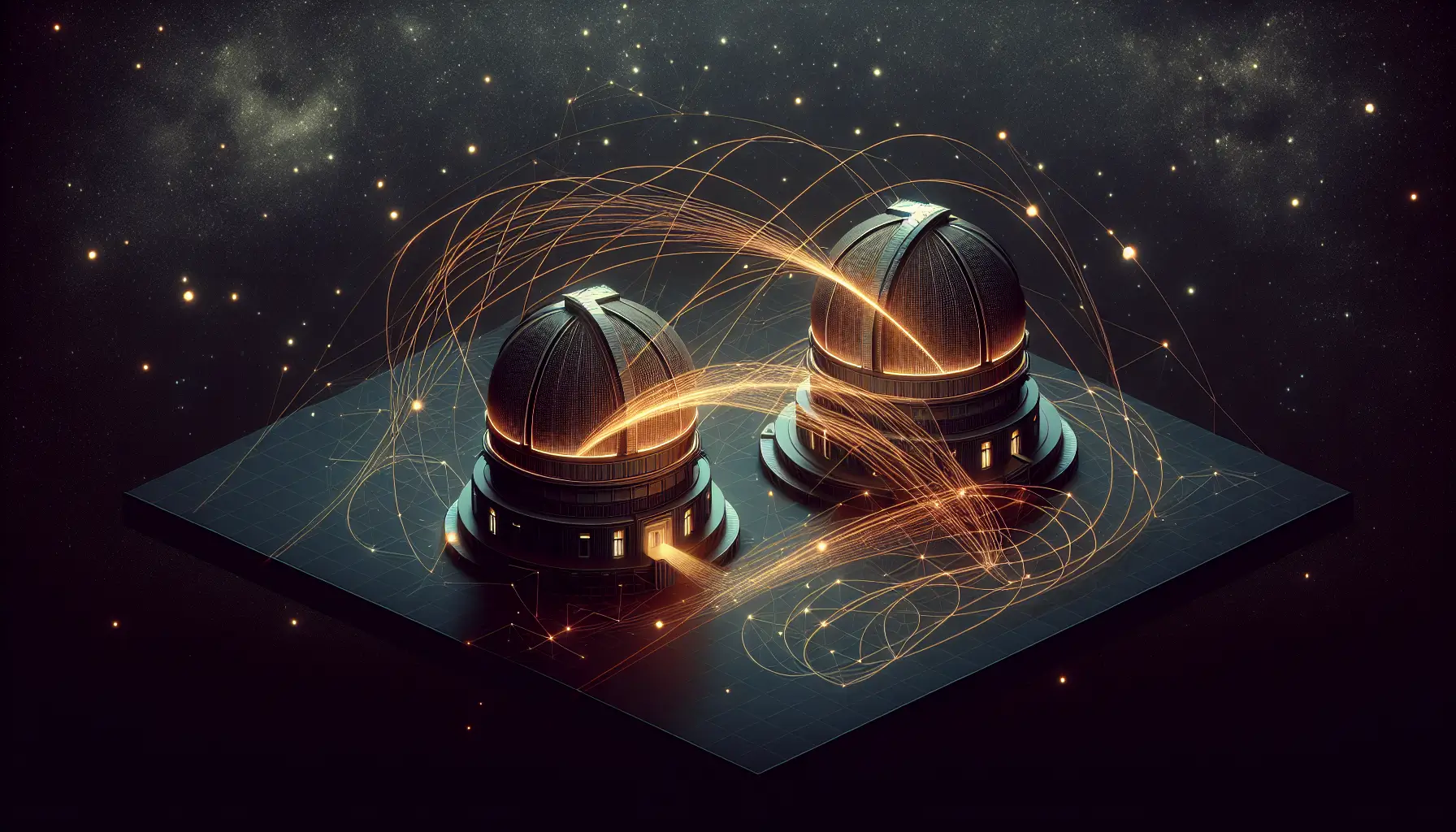
Astronomers have a resolution problem. No matter how large a telescope you build, there's a fundamental limit to how clearly you can see distant objects. The solution? Stop building single telescopes and start linking them together using quantum entanglement.
Researchers at Harvard have demonstrated a technique that uses quantum mechanics to detect single photons across separate telescope sites. The breakthrough could enable observations of celestial objects with a level of detail that's currently impossible.
Why Bigger Isn't Always Better
The resolution of a telescope depends on its aperture - the diameter of its main lens or mirror. Larger apertures collect more light and resolve finer details. But there's a practical limit to how big you can build a single telescope. The largest optical telescopes in the world have mirrors around 10 metres across, and engineering constraints make it difficult to go much larger.
The workaround is interferometry: linking multiple telescopes together so they act as one giant instrument. Radio astronomers have been doing this for decades. But optical interferometry - linking telescopes that observe visible light - is far more challenging. The wavelengths are shorter, the precision required is extreme, and atmospheric distortion makes it nearly impossible to maintain the coherence needed between sites.
Quantum entanglement offers a way around these problems. Instead of trying to combine light waves directly, the Harvard team detects single photons at each telescope site and uses quantum correlations to extract the interference pattern.
Single Photons Across 1.5 Kilometres
The experiment linked two detector stations separated by 1.5 kilometres of optical fibre. Photons arriving at each station were entangled - meaning their quantum states were correlated in ways that can't be explained by classical physics. By measuring these correlations, the researchers could reconstruct interference patterns that reveal details about the light source.
This is significant because it works with single photons - the faintest possible signals. For astronomy, that means you could observe incredibly distant or dim objects that would be invisible to conventional telescopes. And because the technique relies on quantum correlations rather than direct wave interference, it's less sensitive to atmospheric turbulence and other sources of noise.
What Could We See?
If this technique scales to longer baselines - linking telescopes across continents or even in space - the resolution would be extraordinary. We're talking about the ability to image the surfaces of exoplanets, resolve the structure of black hole accretion disks, or study stellar formation in neighbouring galaxies with unprecedented clarity.
The practical challenges are non-trivial. Quantum states are fragile, and maintaining entanglement over long distances requires extremely precise timing and low-noise detectors. But the Harvard demonstration proves the concept works. The question now is engineering: how do you build a network of quantum-linked telescopes that can operate reliably under real-world conditions?
For astronomers, this represents a fundamentally new way to observe the universe. Not just a bigger telescope, but a different kind of telescope - one that uses the strange properties of quantum mechanics to see what was previously invisible.
The full research is detailed at Phys.org, including technical specifications of the entanglement detection setup and potential applications for future observatories.