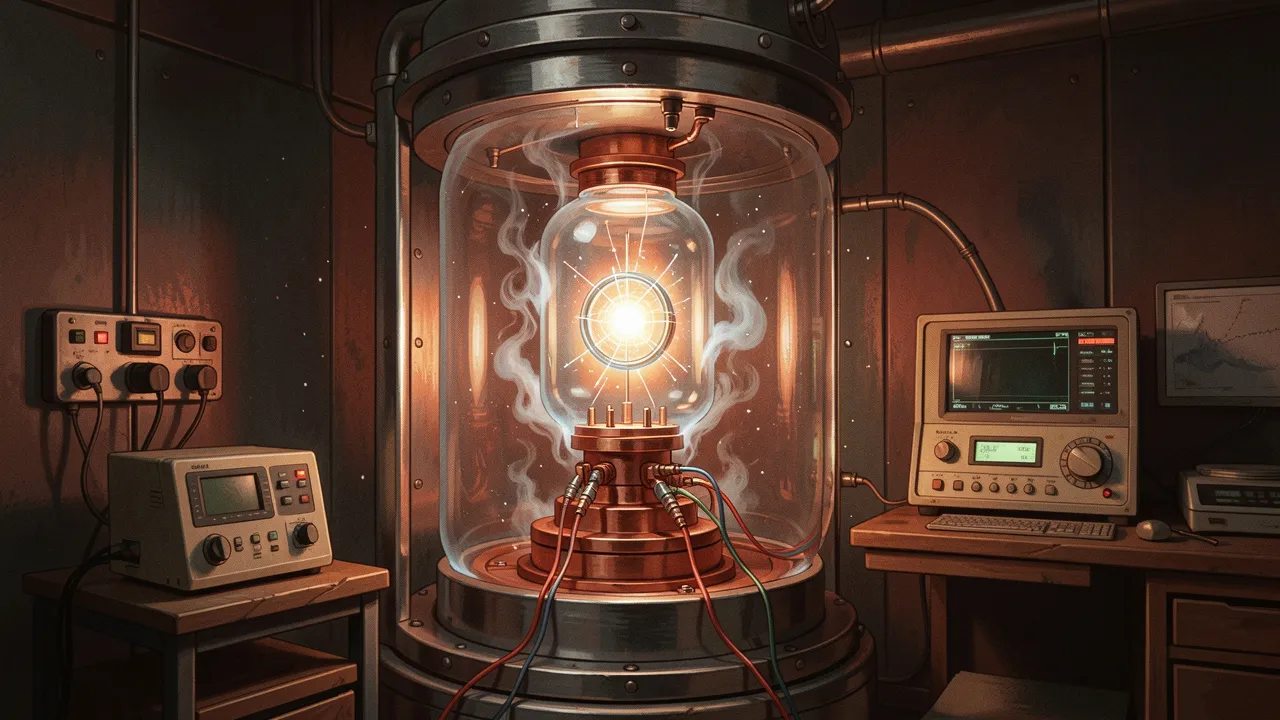
At temperatures close to absolute zero, McGill University researchers built a device that turns electricity into phonons - quantum particles that behave like sound. Not metaphorically. These are actual quantised vibrations moving through matter, and the team can now generate them on demand.
This isn't a curiosity. Phonons could do for sound what lasers did for light: create coherent, controllable beams with applications nobody's fully mapped yet. Medical diagnostics. Secure communications. Quantum computing interfaces. The list is speculative because the physics just became possible.
What Are Phonons and Why Do They Matter?
Phonons are to sound what photons are to light. They're discrete packets of vibrational energy moving through a material. In everyday terms, sound is a wave. At the quantum level, it's these individual particles bouncing through a lattice of atoms.
The challenge has always been control. Light is easy to manipulate - we've had lasers for decades. But sound at the quantum level is messy. It dissipates quickly. It's hard to isolate. You can't just point it in a direction and expect it to stay coherent.
McGill's breakthrough is a device that generates phonons in a controlled way at ultracold temperatures, where quantum effects dominate and noise disappears. This is the first step toward a phonon laser - what researchers call a "saser". It sounds like science fiction, but the device exists and works.
The Ultracold Requirement
Ultracold means close to absolute zero - temperatures where atoms barely move and quantum mechanics takes over completely. At room temperature, thermal noise would drown out any attempt to generate clean phonons. Everything vibrates. Everything interferes. The signal gets lost.
Cool the system down far enough, and those vibrations stop. The lattice becomes quiet. Now you can inject energy precisely and watch phonons form, move, and interact without chaos overwhelming the experiment. It's the same reason quantum computers need extreme cooling - you need silence to hear the signal.
The device itself converts electrical energy into these quantised vibrations. Feed it electricity, get phonons out. The mechanism is elegant: the electrical input excites the material's atomic lattice in just the right way to create discrete vibrational packets instead of a messy wave.
Where This Could Actually Go
The researchers point to communications first. Phonons can carry information through materials in ways electromagnetic waves can't. Think about transmitting data through solid structures - buildings, bridges, underground installations - without needing line-of-sight or radio spectrum. Sound-based quantum communication could work where light and radio fail.
Medical diagnostics is the other obvious target. Ultrasound already uses sound waves to image the body, but it's limited by resolution and noise. Coherent phonon beams could push that resolution far higher, detecting smaller anomalies earlier. A saser could do for medical imaging what lasers did for surgery - make the impossible routine.
Then there's quantum computing. Phonons can couple with other quantum systems - qubits, trapped ions, superconducting circuits. If you can generate and control phonons precisely, you have a new tool for moving quantum information around. That's not a small thing. Quantum systems are notoriously fragile, and finding new ways to manipulate them without destroying coherence is one of the field's biggest challenges.
The Practical Reality
Ultracold quantum devices don't scale easily. Keeping something at near-absolute zero is expensive, complex, and energy-intensive. This won't be in your phone. But it doesn't need to be. The applications here are specialised: research labs, hospitals, secure communications infrastructure. Places where the cost of extreme cooling is justified by what the device enables.
The McGill team isn't claiming a product. They're claiming a new capability: controlled generation of quantum sound particles. What gets built on that foundation is the next decade's problem. But the foundation is real, and it works.
For anyone watching quantum tech beyond the hype cycle, this is the kind of progress that matters. Not a flashy demo, not a press release about a theoretical breakthrough. A working device that generates something we couldn't generate before, opening a path we couldn't walk before. That's how new technologies actually start.