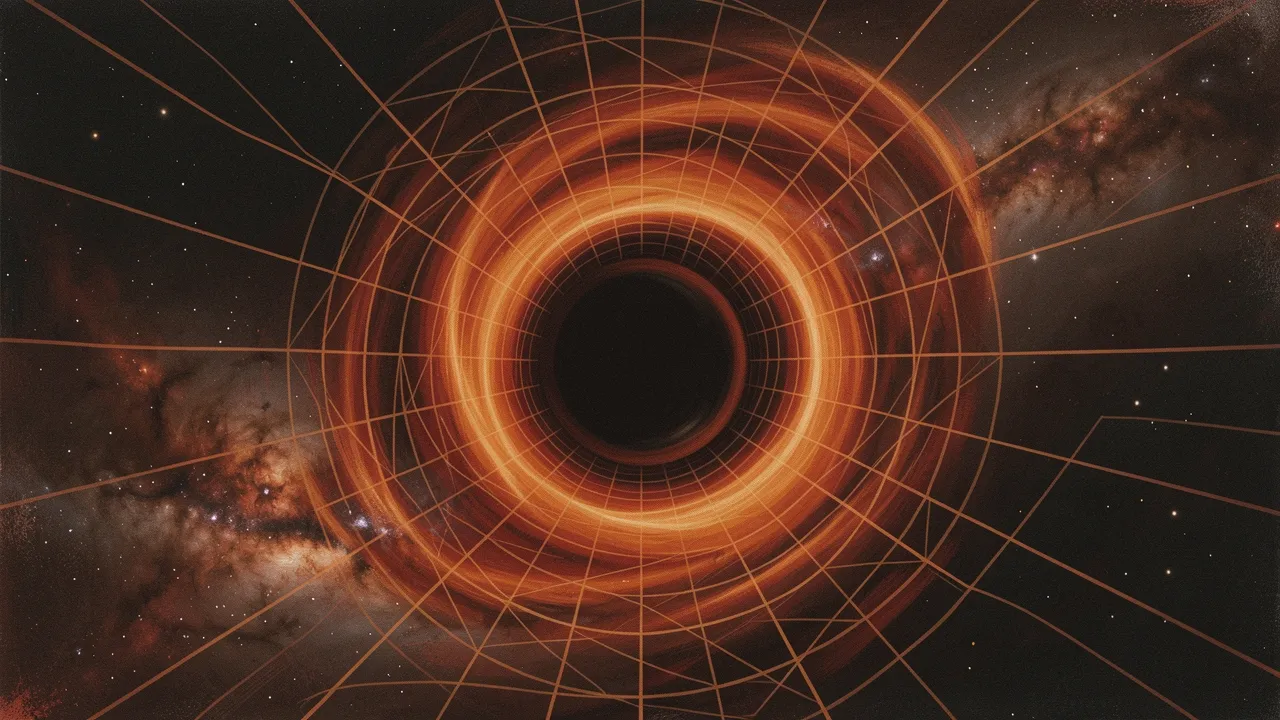
A new mathematical framework just made it easier to model what happens inside black holes. The tool is called the Klein-Gordon inverted harmonic oscillator, and it's not as obscure as it sounds.
Here's the setup: quantum fields behave differently under inverted potentials - imagine gravity pulling outward instead of inward. This happens near black hole horizons, during early-universe inflation, and in certain phase transitions. The maths gets messy fast. Symplectic transformations clean it up.
What Symplectic Transformations Actually Do
Standard quantum oscillators are well-understood. You have a particle in a potential well, it oscillates, the maths is textbook. Invert the potential - flip the well upside down - and the particle wants to escape to infinity. The equations stop behaving.
Symplectic transformations are a coordinate change that preserves structure. Think of it like rotating a Rubik's cube - the relationships between pieces stay intact even as positions shift. Applied to inverted oscillators, these transformations convert unstable, diverging equations into stable, solvable ones.
The research paper uses this approach to derive closed-form partition functions - essentially, a complete statistical description of how quantum fields behave under inverted potentials. That wasn't possible before without approximations.
Why Black Holes Need This
Black hole interiors are inverted potential zones. Time and space swap roles past the event horizon, and quantum fields experience runaway instabilities. Traditional models rely on numerical simulation because the exact solutions are intractable.
With closed-form partition functions, physicists can now calculate entanglement entropy - a measure of quantum information scrambling - directly. This matters for understanding what happens to information that falls into a black hole, one of the core puzzles in theoretical physics.
The framework also applies to cosmology. Early-universe inflation involves inverted potentials driving exponential expansion. The same symplectic methods that work for black holes work here, giving clearer predictions for observable signatures in the cosmic microwave background.
Phase Transitions and Real-World Materials
The most immediate application isn't cosmology - it's condensed matter physics. Certain materials undergo phase transitions where effective potentials invert. Superconductors, quantum magnets, and topological insulators all exhibit this behaviour.
Engineers designing quantum computers face inverted-potential problems when qubits decohere. The new framework provides analytic tools to predict decoherence rates without running expensive simulations. That speeds up qubit design iteration.
The partition functions also connect to thermodynamics. Knowing the partition function means knowing the system's entropy, free energy, and heat capacity - all calculable in closed form now, instead of estimated.
What Makes This Different
Previous approaches to inverted oscillators relied on approximations - perturbation theory, semiclassical limits, or brute-force numerics. Each method works in specific regimes but breaks down elsewhere.
Symplectic transformations are exact. They don't approximate - they reframe. The equations become solvable without losing information. That's rare in quantum field theory, where exact solutions are precious.
The method is also generalizable. It works for scalar fields, spinor fields, and gauge fields. Black holes, cosmology, and materials science all use the same underlying technique. That kind of unification is what physicists look for - one tool with wide reach.
What Happens Next
Expect to see this framework applied to gravitational wave data. Black hole mergers produce gravitational waves carrying information about the interior dynamics. With better models for inverted-potential field behaviour, physicists can extract more signal from existing LIGO and Virgo data.
Quantum computing researchers will adopt it for decoherence modelling. The faster you can predict qubit instability, the faster you can design around it. Closed-form solutions beat simulations for iteration speed.
And cosmologists will use it to refine inflation models. The observable universe still carries signatures from the first fractions of a second after the Big Bang. Better maths means better predictions, which means better tests when next-generation telescopes come online.
The Bigger Picture
This is what progress in theoretical physics looks like - not a dramatic breakthrough, but a sharper tool that makes existing problems tractable. The questions stay the same: what happens inside black holes, how did the universe begin, why do materials behave the way they do?
But now the maths cooperates. That matters more than it sounds.