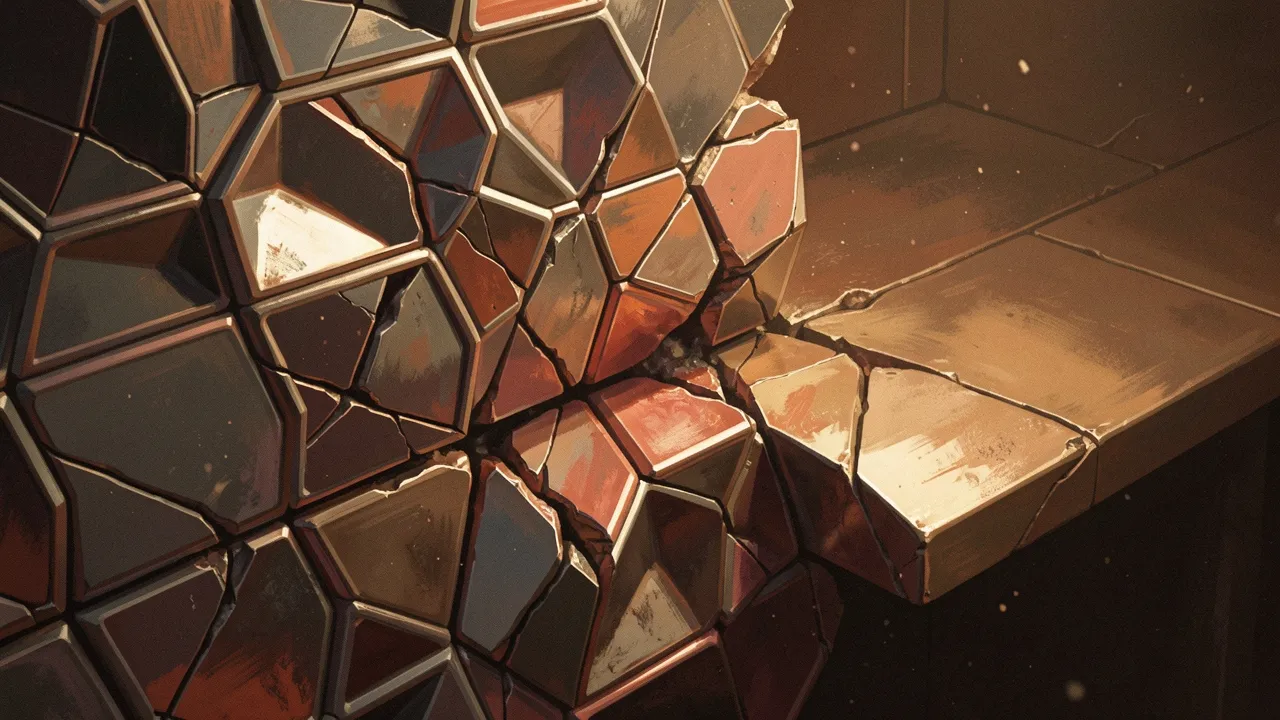
Electrons aren't supposed to behave like this. Inside certain metals, they stop acting like individual particles and start forming patterns - crystal-like structures that can deform under stress and melt when conditions shift. University of Michigan researchers watched this happen and realised they were seeing something analogous to a solid melting into a liquid, except the "solid" was made of electrons.
This isn't a metaphor. The electron patterns - called charge density waves - have structure. They respond to pressure by deforming, just like a crystalline lattice would. Apply enough force and the pattern collapses into a disordered state, the electronic equivalent of melting.
What makes this useful is where it breaks down. At the boundary between ordered and disordered states, the material becomes extraordinarily sensitive to small changes. That sensitivity is what makes neuromorphic computing possible - systems that process information the way brains do, with gradual state changes rather than binary on-off switches.
Why Materials That Almost Break Are Interesting
Most computing happens in stable states. A transistor is on or off. A bit is one or zero. But brains don't work that way. Neurons exist in a continuum of activation, responding proportionally to input strength. Building hardware that mimics this requires materials that sit at the edge of stability - where a small input creates a large, graduated response.
Charge density waves near their melting point do exactly this. Push them slightly and the pattern shifts. Push harder and it collapses. The system has memory - not in the sense of storing data, but in the sense that its current state depends on its history. That's analog computing at the material level.
The Michigan team also found connections to superconductivity. In some materials, charge density waves and superconducting states compete. Understanding how the electron crystal deforms helps predict when superconductivity emerges. That's not just academic curiosity - higher-temperature superconductors would change energy transmission, medical imaging, and quantum computing overnight.
The Technical Bit That Matters
The researchers used X-ray scattering to watch the electron crystals in real time as they applied pressure. What they saw was a phase transition - a sharp change from ordered to disordered - but with a crucial twist. Near the transition point, the material showed plasticity. The electron crystal could deform without immediately collapsing, creating a zone where the material's properties changed gradually rather than abruptly.
In simpler terms: imagine ice that could bend before it shattered. That's what these electron patterns are doing. The bending region is where the interesting computing properties live.
This matters for chip design. Current neuromorphic systems use traditional materials pushed into nonlinear regimes - making silicon behave in ways it wasn't designed for. Materials with built-in plasticity at the electron level could do the same job more efficiently, with less energy and more control.
What Happens Next
The immediate challenge is engineering. Observing electron crystals in a lab is one thing. Building devices that exploit their properties at room temperature is another. Most charge density wave materials only show these effects at cryogenic temperatures. For neuromorphic chips, that's a non-starter.
But the principle is proven. Electrons can form structured patterns that deform and melt like solids. Those transitions can be controlled. And the materials that exhibit them have properties useful for computing that doesn't fit the binary mould.
The full study is published in Phys.org. It's dense, but the core idea is simple: matter at the quantum level has structure we're only beginning to exploit. When that structure starts to break, interesting things happen.
For anyone watching where computing goes next, this is one of the threads. Not faster transistors. Not bigger models. Materials that compute by being on the edge of collapse.