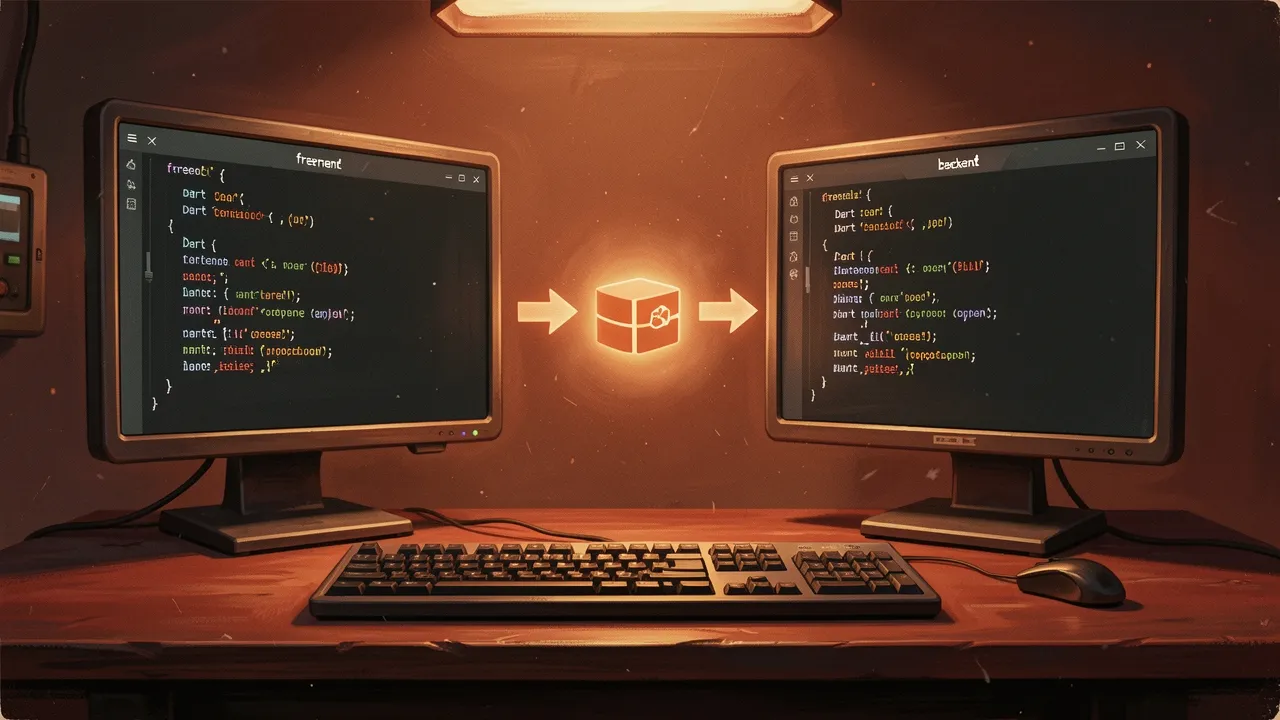
Most full-stack developers live in two codebases. One for the frontend. One for the backend. Same data models, different languages. Same validation logic, duplicated. Same business rules, written twice. It works, but it's inefficient and error-prone.
Dart just made that optional. With Cloud Functions now in experimental preview and the Firebase Admin SDK available for server-side Dart, you can write your entire stack - frontend, backend, and shared packages - in a single language. Same types. Same tooling. Same mental model.
The new handbook from freeCodeCamp walks through the whole pattern: building shared packages that both your Flutter app and your Cloud Functions import, eliminating duplicate model definitions, and handling the gaps where server and client logic genuinely need to diverge.
Why This Matters Now
Dart has been a strong frontend language since Flutter proved you could build production mobile apps with it. But the backend story was always awkward. You could run Dart on a server, but without mature tooling and library support, most teams just used Node or Python for backend work.
That meant two languages, two dependency managers, two sets of testing frameworks, and - most painfully - two versions of every data model. Change a field in your User model? Update it in TypeScript. Update it in Dart. Miss one, and you're debugging type mismatches at runtime.
Cloud Functions in Dart and the Admin SDK change that. Now your backend functions are written in the same language as your app. Your User model lives in a shared package. Both import it. Change it once, both sides get the update. Type safety flows from database to backend to frontend without manual translation layers.
The Shared Package Pattern
The core idea is simple: create a Dart package for shared code - data models, validation logic, utility functions - and import it in both your Flutter app and your Cloud Functions.
Your User model goes in the shared package. Your email validation regex goes in the shared package. Your business logic for calculating invoice totals goes in the shared package. Anything that needs to work the same way on both client and server lives there.
The beauty is type safety. When your Cloud Function receives a JSON payload, it deserialises to the same User class your Flutter app uses. The compiler enforces consistency. If you change a required field, both sides break at compile time, not in production.
This is the developer experience improvement that matters. Not faster code. Not smaller bundles. Fewer places where inconsistency can hide.
Where Server and Client Still Diverge
Not everything belongs in shared code. Some logic is fundamentally server-side. Database writes. Authentication checks. Payment processing. Email sending. These stay in your Cloud Functions because they require credentials or access that clients shouldn't have.
But even here, the shared package helps. Your Cloud Function imports the User model from the shared package, fetches data from Firestore, and returns a typed User object. Your Flutter app imports the same model and deserialises the response. No manual mapping. No field name mismatches.
The handbook covers testing strategies for this split. Shared package tests run in isolation and verify business logic. Cloud Function tests mock Firebase services and verify server-side behaviour. Flutter widget tests import the real shared package and verify UI behaviour. Each layer tests what it's responsible for, using the same models throughout.
Current Limitations
Cloud Functions for Dart is experimental. That means breaking changes are possible, production support is limited, and some Firebase features aren't available yet. The Admin SDK is more mature, but still catching up to the Node.js version in terms of feature coverage.
The biggest gap is cold start performance. Dart Cloud Functions spin up slower than Node equivalents, which matters for latency-sensitive endpoints. The team is working on it, but if you need sub-100ms cold starts, this isn't ready yet.
There's also the ecosystem question. Node has a massive library ecosystem for server-side work. Dart's is smaller. If your backend needs a niche library for PDF generation or video processing, you might not find a Dart version. That's not a showstopper - you can run multiple backend languages - but it's a trade-off.
Who This Benefits
This setup makes most sense for Flutter teams building apps with Firebase backends. If you're already using Firestore, Firebase Auth, and Cloud Storage, adding Dart Cloud Functions is a natural extension. The shared package pattern pays off immediately because you're already dealing with the model duplication problem.
For teams not on Firebase, the value is less clear. You can run Dart servers outside Firebase, but the tooling and deployment story is less polished. The handbook focuses on Firebase specifically because that's where the integration is strongest.
The other beneficiary is solo developers or small teams. Managing one language instead of two reduces cognitive load significantly. You're not context-switching between TypeScript and Dart. You're not maintaining two sets of dependencies. You write code, it runs everywhere, and the compiler keeps you honest.
What Comes Next
The experimental tag won't last forever. If adoption is strong and the performance issues get resolved, Cloud Functions for Dart will move to stable. At that point, the question for Flutter teams becomes: why wouldn't you use this?
The reduction in duplication alone justifies the switch. Add in better type safety, simpler testing, and one fewer language to manage, and the case gets stronger. The only reason to stick with Node or Python on the backend is if you need something those ecosystems provide that Dart doesn't.
For now, this is a solid option for greenfield projects and teams willing to work with experimental tooling. The handbook provides enough detail to get started and enough production patterns to deploy with confidence. Whether it becomes the default for Flutter apps depends on how fast the ecosystem matures.
But the loop is closed. Frontend, backend, shared models. One language. That's worth paying attention to.