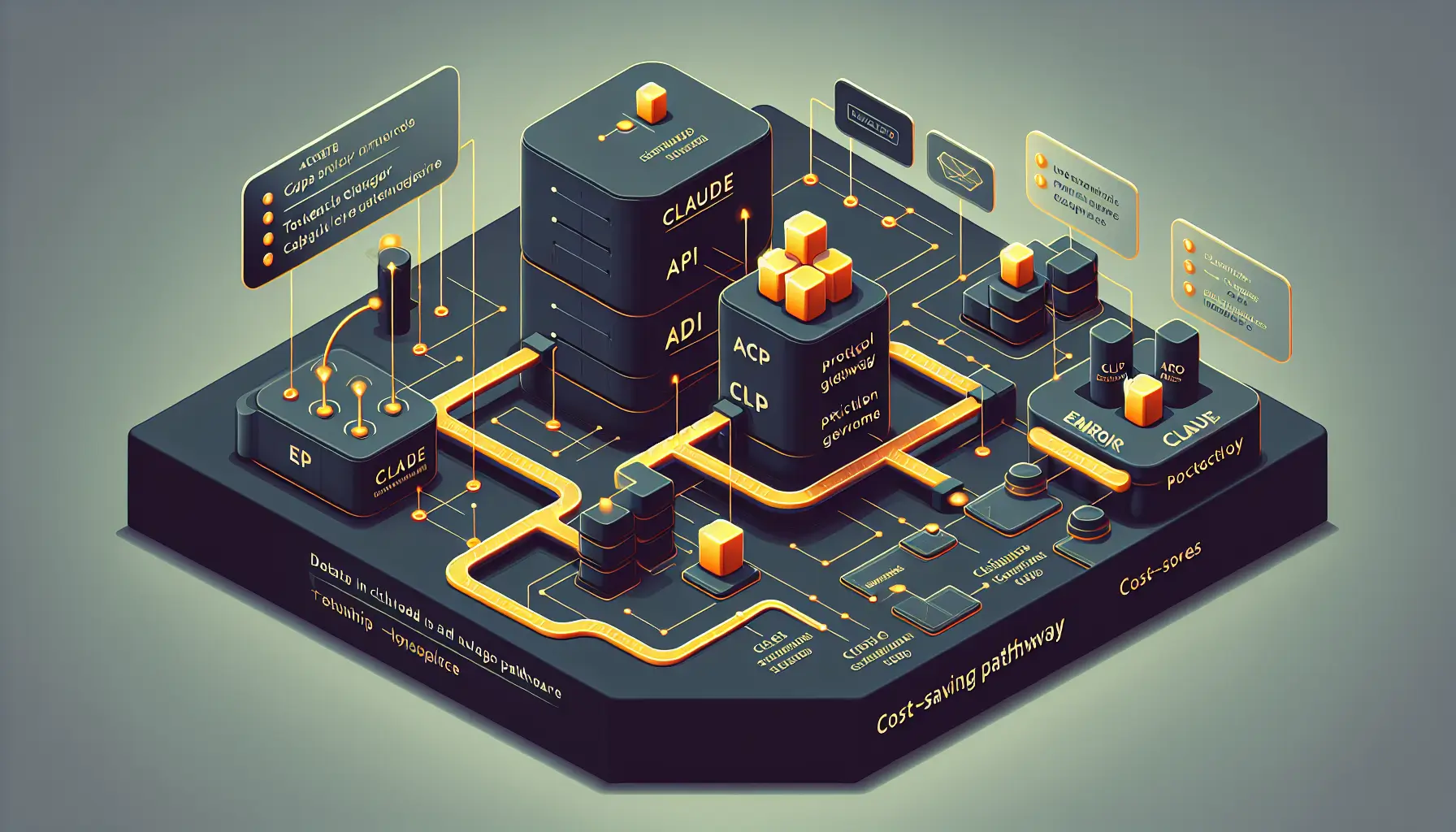
Running coding tasks through Claude API gets expensive fast. Every time your AI agent needs to write, test, or debug code, you're burning tokens. A new integration pattern cuts that cost by 60-80% for development workflows.
The trick: route coding tasks to Kiro CLI via Agent Communication Protocol, execute the code independently, return only results to Claude. You pay for Kiro execution separately, but the token savings on the API side are immediate.
The Token Cost Problem
Here's what happens in a typical Claude API workflow. Your agent decides it needs to write Python code. It generates the script (tokens), explains what it's doing (tokens), shows you the code (tokens), runs it, captures output (tokens), formats the results (tokens), explains those results (tokens).
Every step is billable API usage. And when you're iterating - fixing bugs, handling edge cases, refining logic - those costs multiply fast.
For agents doing significant development work, coding tasks can dominate token budgets. You're paying premium API rates for what's essentially code execution, which should be cheap.
What Agent Communication Protocol Does
ACP is a standardised way for AI agents to talk to external tools. Instead of Claude running everything internally, it sends structured messages to specialised services - code execution environments, database clients, API wrappers.
Kiro CLI is a coding agent optimised for execution. Give it a task, it writes code, runs it, tests it, returns results. It's built for this workflow, which means it's more efficient than general-purpose LLM agents at coding specifically.
The integration pattern is straightforward. Your Claude-based agent (via Openclaw or similar orchestration) recognises a coding task, formats it as an ACP message, sends it to Kiro, waits for results, continues with the broader workflow.
Claude never sees the intermediate code, execution logs, or iteration steps. It just gets the final output. Massive token reduction.
The Billing Model Shift
This introduces a two-tier cost structure. You're paying Claude API rates for orchestration, reasoning, and high-level planning. You're paying Kiro Credits for code execution. Kiro Credits are separate, typically cheaper for compute-heavy tasks than equivalent Claude API token usage.
The guide reports 60-80% reduction in Claude API costs for coding-heavy workflows. That tracks. If coding tasks were eating half your token budget, and you've now moved that off-API, you're immediately cutting costs by 30-40%. Add in the efficiency gains from Kiro's specialised execution model, and 60-80% becomes plausible.
There's a catch. You're now managing two billing systems. Kiro Credits need to be topped up separately. Budget planning gets slightly more complex. But for teams running serious development workflows through Claude, the savings justify the added complexity.
Production Setup Considerations
The Dev.to guide is production-focused, which is rare and useful. It covers error handling, timeout management, credential isolation, and logging. These aren't optional nice-to-haves. They're what separates a demo from something you can deploy.
Error handling is critical. When Kiro execution fails, your Claude agent needs clean error messages to decide next steps. Timeouts matter because code execution can hang. Credential isolation ensures Kiro doesn't access resources it shouldn't.
The logging setup is particularly smart. You want separate logs for Claude orchestration and Kiro execution. When debugging multi-agent workflows, being able to trace exactly what happened where is essential.
One thing the guide doesn't cover deeply: latency. Routing tasks to external services adds round-trip time. For workflows where speed matters more than cost, this trade-off might not work. For batch processing or workflows with natural wait times, it's fine.
When This Makes Sense
This pattern is for teams already using Claude API for agent orchestration who are hitting token budget limits on coding tasks. If you're not coding-heavy, the complexity isn't worth it. Use Claude natively.
If you're running agents that write scripts, process data, generate reports, or automate development workflows, this is immediately relevant. The token savings compound over time, and the independent billing model gives you better cost visibility.
Teams building internal tools on Claude should consider this early. It's easier to architect with ACP from the start than to retrofit it later when token costs become painful.
The ACP Ecosystem Angle
What makes this interesting beyond cost savings is the pattern. ACP enables specialisation. Instead of one LLM doing everything, you compose agents - Claude for reasoning, Kiro for coding, other tools for database access, API calls, file operations.
Each component does what it's good at. The orchestration layer (Claude) handles high-level planning and decision-making. Specialised tools handle execution. You get better performance and lower costs because you're not forcing a general-purpose LLM to be good at everything.
This is the direction agentic systems are heading. Not monolithic AI agents trying to do everything, but composed workflows where LLMs orchestrate and delegate to specialised services.
The Kiro integration is one example. Expect to see more ACP-compatible tools for specific domains - data analysis, API interactions, system administration, testing. The standardised protocol makes it feasible to build and integrate these without custom glue code for every combination.
Implementation Timeline
For teams with existing Claude API workflows, this is a week or two of integration work. The ACP setup, Kiro account creation, error handling, and testing. Not trivial, but not massive.
The guide provides working code examples, which helps. You're not starting from scratch. Adapt the patterns to your specific workflow, add your error handling requirements, deploy.
The payback period depends on your coding task volume. High-frequency coding workflows see ROI in weeks. Lower-frequency workflows might take months. Run the numbers based on your current Claude API usage before committing.
What's clear: for coding-heavy agentic workflows, the economics favour specialisation. Paying premium LLM API rates for code execution is inefficient. Route it to tools built for execution, save tokens for what LLMs actually excel at - reasoning, planning, and orchestration.