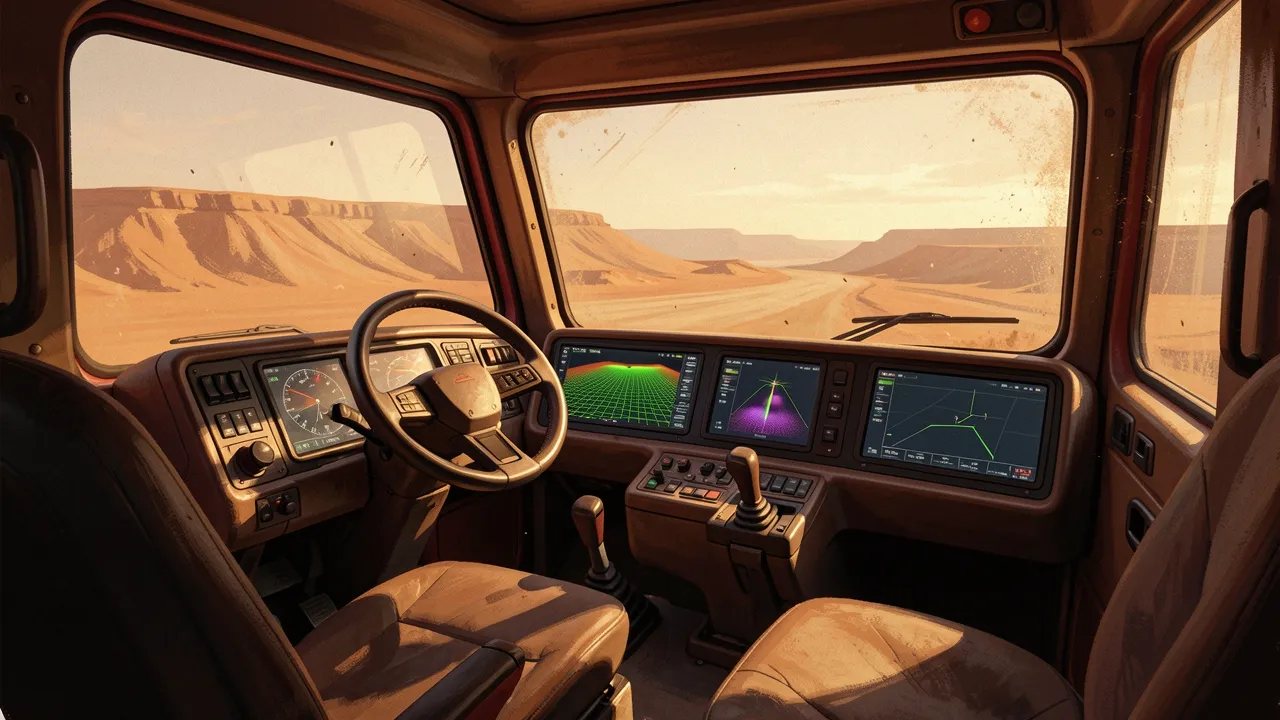
Applied Intuition started by building simulation tools for self-driving cars. Now they're building the operating system layer for every machine that moves autonomously - trucks, tractors, mining equipment, military vehicles.
Qasar Younis and Peter Ludwig, the company's founders, explained the shift in a recent Latent Space podcast. The core insight: autonomy isn't one problem. It's a shared infrastructure problem across industries, and the companies solving it are constrained by the same bottlenecks - simulation, validation, deployment at scale.
From Tooling to Operating Systems
Applied Intuition began as a simulation platform. Automotive companies needed a way to test autonomous systems without putting prototypes on public roads. Simulation let them run millions of test scenarios - edge cases, rare failures, dangerous conditions - in software before touching hardware.
But simulation alone doesn't ship a product. You still need sensor processing, motion planning, control systems, over-the-air updates, and monitoring infrastructure. Applied Intuition realised their customers needed all of it, and they were building the same stack over and over.
So they built the stack once. ADAS (Advanced Driver Assistance Systems), autonomy middleware, deployment tooling, and fleet management - the full operating system for autonomous machines. Companies can now license the platform and focus on their specific application rather than rebuilding the foundation.
Why Embedded Constraints Drive Innovation
One recurring theme in the conversation: the best ideas come from constraints. Self-driving cars have to work in real time, on limited compute, in environments where failure isn't acceptable. You can't throw more GPUs at the problem - the hardware is fixed, the power budget is fixed, and the latency requirements are brutal.
Ludwig pointed out that this forces better engineering. You can't brute-force a solution with a bigger model. You have to optimise. You have to understand the problem deeply enough to know what can be approximated and what can't. The constraint becomes the design principle.
This is why Applied Intuition's customers span automotive, agriculture, mining, and defense. The constraints are similar: real-time performance, safety criticality, deployment on hardware with limited compute. The applications differ, but the infrastructure is the same.
Statistical Validation Replaces Pass-Fail Testing
Traditional software testing is binary: a test passes or it fails. But autonomy doesn't work that way. A self-driving system might make a safe decision 99.9% of the time and a dangerous decision 0.1% of the time. That 0.1% matters - but you can't catch it with pass-fail tests.
Applied Intuition uses statistical validation. Instead of asking "did this system pass?", they ask "what is the probability of failure in this scenario class?" They run thousands of variations of a scenario - different lighting, different pedestrian behaviours, different road conditions - and measure the distribution of outcomes.
This shifts the conversation from "is it safe?" to "how safe is it, and where are the failure modes?" That's a more honest question. It doesn't guarantee safety, but it gives you a quantified understanding of risk.
Physical AI is Infrastructure, Not Magic
The phrase "physical AI" has become shorthand for robots, drones, and autonomous vehicles. But Younis and Ludwig pushed back on the idea that this is fundamentally different from other AI applications. It's not magic. It's infrastructure.
The hard part isn't the AI model - it's the integration. Sensors need calibration. Actuators need control loops. Systems need redundancy. Deployment needs to be reliable across fleets, not just one prototype. The AI is one component in a much larger system.
Applied Intuition's bet is that most companies don't want to build that system from scratch. They want to focus on their application - autonomous tractors for agriculture, or driverless trucks for logistics - and use a platform for the rest. That's why the operating system model works.
Automotive, Mining, Defense, Agriculture
Each industry has different requirements, but the problems overlap. Automotive needs high-speed perception and motion planning in dynamic environments. Mining needs reliable operation in GPS-denied zones with heavy machinery. Defense needs robustness in adversarial conditions. Agriculture needs seasonal adaptability and operation in unstructured terrain.
The common thread: all of them need simulation, validation, deployment infrastructure, and fleet management. Applied Intuition built one platform that adapts to all four.
This is the industrialisation of autonomy. Not one-off research projects, but repeatable systems that work at scale. The companies that solve this won't be building robots - they'll be building the infrastructure that makes robots possible.
The Next Phase
Applied Intuition is now working with companies deploying autonomous systems commercially. Not prototypes - production vehicles operating in the real world. That means the validation work has to be bulletproof, the deployment has to be reliable, and the monitoring infrastructure has to catch failures before they become incidents.
This is where the operating system model proves itself. If you've solved these problems once, you can apply them across domains. Automotive validation workflows transfer to mining. Fleet management for trucks works for tractors. The platform becomes more valuable as more industries adopt it.
The full conversation with Qasar Younis and Peter Ludwig is available on Latent Space. It covers the company's early days, the shift from tooling to operating systems, and the technical challenges of deploying physical AI at scale.