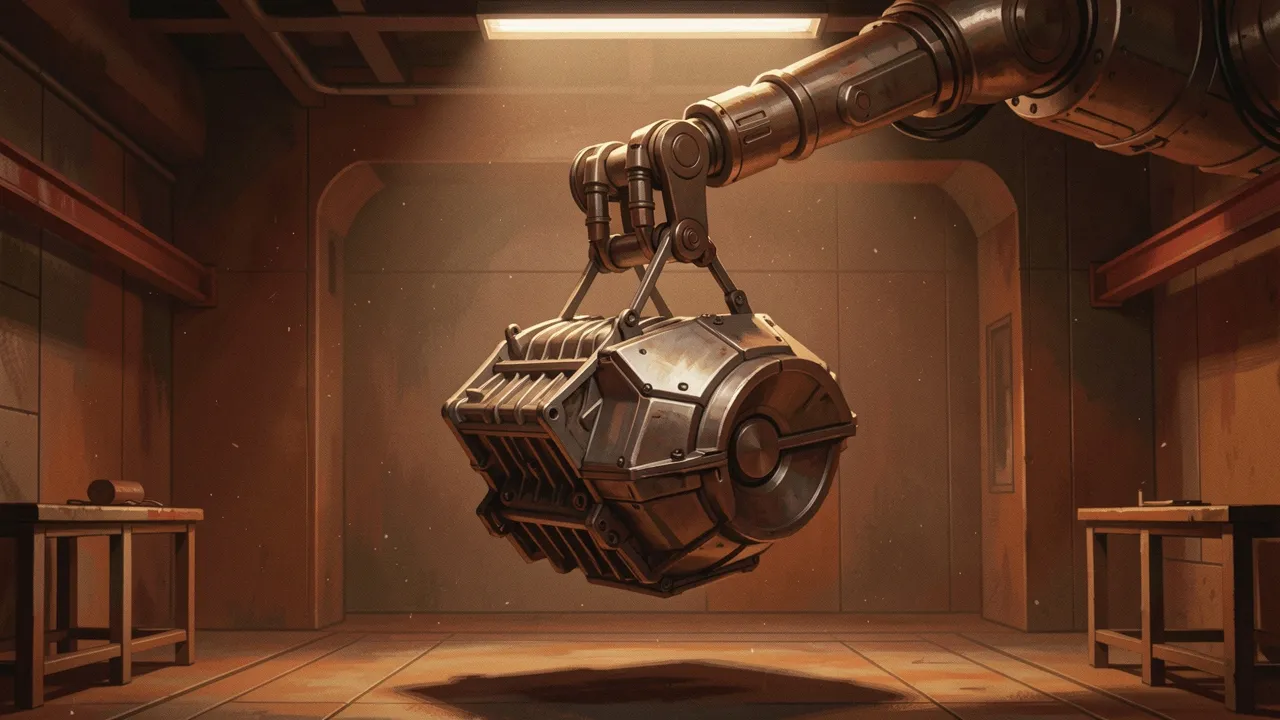
Boston Dynamics just pulled back the curtain on something genuinely surprising: Atlas isn't following a script anymore. The robot is learning through reinforcement learning, building its own strategies for handling heavy, awkward objects in real time.
The video shows Atlas lifting engine covers - the kind of industrial parts that are heavy, unbalanced, and genuinely difficult to manoeuvre. What's notable isn't the lifting itself. It's that Atlas is accounting for mass distribution and inertia on the fly, adjusting its grip and posture as the object's weight shifts. That's not pre-programmed choreography. That's whole-body control driven by learned behaviour.
Reinforcement Learning in Physical Space
Here's what's changed: Atlas trains in simulation, failing thousands of times, building an intuition for how objects behave when lifted, rotated, or passed between hands. The robot then transfers that learned behaviour to the real world. When it encounters a new object, it's not starting from zero - it's drawing on patterns it's already internalised.
The result is balance that looks superhuman because it is. Atlas can recover from off-centre loads that would topple a human. Its range of motion - rotating its torso independently of its legs, for example - gives it options we simply don't have. This isn't mimicry. It's a different kind of physical problem-solving.
Boston Dynamics' video is deliberately low-key, but the implications are anything but. This is reinforcement learning escaping the digital realm and proving itself in physical tasks with real consequences. The robot doesn't just need to get the answer right - it needs to not drop a 20-kilogram engine part.
From Lab to Loading Bay
What makes this notable is the shift in focus. Boston Dynamics spent years perfecting Atlas as a research platform - parkour, backflips, dance routines. Impressive, but not particularly useful. This video shows Atlas doing something a warehouse supervisor would actually pay for: picking up heavy, irregular objects and moving them safely.
The industrial application is obvious. Manufacturing facilities and logistics hubs handle thousands of objects that are too heavy, too awkward, or too dangerous for humans to lift repeatedly. Atlas is being positioned as the solution - not for every task, but for the subset where human strength and endurance are the bottleneck.
The timing matters. Boston Dynamics is now owned by Hyundai, a company with factories full of exactly these problems. This isn't speculative robotics anymore. It's product development with a clear customer in mind.
The Learning Model Changes Everything
The reinforcement learning approach is what makes this scalable. Teaching a robot to lift one specific object in one specific way is trivial - you hard-code the movements. Teaching it to generalise across thousands of different objects, each with different weights and grip points, is a different problem entirely. That requires learning.
Atlas is building an internal model of how physics works - how objects rotate, where the centre of mass shifts, how much force is needed to stabilise something mid-lift. Once that model exists, new tasks become variations on learned patterns rather than entirely new challenges.
This is where robotics and AI converge in a way that actually matters. The AI isn't generating text or images. It's controlling actuators in real time, making split-second adjustments based on sensor feedback. The margin for error is zero. The robot either maintains its grip or it doesn't. It either keeps its balance or it falls. There's no hallucination here - just physics.
For developers and business owners watching this space, the question is no longer whether robots can do complex physical tasks. The question is how long before the economics make sense. Atlas isn't cheap, and neither is the infrastructure to support it. But the capability is real, and the learning model means it's only getting better.
Boston Dynamics just moved robotics out of the demonstration phase and into the deployment conversation. Whether factories are ready to have that conversation is another matter entirely.