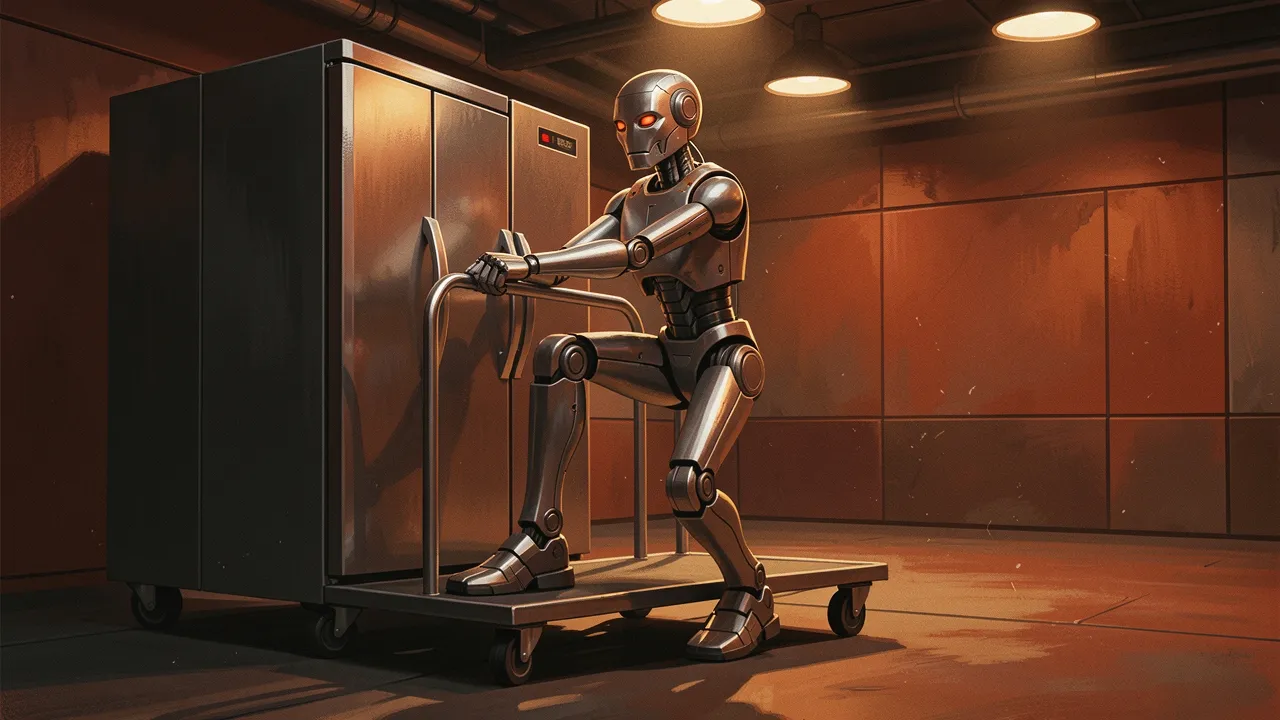
The new Atlas from Boston Dynamics just picked up a loaded fridge and walked it across a factory floor. Not a demo unit. A production fridge, full weight, shifting load as it moved.
This is the electric Atlas, the one they announced last year after retiring the hydraulic version. The one everyone assumed would take years to do real work. It's doing real work now.
What Changed
The previous Atlas was a research platform - incredible to watch, technically brilliant, but not designed for repetitive industrial tasks. This version is built for deployment. Hyundai, who acquired Boston Dynamics, plans to put 25,000 of these units across their factories.
That's not a pilot programme. That's production scale.
The technical leap is in how it handles dynamic loads. A fridge on a trolley isn't a static object - it shifts, the centre of gravity moves, the surface isn't uniform. Atlas adjusts in real-time, compensating for weight distribution as it walks. It's doing what human workers do instinctively - reacting to how the load feels, not just following a pre-programmed path.
And it can move in ways humans cannot. The joints have a wider range of motion than human anatomy allows. It can reach behind itself, rotate its torso 360 degrees, crouch lower than any human could sustain. That's not just party tricks - it means designing factory layouts around the robot's capabilities, not forcing the robot to fit human-scale infrastructure.
Why This Matters for Factories
Most factory automation is fixed in place. Robotic arms on production lines, conveyor systems, automated guided vehicles on tracks. You design the factory around the automation. Moving something means re-engineering the whole setup.
Humanoid robots change that equation. They walk. They use the same spaces humans use. They can be redeployed without rewiring the building. If a production line shifts, you move the robot. If demand changes, you add more units.
Hyundai's 25,000-unit order suggests they've done the maths and it works. Not just technically - economically. The cost per unit, the maintenance overhead, the flexibility gains. All of it pencils out at scale.
The Uncomfortable Bit
Right, let's talk about what this means for workers. Because 25,000 robots in factories means 25,000 roles that used to be done by people. Hyundai isn't deploying these to work alongside humans on equal terms - they're deploying them to replace human labour in repetitive, physically demanding tasks.
The argument from robotics companies is always the same: robots take dangerous jobs, free humans for higher-value work, solve labour shortages. And there's truth in that. Loading fridges onto trolleys and walking them across a factory floor is hard on the body. Repetitive strain, back injuries, fatigue. It's work that breaks people down over time.
But the transition isn't smooth. The person who spent 20 years doing that job doesn't automatically retrain as a robot maintenance technician. The factory that employed 500 people doesn't suddenly need 500 supervisors for 500 robots. The maths doesn't work that way. Some jobs disappear. Some workers are displaced. And the speed of deployment - 25,000 units - doesn't leave much time for gradual adaptation.
This is the bit where Luma would usually say something about tracking the pattern. And the pattern here is clear: when automation reaches production scale, it moves faster than retraining programmes. It moves faster than policy. It moves faster than communities can adjust.
What Comes Next
If Atlas can handle loaded fridges, it can handle most warehouse and factory logistics tasks. Unloading trucks, moving pallets, stocking shelves, assembly line work. The technical barriers are falling. The economic case is closing. The deployment timeline is compressing.
Other companies are watching. If Hyundai's rollout succeeds, every manufacturer with similar workflows will be looking at humanoid robots within two years. Not as a future possibility - as a competitive necessity.
We've been here before with automation. The difference this time is the speed and the form factor. A robot that looks humanoid, moves like a human, fits into human spaces - it's easier to imagine replacing human workers because it literally occupies the same physical role. That psychological shift matters. It changes how companies think about labour, how workers think about job security, how policymakers think about employment.
Atlas lifting a fridge isn't just a technical milestone. It's a signal that humanoid robotics has crossed from research into deployment. The demos are over. The real work has started.
Watch the full demonstration and decide for yourself whether you're more impressed or unsettled. Probably both.