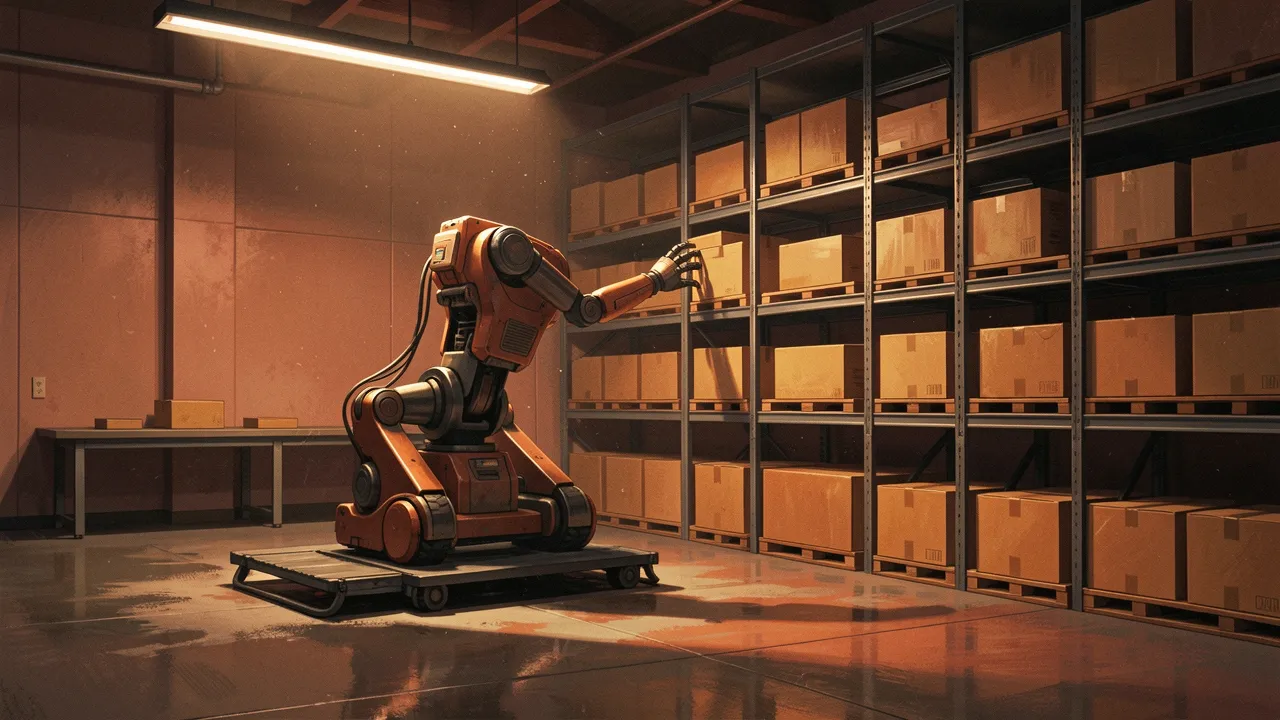
Schaeffler is deploying thousands of wheeled humanoid robots across its German manufacturing facilities starting December 2026. The hardware comes from Humanoid, the robotics company building HMND - a mobile manipulation platform designed for industrial work. Bosch is the manufacturing partner scaling production.
This isn't a pilot programme or a proof of concept for the press release. Schaeffler tested the robots handling boxes of multiple sizes in real production environments. The robots worked. Now they're ordering at scale.
What Makes HMND Different
HMND robots use wheels instead of legs. That single design decision changes the economics entirely. Wheeled bases are cheaper to manufacture, more stable under load, and require less compute to control. For warehouse and factory work - moving boxes, transporting materials, handling repetitive tasks - wheels solve 90% of the mobility problem at a fraction of the cost.
The humanoid torso matters for manipulation. Human-designed facilities assume human reach, human grip strength, human sight lines. A wheeled base with humanoid arms can work in existing spaces without facility redesign. That's the economics talking again - you don't retrofit the building, you retrofit the workforce.
Humanoid demonstrated this handling boxes of varying dimensions. Not one standard box in controlled conditions. Multiple sizes, real materials, actual production flow. The kind of variability that breaks brittle automation.
Bosch as Manufacturing Partner
Bosch manufacturing these units signals something beyond a simple supply agreement. Bosch builds at volume - automotive components, power tools, industrial hardware. They understand precision manufacturing at scale and the tolerances required for reliable mechanical systems.
For Humanoid, this partnership solves the hardest problem in robotics: getting from prototype to production volume without quality collapse. Most robotics companies can build ten units that work beautifully. Building ten thousand that work identically is a different discipline entirely.
Bosch brings mature supply chains, quality control systems, and the manufacturing expertise to hit cost targets at volume. Humanoid brings the design and the software. Schaeffler brings the deployment commitment - thousands of units, across multiple facilities, with a concrete timeline.
December 2026 Deployment Timeline
Twenty-six months from now. That's not aggressive for hardware, but it's not conservative either. It suggests Humanoid has working units now, Bosch has validated the manufacturing process, and Schaeffler has seen enough to commit capital.
For context: most humanoid robotics companies are still demonstrating impressive videos. Humanoid has a Fortune 500 manufacturing partner and a deployment contract with specific dates and unit counts. The gap between those two positions is the difference between research and product.
Schaeffler operates precision manufacturing facilities. They make bearings, clutches, transmission components - parts with micron-level tolerances. Their production requirements are demanding. If HMND robots can handle their workflows, the technology generalises to less demanding environments.
What This Means for Industrial Automation
Germany has a labour shortage and an ageing workforce. Schaeffler isn't deploying robots to cut costs - they're deploying robots because they can't hire enough people to run the facilities. That's a different economic driver, and it changes the adoption curve.
When automation competes with human labour on cost alone, adoption is slow. Companies delay, unions resist, implementations drag. When automation fills roles that simply can't be filled with people, adoption accelerates. The robots aren't taking jobs - they're doing jobs nobody is available to do.
This matters beyond Schaeffler. Every industrial company in Europe faces similar workforce constraints. If Humanoid's deployment succeeds, the playbook becomes obvious: wheeled humanoids for mobile manipulation, Bosch-quality manufacturing, deployment at scale within 24 months.
The interesting bit isn't the robots themselves - it's that the infrastructure is now in place to manufacture them reliably at volume. That shifts the conversation from "can we build this?" to "how fast can we deploy?"
For business owners watching these developments: the timeline is clear, the partners are credible, and the use case is proven. This isn't speculative technology anymore. It's industrial hardware with a delivery date.