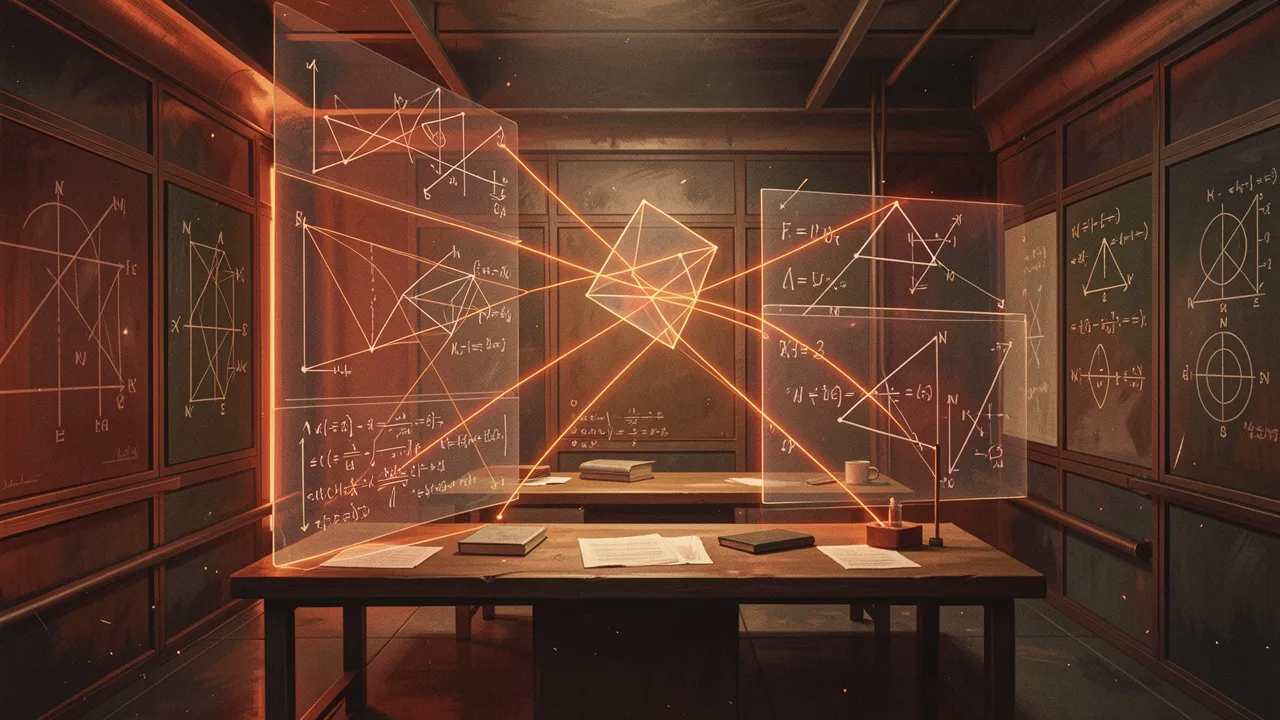
OpenAI's reasoning model just solved an 80-year-old geometry problem. Not by brute force, not by training on millions of examples, but by finding an unexpected bridge between discrete geometry and algebraic number theory. Two fields that mathematicians had studied separately for decades, connected by an insight the model surfaced in minutes.
Azeem Azhar's reflection on this in Exponential View #575 points to something deeper than raw problem-solving capability. The value of AI might not be in replacing human reasoning, but in connecting isolated domains of knowledge that we've kept in separate boxes.
Why This Matters Beyond Mathematics
The geometry breakthrough is impressive on its own. But the pattern is what's interesting. The model didn't invent new mathematics from scratch. It recognised that tools from one field - algebraic number theory - could unlock problems in another - discrete geometry. That's not brute computation. That's pattern recognition across domains.
We compartmentalise knowledge. Physics researchers rarely read biology papers. Economists don't typically study cognitive neuroscience. Urban planners don't cross-reference epidemiology. Not because they're unconnected, but because the sheer volume of human knowledge makes cross-domain exploration impractical. AI doesn't have that constraint. It can hold multiple fields in context simultaneously and notice when a technique from one might apply to another.
That's a different kind of intelligence. Not creative in the sense of generating entirely novel ideas from nothing, but connective - finding links that exist but remain hidden because no single human has the bandwidth to see them.
The Limits of Creative Reasoning
Azhar also points to the constraints. AI's math breakthrough is significant, but it's still operating within established frameworks. It found a bridge between existing theories. It didn't invent a new branch of mathematics. It didn't ask a question nobody had thought to ask. It solved a problem humans had already defined.
This distinction matters. AI is extraordinarily good at exploration within known spaces. Give it a problem, a set of tools, and enough compute, and it will find solutions that humans might take decades to discover. But it doesn't yet generate the why behind the question. It doesn't wonder about the problem nobody's noticed yet. That's still ours.
What Researchers Should Be Thinking About
If AI's strength is connecting isolated domains, the practical implication is clear: researchers should be using these models to test cross-domain hypotheses. Not as replacements for human insight, but as tools for exploring connections at scale.
A biologist studying protein folding could ask: are there analogues in materials science that apply here? An economist modelling market behaviour could check: do network effects in epidemiology suggest new variables? A climate scientist tracking ice melt could query: are there parallels in fluid dynamics that haven't been applied yet?
The model won't always be right. But it can surface possibilities faster than any human literature review. And occasionally, like in the geometry problem, it will find something real.
The Question That Remains
Azhar's piece ends on the question that matters most: can AI move beyond connecting known domains to imagining entirely new ones? Can it generate the conceptual leap - the fundamental shift that redefines a field?
Not yet. But the geometry breakthrough suggests we're closer than we thought. And if AI can bridge 80 years of isolated research in mathematics, the next decade of scientific discovery is going to look very different from the last.