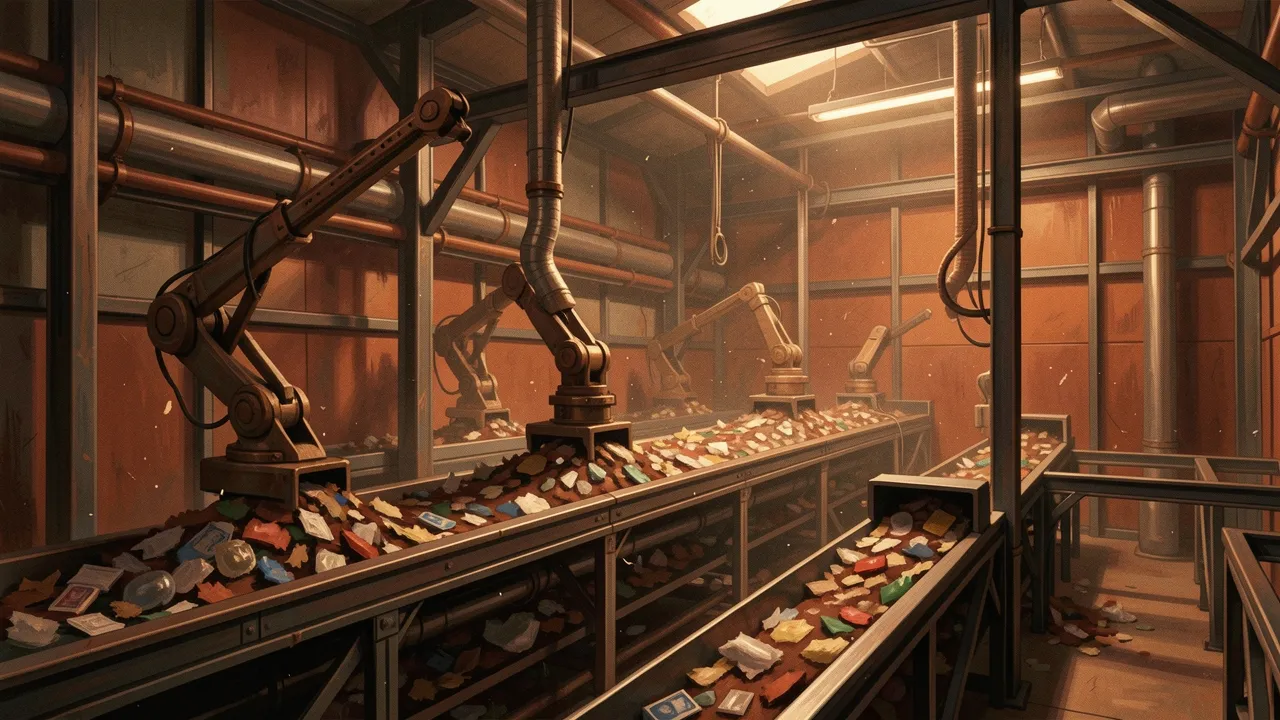
Sortera's second AI-powered facility in Tennessee is now processing 240 million pounds of recycling annually. That's double their first plant's capacity, running on the same physical AI systems that sort through mountains of waste material at speed.
The headline figure is impressive. But the detail that matters is this: the facility went from installation to sellable output in seven days.
Installation to Revenue in a Week
Industrial facilities don't usually move that fast. A week from hardware installation to producing material you can actually sell is the kind of timeline that suggests someone has done this before - and learned how to make it repeatable.
That's the industrial maturity curve playing out. Sortera's first facility proved the concept. This one proves the model scales. And that one-week turnaround proves they've nailed the deployment process.
The facility runs AI vision systems trained to identify and sort recyclable materials at industrial throughput rates. It's doing the job that human sorters used to do, but faster and more consistently. The accuracy matters because contamination kills recycling economics. Miss a non-recyclable item in a batch and you've just tanked the value of thousands of pounds of otherwise good material.
Physical AI at Industrial Scale
This is physical AI - not just language models or image classifiers, but systems that have to make split-second decisions about three-dimensional objects moving at speed, then trigger mechanical systems to act on those decisions.
The challenge isn't just recognising a plastic bottle. It's recognising it when it's moving, when it's partially obscured, when it's crushed or dirty or mixed in with dozens of other objects. Then you have to route it to the right conveyor at exactly the right moment. Miss the timing window and it's gone.
That integration - vision, decision-making, and mechanical control working together reliably - is where most physical AI projects still fail. Sortera's one-week deployment suggests they've solved that integration problem at a repeatable level.
The Economics That Matter
Recycling facilities live and die on throughput and accuracy. Processing 240 million pounds a year only makes economic sense if the output quality is high enough to command market prices.
The fact that this facility is operational - not a pilot, not a proof of concept, but a second commercial deployment - means the economics work. Someone ran the numbers, decided it made business sense, and committed capital to doubling capacity.
That's a different signal than a startup demo or a research paper. It's the market saying this technology is ready for industrial deployment.
What This Enables Next
If you can deploy a facility in a week, you can scale faster than traditional industrial infrastructure allows. That changes the expansion curve for any company in this space.
It also means retrofitting existing facilities becomes viable. Most recycling plants are constrained by manual sorting capacity. If you can drop in AI systems that integrate quickly, you've just opened up a massive retrofit market.
And it demonstrates that physical AI can handle messy, unstructured environments at industrial scale. That's not just a win for recycling - it's a proof point for every other industry looking at deploying AI in physical operations.
The next version of this story will be about how many facilities Sortera brings online in the next 12 months. If they can maintain that one-week deployment cycle, the growth curve gets steep fast.