Most quantum error correction codes face a brutal trade-off. Pack more qubits into the same physical space and your error correction gets worse. Spread them out for better protection and you need exponentially more hardware. A new paper from arXiv just published a code that breaks that pattern.
The researchers built a three-dimensional CSS stabiliser code on a face-centred cubic lattice. The technical name is dense, but the result is concrete: 67% encoding rate. That means 67% of your physical qubits store actual data, not just error correction overhead. For comparison, the standard 3D toric code - the benchmark most people use - manages 2.8%.
That's not an incremental improvement. That's 24 times more data in the same physical volume.
Why Lattice Geometry Matters
Quantum computers need error correction because qubits are fragile. A stray photon, a temperature fluctuation, any interaction with the environment corrupts the quantum state. The solution is redundancy - encode one logical qubit across many physical qubits, then use that redundancy to detect and fix errors.
But here's the constraint: qubits can only talk to their neighbours. You can't wire every qubit to every other qubit. The geometry of how you arrange qubits in space determines what kind of error correction you can do.
Most quantum error correction uses a cubic lattice - think of a 3D grid where each qubit sits at an intersection. It's simple, well-understood, and scales predictably. But it's also inefficient. You need a lot of physical qubits to encode a small amount of logical information.
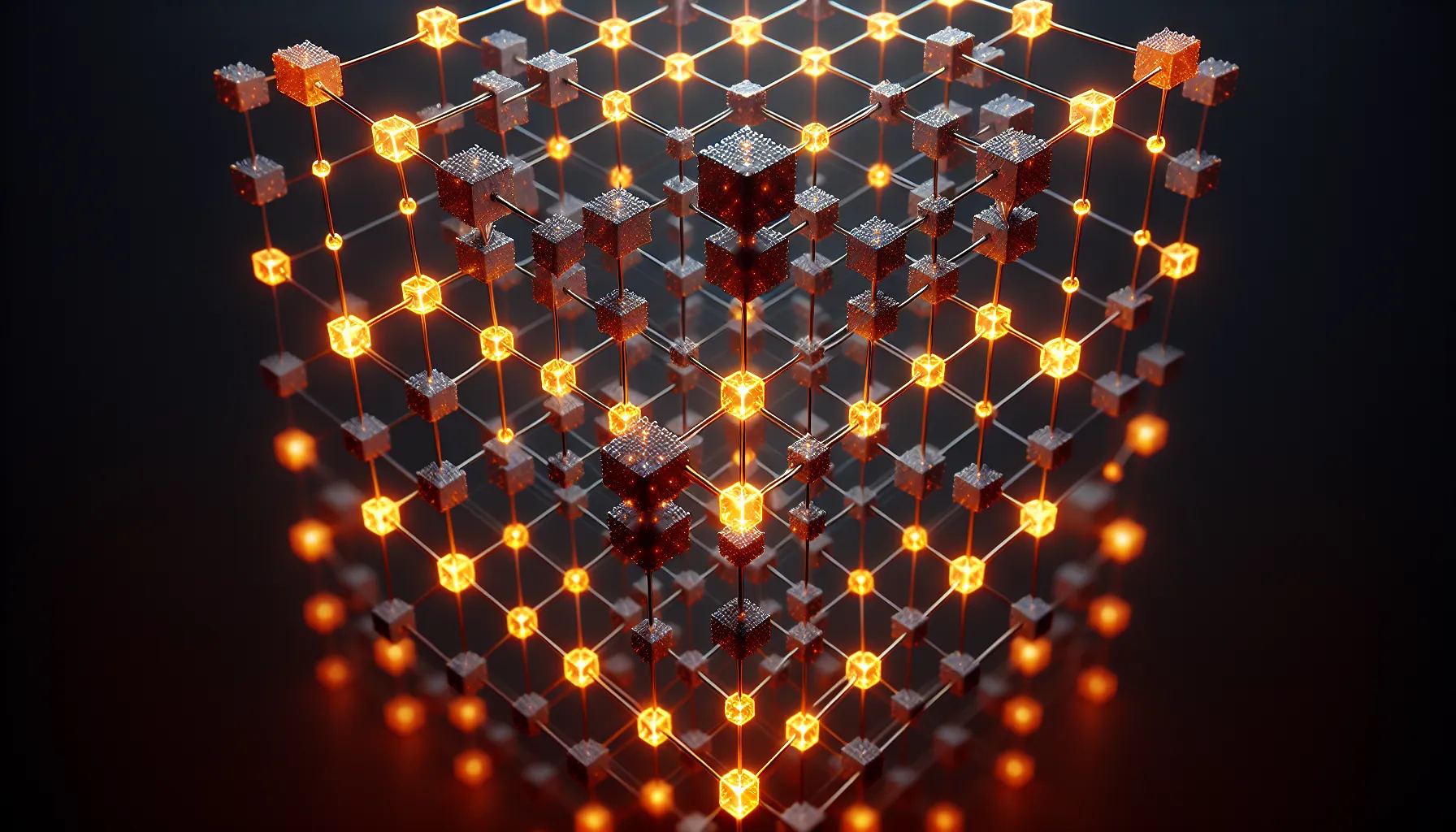
This new code uses a face-centred cubic (FCC) lattice instead. Same three dimensions, but qubits sit at different positions - at cube corners and at the centre of each cube face. That geometry allows more connections per qubit without increasing the physical distance between them.
The result is a code with distance 3 - meaning it can correct any single error - while encoding far more logical qubits than a cubic lattice code of the same size.
The Performance Numbers
At a physical error rate of 0.1% (p=0.001), the new code shows a 10x coding gain compared to the cubic toric code. That's using minimum-weight perfect matching (MWPM) as the decoder - a standard algorithm for figuring out which errors happened and how to fix them.
Coding gain measures how much better one code is than another at the same error rate. A 10x gain means you can tolerate 10 times more physical errors before your logical qubit fails. Or, flipped around, you can use noisier hardware and still get reliable computation.
The paper specifies 192 physical qubits encoding 130 logical qubits with code distance 3. That's the [[192,130,3]] notation in the title - physical qubits, logical qubits, distance. The encoding rate (130/192 = 67%) is what makes this remarkable.
Where This Actually Matters
Two quantum computing platforms benefit immediately: neutral atoms and photonics. Both can arrange qubits in arbitrary 3D geometries relatively easily. Neutral atom systems trap atoms in optical lattices - they can position atoms wherever the laser interference pattern creates a trap. Photonic systems encode qubits in light and route them through 3D waveguide structures.
Superconducting qubits (the kind IBM and Google use) are harder. Those live on flat chips. You can do multi-layer chips, but the engineering is significantly more complex. This code might push that engineering forward - if the performance advantage is large enough, it justifies the fabrication complexity.
The immediate application isn't building a full quantum computer with this code. It's hybrid systems. Use high-rate codes like this for dense data storage, and switch to lower-rate codes (better error correction, worse encoding efficiency) for computation. You optimize different parts of the system for different tasks.
The Bigger Picture
Error correction is the bottleneck for scaling quantum computers. We can build machines with hundreds of qubits now. But if only 3% of those qubits store useful data, you need tens of thousands of physical qubits to do anything practical. That's expensive, hard to cool, hard to control.
Codes like this change the economics. If you can get 67% encoding efficiency, the same hardware does 20x more useful work. That doesn't mean quantum computers suddenly become practical for everything - they're still only good for specific problems. But it shrinks the gap between "research curiosity" and "tool someone might deploy".
The research also highlights something about quantum computing more broadly. Progress isn't just better qubits. It's better codes, better decoders, better ways to arrange qubits in space. The hardware gets attention because it's visible. But the algorithmic and geometric work - figuring out how to pack more logical qubits into the same physical volume - might matter just as much.
This is specialist work. Most people building applications won't touch error correction codes directly. But the efficiency of those codes determines what's possible. A 24x improvement in encoding rate is the kind of shift that changes what you can build.