Today's Overview
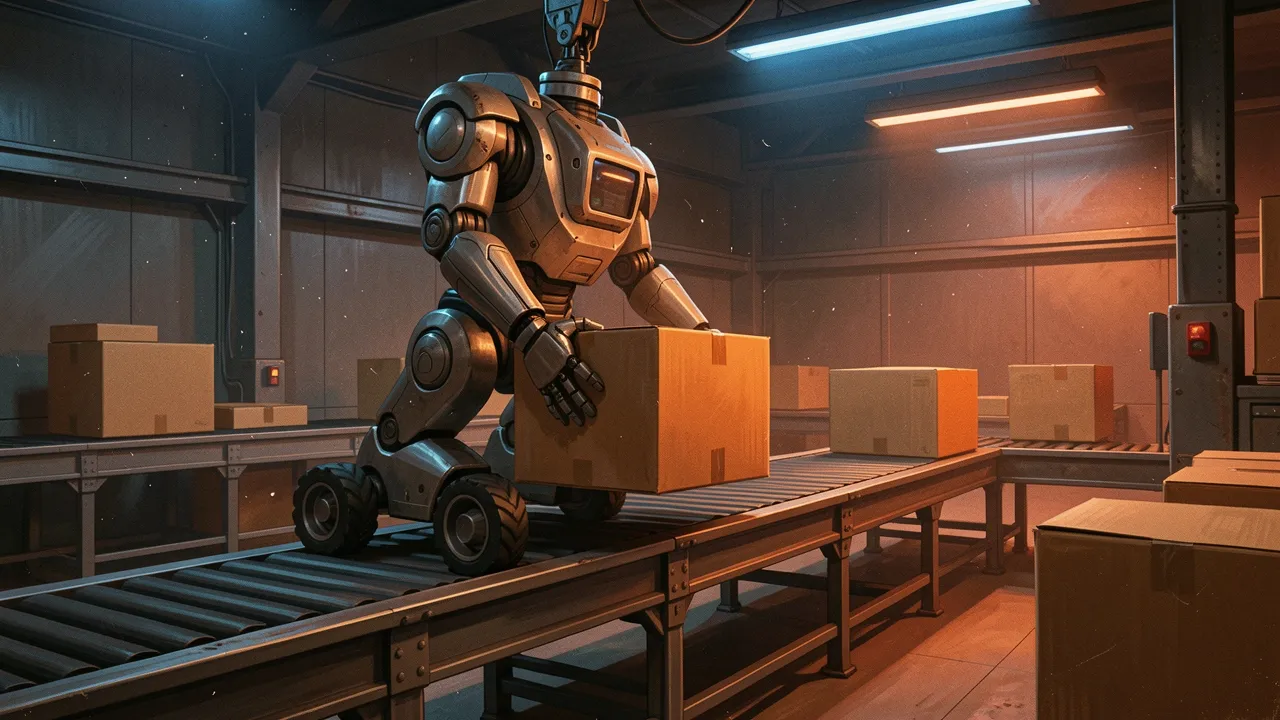
The robotics industry just crossed a visibility threshold. Humanoid signed production agreements with Bosch and Schaeffler that will see humanoid robots deployed across European manufacturing by end of 2026. Not prototypes or POCs-actual robot-as-a-service deployments handling box transfer in industrial settings. This is the first time we're seeing humanoid form factors move from research labs into actual supply chains at scale.
When robots meet real factories
Humanoid's HMND platform proved itself in a Bosch facility in Bühl, Germany, handling five box sizes across varying heights and weights. The proof of concept demonstrated something more important than perfect autonomy: it showed that wheeled bimanual manipulators can operate in spaces already designed for humans. No infrastructure redesign. No custom end-effectors. Just a robot that fits into existing workflows. Schaeffler is rolling out thousands of units across its German facilities starting December 2026, with a target of four-digit deployments by 2032. That's not experimental compute. That's manufacturing planning.
Meanwhile, OpenAI's reasoning model just disproved an 80-year-old conjecture in discrete geometry-the Erdős unit distance problem. A general-purpose model, not a system built specifically for mathematics, held together a chain of reasoning that discovered new geometric constructions. Mathematicians like Timothy Gowers called it the first clear example of AI solving a well-known open problem. This matters because it wasn't an algorithmic breakthrough or a clever prompt. It was extended reasoning at inference time. If that pattern generalises beyond pure mathematics into biology, physics, and engineering, the implications for how researchers work shift completely.
Infrastructure for the agent era
Jake Cooper's Railway platform has been quietly building the infrastructure that agents actually need: bare-metal data centers with 70% margins, forking and cloning for safe production testing, and a three-month payback period versus hyperscaler cloud costs. Railway is now running at 100% utilisation on its own metal, adding 100,000 users a week, with a 35-person team supporting 3 million users. The company is literally building a new cloud from first principles-not because it's fashionable, but because the activation energy to deploy something should be instantaneous, and hyperscalers aren't optimised for that. Their inference spend on coding agents is hitting $200K+ monthly. That's not a side project. That's the primary workflow.
What connects these three threads-robots entering factories, AI solving mathematics, infrastructure scaling for agents-is that the experimental phase is closing. Robots are moving from demos to deployments. Reasoning is solving actual open problems. Cloud infrastructure is being rebuilt from scratch because the old assumptions no longer hold. The companies executing on this aren't announcing breakthroughs. They're announcing manufacturing partners, shipping dates, and utilisation numbers.