Today's Overview
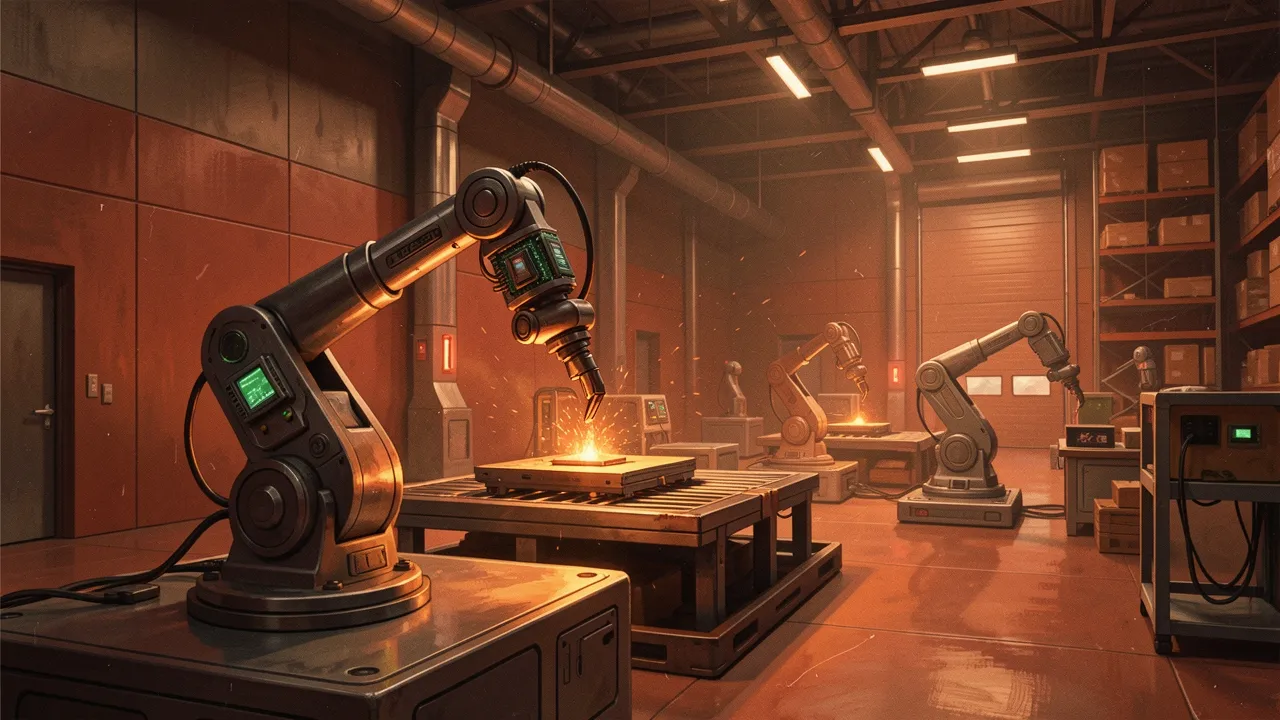
The robotics industry is having a quiet reckoning about what actually works at scale. Yaniv Sulkes at Hailo argues the future isn't general-purpose humanoids that cost millions and do everything poorly. It's task-specific machines-lawn mowers with real-time obstacle avoidance, kitchen assistants that chop and clean surfaces reliably, warehouse robots optimised for one job. These systems run AI locally on edge processors, not in the cloud. That matters because real-world decisions can't wait for network latency. A robot picking up an object needs to sense, reason, and act in milliseconds. The constraint isn't intelligence anymore. It's hardware cost and whether you can deploy it at scale. A £3,000 humanoid robot in a warehouse doesn't scale. A £500 task-specific system running millions of times does.
The gap between intelligence and execution
The practical implication: edge processors become as important as the models themselves. Running a 26B Gemma model on-device with 10 sub-agents generating SVGs in parallel-that's the work happening now at Google DeepMind. Not to replace cloud. To own the moment when a decision matters. This is why GE Vernova just acquired Robotech Automation, a Canadian systems integrator with 35 people and deep experience deploying robots in factories. GE Vernova has been using ANYbotics for asset inspections and Robotech for supply chain projects. The acquisition signals something: the companies that win at physical AI won't be the ones building the most advanced models. They'll be the ones who can integrate, deploy, and maintain systems in real factories with real constraints.
On the software side, the leaks and the infrastructure gaps
Anthropic's next-generation models are starting to surface in the wild-Claude Mythos 1, spotted Claude Sonnet 4.8 and Opus 4.8 references. The leaked model slugs suggest Anthropic is working on versions designed specifically for Claude Code and Claude Security use cases. Whether that's meaningful differentiation or iterative improvement remains unclear. More interesting structurally: a growing realisation that AI agents need orchestration infrastructure that doesn't exist yet. Lou Bichard at Ona argues the missing piece isn't better models or faster inference. It's a coordination layer for agent swarms. Stripe and RAMP built this internally (they call theirs Minions and Inspect respectively). But the pattern repeats: every company starts from scratch. Bichard's argument is that coordination-where agents pick tasks from queues, pass messages, verify they've completed stages before proceeding-probably needs to be a CLI gateway that any local coding agent can invoke. Think of it as commit-workflow infrastructure for agents instead of humans.
The practical tension: chat interfaces dominate how people interact with agents today. But RL Nabors at Dressed for Space has built something different-a comic reader that renders inside Claude with full panels and navigation, matched to the original website design. No browser tabs. She's using MCP (Model Context Protocol) to turn any tool response into a real interactive surface. The pattern suggests the next wave of agent software won't be terminal-like chat. It'll be interfaces that feel like the web-interactive, navigable, designed. That's a build problem, not a model problem.
For teams building robotics systems or agent infrastructure, the pattern is clear: specialisation wins. Whether it's task-specific robots or purpose-built coordination layers, generality is expensive. The companies moving fastest are choosing narrow scope, optimising within it, and scaling reliably. That matters more than the next headline model.