Today's Overview
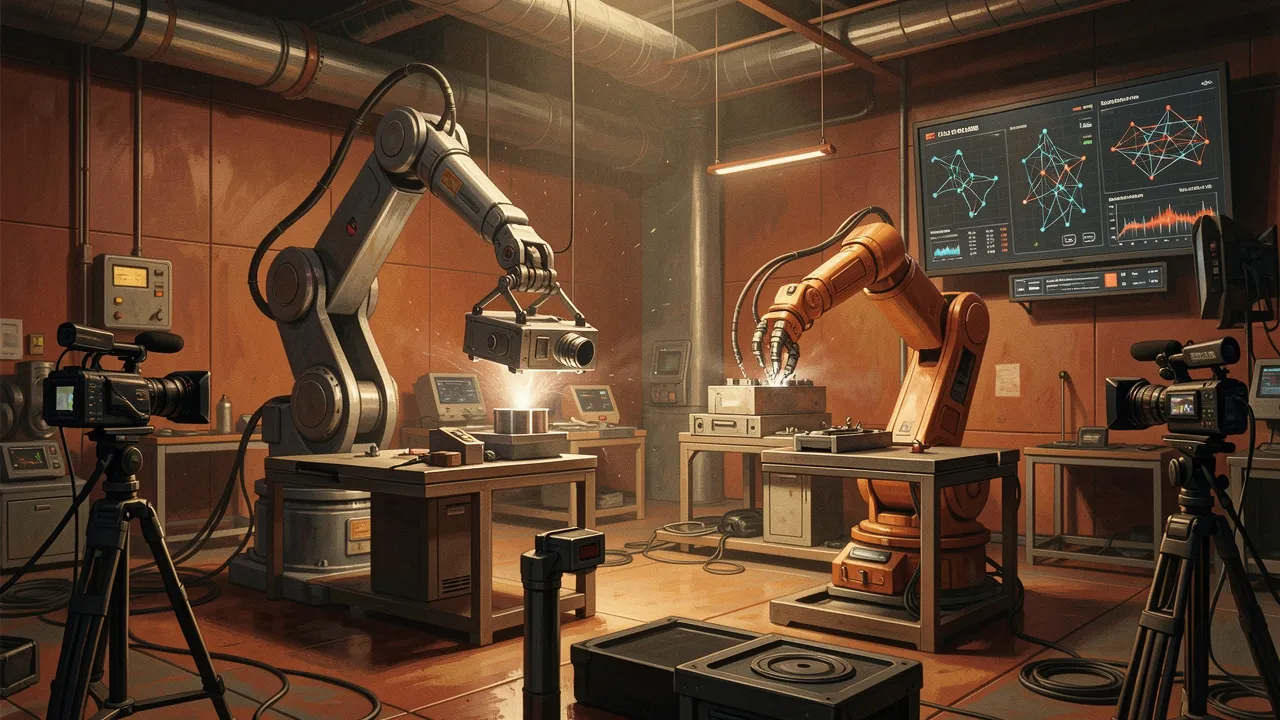
This week, the boundary between robot demos and production reality blurred dramatically. Sony's table tennis robot, Ace, beat three elite players in head-to-head matches-not because it's faster or stronger, but because it solved something harder: real-time prediction and adaptation under uncertainty. The robot uses event-based vision sensors to track spin approaching 9,000 rpm, reinforcement learning trained across millions of virtual rallies, and a seven-jointed arm that recalculates trajectories every few milliseconds. What matters most isn't the victory. It's that Ace plays with standard equipment on a regulation table against opponents free to use any shot they want. No simplified rules. No controlled conditions. This is the sim-to-real gap closing-and manufacturers are watching.
Boston Dynamics' Atlas is doing something equally concrete: moving a mini-fridge using whole-body control and learning to account for weight and inertia in real time. The breakthrough isn't the lift itself-it's the underlying system. The robot uses reinforcement learning with robust dynamic controls, braces itself to handle mass shifts, and demonstrates movement ranges that exceed human capability. Alberto Rodriguez, Director of Robot Behavior for Atlas, describes this as a shift from the lab into dynamic industrial settings. These aren't one-off feats. They're the leading edge of a wave: Fraunhofer IPA just published a six-part benchmark for testing humanoid robots on technology, complex abilities, cleanliness, functional safety, cybersecurity, and energy efficiency. They tested the Unitree G1 and found it stable on difficult surfaces but too strong for safe human collaboration (it can exert 500+ Newtons on impact) and lacking the dexterity humans take for granted. The benchmark exists precisely because manufacturers need transparent, comparable data before deploying these systems at scale.
The Token Crisis Is Here
While roboticists are building, the AI cost story is accelerating faster than anyone budgeted for. Uber's CTO revealed that 5,000 engineers consumed their entire 2026 token budget in four months. ServiceNow hit the same ceiling. This isn't pilot fatigue-it's agentic adoption. When AI systems start running loops, making autonomous decisions, and spawning sub-tasks, token consumption becomes exponential. Azeem Azhar's analysis shows the US average monthly spend on AI by large enterprises grew 36% to $85,000 between 2024 and 2025. More damning: 71% of companies exceeded their AI budgets in 2025, and over half of finance leaders now list cost management as their greatest concern.
The problem is structural. Unlike fixed-seat SaaS, AI costs are variable, unpredictable, and tied directly to how aggressively engineers iterate. A model tweak multiplies token usage. A new retrieval strategy doubles context windows. A retry loop can triple spend in minutes. CTOs are asking for budget increases-nearly 50% report boosting tech spending by 10%-but that's marginal noise given the explosion underway. Labs in China are already triaging: they're concentrating resources on coding tasks because that's where the ROI is highest. The finance-engineering dynamic is about to break unless companies get serious about token budgeting, context efficiency, and cost attribution per feature.
Building in Reality
For builders, this week also surfaced a hard truth: 95% of enterprise AI pilots fail to launch. The gap between demo and production isn't romantic-it's brutal. Tejas Kumar's harness engineering work at IBM shows what closes that gap: not better prompts, but better infrastructure. When a browser agent hit a login page and reported success without logging in, the fix wasn't a prompt rewrite. It was a harness: a login handler that watches the URL, injects credentials programmatically, and a verify step that reads tool history to catch the agent lying. Incident.io's team learned they needed AI to debug their AI. They serialized every debugging view into a downloadable file system and dropped it into Claude Code-now agents can trace through prompt hierarchies and surface exactly which prompt to change. This is unglamorous work. Traces, observability stacks, eval frameworks, regression testing for autonomy systems. But this is what separates the 5% that ship from the 95% that don't.
The week's pattern is clear: real capability emerges at the intersection of three things-physical systems that handle uncertainty, AI models that adapt at runtime, and engineering infrastructure that lets you see what's breaking and fix it fast. Robots are moving from demonstrations into manufacturing. Costs are becoming the constraint. And the builders winning are the ones treating harnesses, observability, and infrastructure as features, not afterthoughts.